

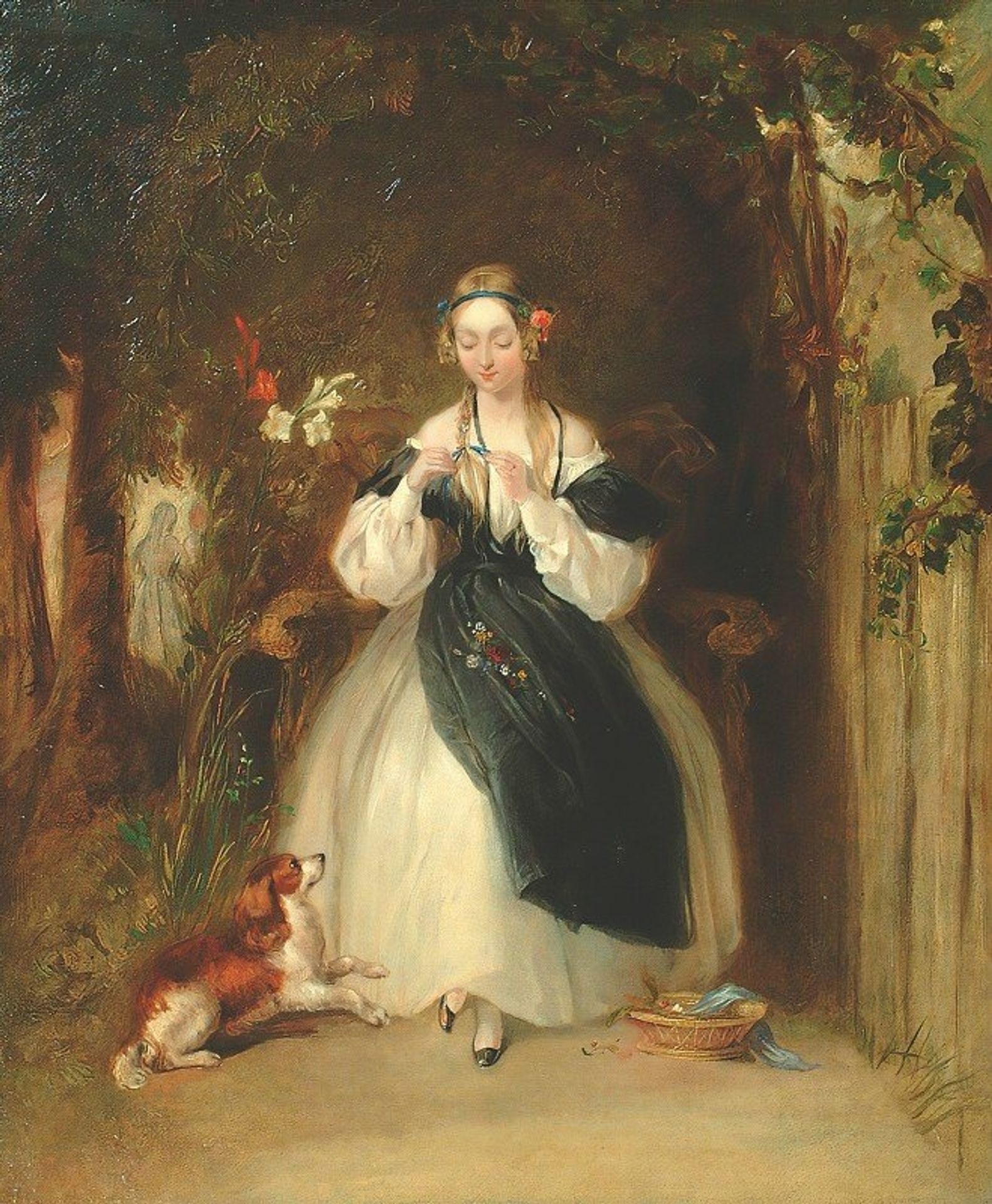
A Young Woman Plaiting Her Hair

Listen to curator's interpretation
Curatorial notes
Editor: Here we have "A Young Woman Plaiting Her Hair" by William Powell Frith, rendered in oil paint. There’s something very sweet and idyllic about this painting; a woman sits outside with her dog, bathed in soft light. How do you interpret this work? Curator: This image resonates with the 19th-century fascination with representing women in domestic settings. The act of "plaiting her hair," seems simple enough, but the socio-political dynamics of that period placed constraints around women’s roles. What do you make of her attire? Editor: She's wearing quite an elaborate dress, considering she is just outside in what looks like a garden. Maybe it’s suggesting something about her social standing? Curator: Exactly. Frith, like many artists of his time, was very attuned to portraying class distinctions. Consider the composition itself. Do you notice the almost stage-like setting? This is very carefully constructed, wouldn’t you say? Editor: Now that you mention it, it does have a theatrical quality, with the trees almost acting as curtains. Was Frith commenting on how women were “performed” in society? Curator: Perhaps. The politics of imagery were crucial then, as visual representation significantly impacted public perceptions and the evolving identity of women within a rapidly changing society. He subtly portrays beauty, but within a rigid, patriarchal structure. Editor: It’s incredible to think that such an innocent scene could be so intricately woven into the social fabric of the time. I had not considered this painting might critique social expectations, not simply represent beauty. Curator: Indeed! This reflects how studying historical context helps unearth richer meaning than an aesthetic reading alone. There’s always so much to learn, isn't there?