1814
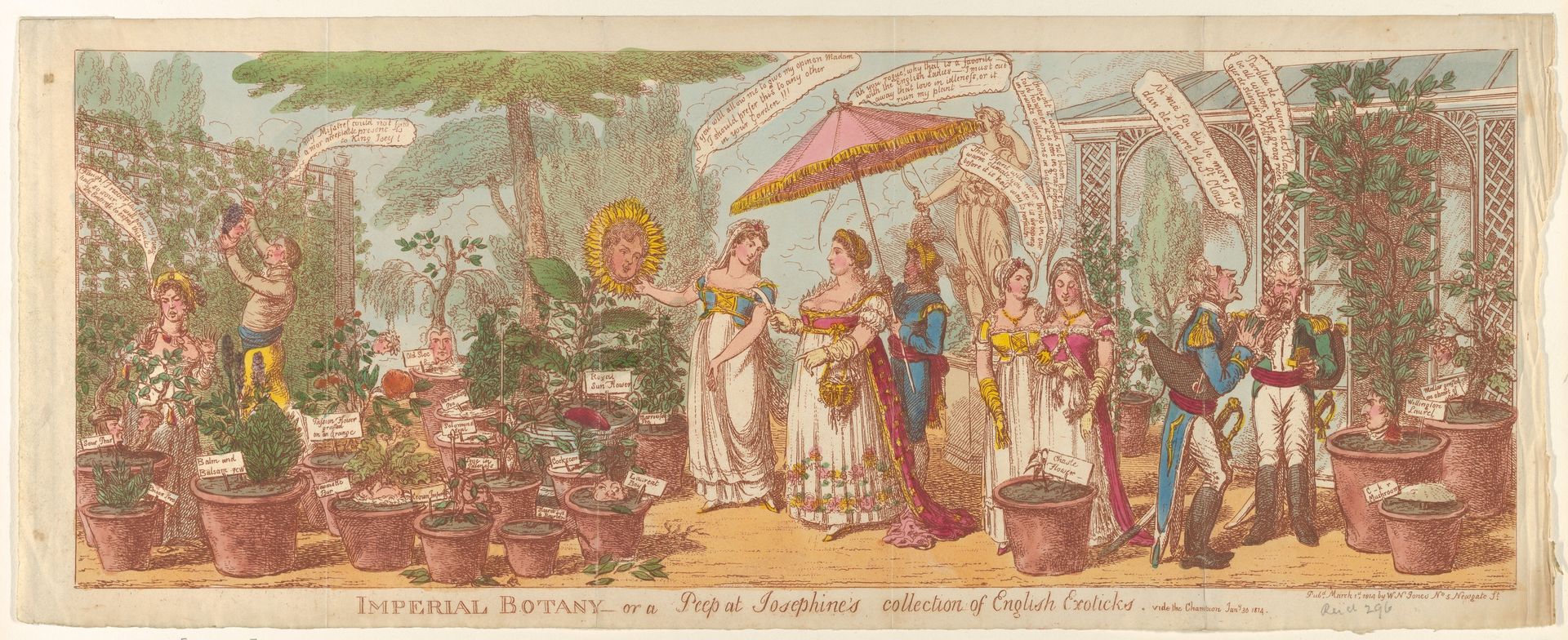
Imperial Botany–or a Peep at Josephine's Collection of Engilsh Exoticks, vide the Champion Jany 30, 1814

Charles Williams
@charleswilliams
The Metropolitan Museum of Art
Metropolitan Museum of Art, New York, NYListen to curator's interpretation
Curatorial notes
Curator: Good morning. We are standing before a print titled "Imperial Botany–or a Peep at Josephine's Collection of English Exoticks," created in 1814 by Charles Williams. Editor: What strikes me immediately is the controlled chaos of the composition. There is such a vibrant, almost overcrowded feeling with the arrangement of figures, speech bubbles, and plants in pots that it creates a certain heightened tension, almost claustrophobia within what should be an open botanical setting. Curator: It’s indeed dense, yet highly structured. This work participates in the British tradition of political caricature, deploying visual metaphors to satirize Napoleon and Josephine's ambition to accumulate European territory. Each potted plant represents a conquered nation or ruler. Notice how caricatured figures and inscribed banners intertwine with botanical elements to reinforce the artist's point of view. Editor: So it is allegorical as well. And I wonder, in terms of visual encoding, how the composition emphasizes the instability of power, especially in the scattered arrangement and almost overwhelming feeling—almost a visual anxiety of accumulating. Look at Josephine herself; is she the viewer of this collection or complicit in this display? What does her apparent passivity or quiet observation say about feminine influence in the construction of empires? Curator: She represents consumption, as the personification of a society which craves the rare, the beautiful, the powerful, and the politically strategic. Technically, observe the controlled use of watercolor and precise linework, where formal qualities are subordinate to narrative and satire. It’s less about the aesthetic value of line or form and more about its efficacy in delivering a socio-political message. The landscape style belies the caricatural intention, creating irony. Editor: Indeed. Also, it seems relevant to consider how its presence in a collection like the Met implicates our viewing experience—what histories of colonial power are reproduced in this present gaze? This display within our contemporary institution becomes another layer to the complexity of the work. Curator: I agree completely. Analyzing the visual and structural qualities, in tandem with this historical context, yields a richer understanding of the art. Editor: Absolutely. And the visual tension alerts us to the broader unease circulating around this political landscape during its making, an unease that the botanical imperial collection does so much to dramatize for the contemporary viewer.