About this artwork
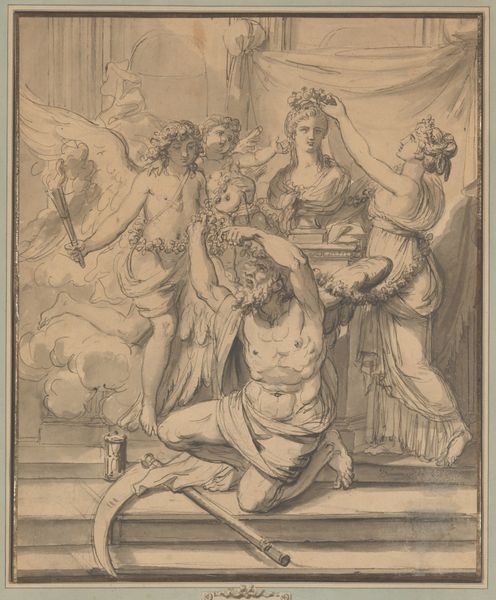
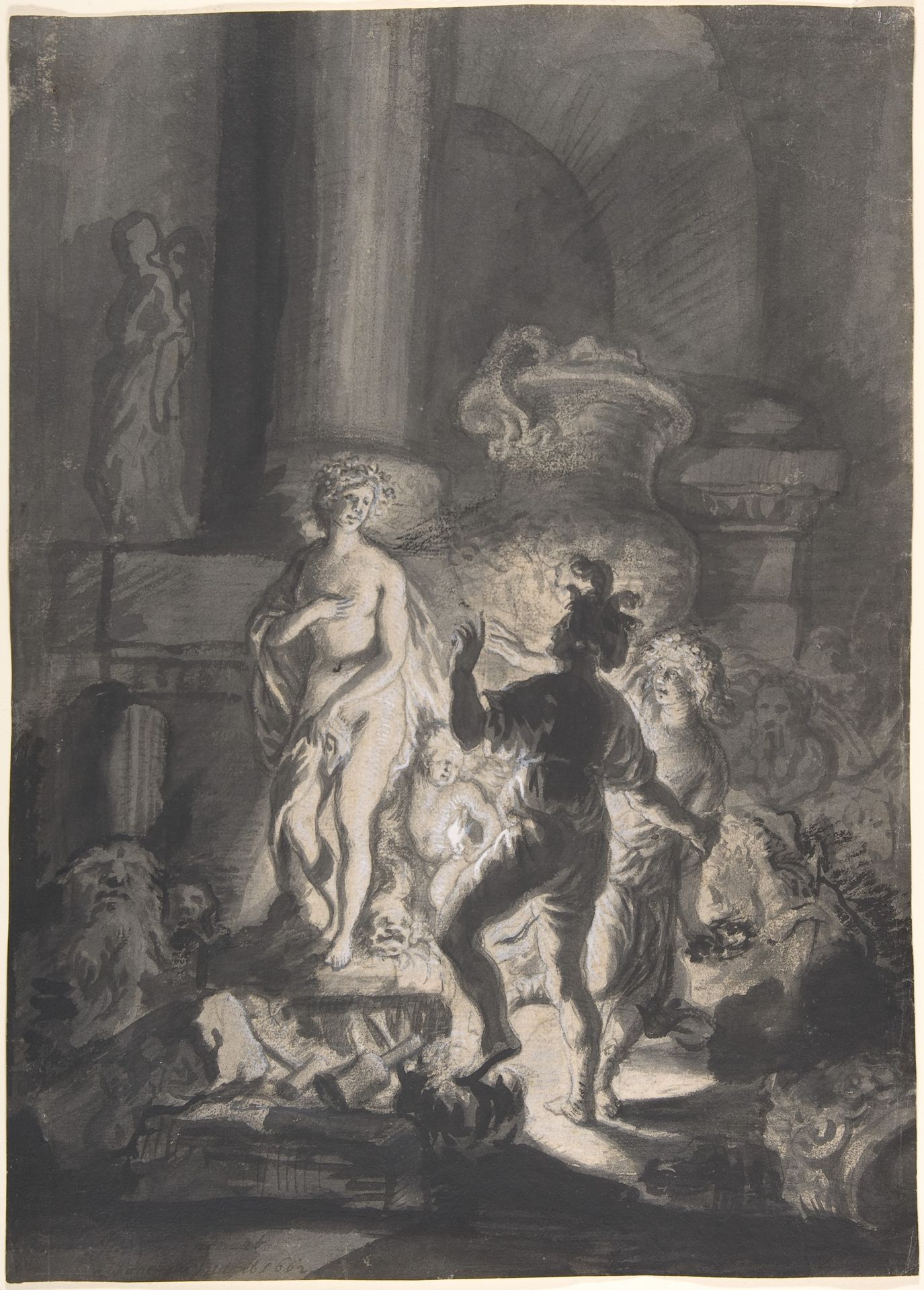
Curator: This arresting ink drawing, titled "Pygmalion," comes to us from Joachim von Sandrart and dates back to 1662. Currently, it resides here at the Metropolitan Museum of Art. Editor: There's such a dramatic play of light and shadow, a strong chiaroscuro effect. It creates an intense, almost theatrical atmosphere. Curator: Absolutely. Sandrart’s Baroque style is very effective in conveying the narrative of Pygmalion. Think of it not just as myth, but as an early exploration of male artistic agency and the male gaze and how this artistic power dynamic reduces the feminine subject into an idealized, static object of beauty. Editor: Yes, and notice the statue. It's rendered with smoother, lighter lines than the figure of Pygmalion. The contrast highlights the transformation taking place, moving from stone to flesh, from artifice to life. Semiotically, this stark contrast invites inquiry of what the statue lacks, even when it may represent an artistic achievement, compared to a body of flesh. Curator: Consider, too, the cultural implications. Sandrart created this in a context where art was actively being utilized to create an entire cultural epoch defined by masculine power. He doesn’t give us a simple recounting of a beloved story; this is social commentary made possible by Baroque allegory. The abundance of nudes for the artist isn't simple aesthetics, but instead, symbolic of the human condition and art itself being birthed. Editor: The composition also creates a compelling sense of depth. The placement of figures and architectural elements directs the viewer’s eye deeper into the image, which pulls us, once again, to the center and to Pygmalion's gesture. There’s a sort of triangular rhythm established here which makes the narrative legible. Curator: Seeing it through that lens, we begin to understand how “Pygmalion” also reveals a complex power structure embedded in the creative process and the mythologizing of both artist and muse. It really becomes this nexus of historical forces, artistic genius, and cultural ideology that is visualized. Editor: Well, it certainly invites one to closely examine line, shade, and the organization of these components as they lead the eye and deepen one’s understanding. Curator: For me, this is more than just visual mechanics; it’s history actively speaking through the artistic language.
Pygmalion
1662

Joachim von Sandrart
1606 - 1688
The Metropolitan Museum of Art
Metropolitan Museum of Art, New York, NYArtwork details
- Medium
- drawing, print, ink
- Dimensions
- Overall: 16 x 11 9/16 in. (40.7 x 29.4 cm)
- Location
- Metropolitan Museum of Art, New York, NY
- Copyright
- Public Domain
Tags
drawing
allegory
baroque
figuration
ink
history-painting
nude
Comments
Be the first to share your thoughts about this work.
About this artwork
Curator: This arresting ink drawing, titled "Pygmalion," comes to us from Joachim von Sandrart and dates back to 1662. Currently, it resides here at the Metropolitan Museum of Art. Editor: There's such a dramatic play of light and shadow, a strong chiaroscuro effect. It creates an intense, almost theatrical atmosphere. Curator: Absolutely. Sandrart’s Baroque style is very effective in conveying the narrative of Pygmalion. Think of it not just as myth, but as an early exploration of male artistic agency and the male gaze and how this artistic power dynamic reduces the feminine subject into an idealized, static object of beauty. Editor: Yes, and notice the statue. It's rendered with smoother, lighter lines than the figure of Pygmalion. The contrast highlights the transformation taking place, moving from stone to flesh, from artifice to life. Semiotically, this stark contrast invites inquiry of what the statue lacks, even when it may represent an artistic achievement, compared to a body of flesh. Curator: Consider, too, the cultural implications. Sandrart created this in a context where art was actively being utilized to create an entire cultural epoch defined by masculine power. He doesn’t give us a simple recounting of a beloved story; this is social commentary made possible by Baroque allegory. The abundance of nudes for the artist isn't simple aesthetics, but instead, symbolic of the human condition and art itself being birthed. Editor: The composition also creates a compelling sense of depth. The placement of figures and architectural elements directs the viewer’s eye deeper into the image, which pulls us, once again, to the center and to Pygmalion's gesture. There’s a sort of triangular rhythm established here which makes the narrative legible. Curator: Seeing it through that lens, we begin to understand how “Pygmalion” also reveals a complex power structure embedded in the creative process and the mythologizing of both artist and muse. It really becomes this nexus of historical forces, artistic genius, and cultural ideology that is visualized. Editor: Well, it certainly invites one to closely examine line, shade, and the organization of these components as they lead the eye and deepen one’s understanding. Curator: For me, this is more than just visual mechanics; it’s history actively speaking through the artistic language.
Comments
Be the first to share your thoughts about this work.