About this artwork
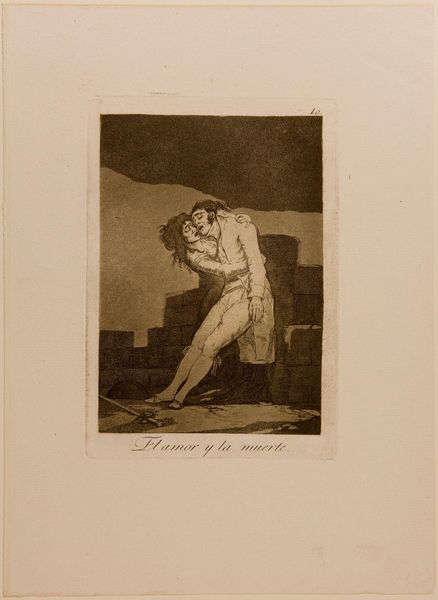
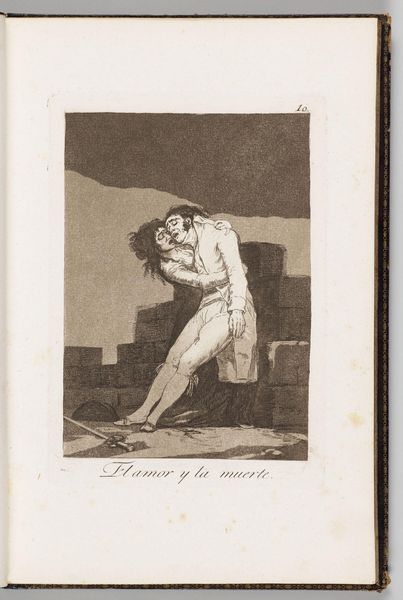
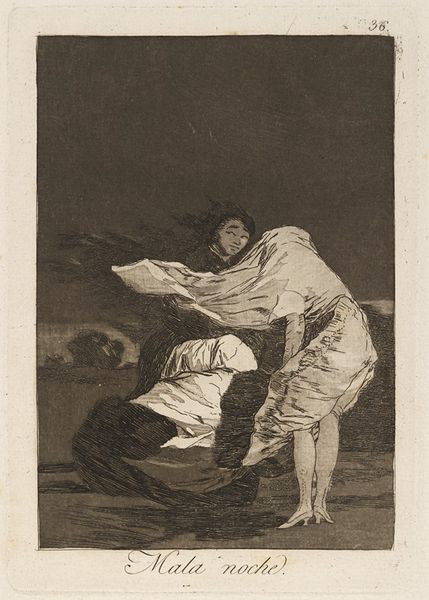
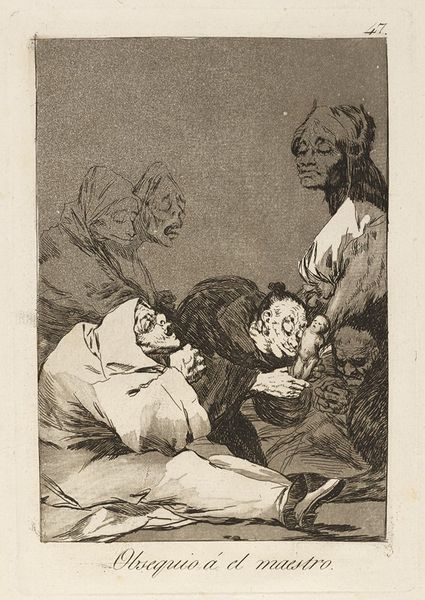
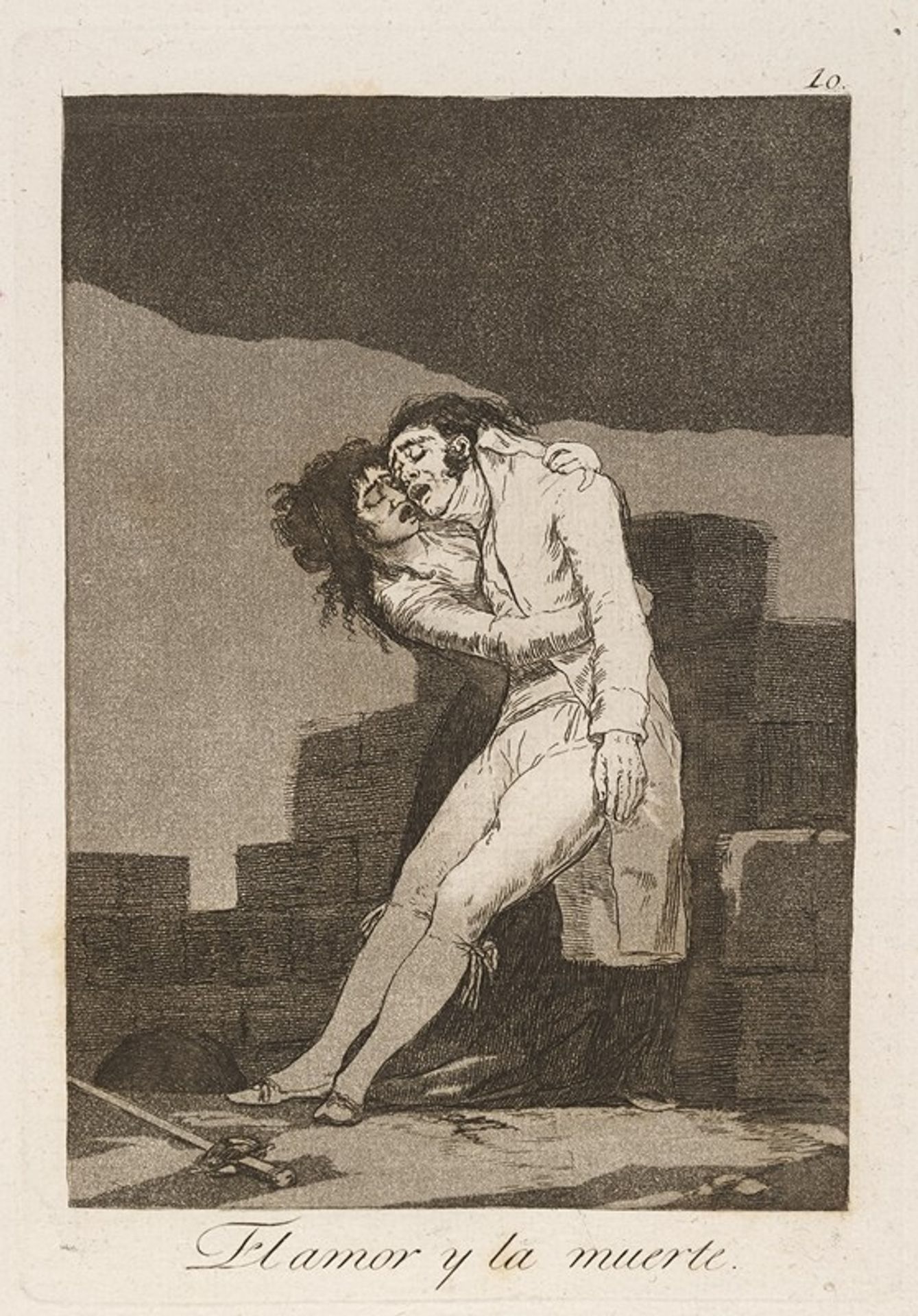
Curator: "El amor y la muerte", Love and Death. This etching by Francisco Goya was completed between 1796 and 1797. Editor: My first impression is its brutal tenderness; the way the bodies are clinging to each other in this coarse etching...it speaks of desperation. What are we seeing, exactly? Curator: Well, the narrative suggests a clandestine love affair ending in tragedy, likely discovered and punished. The dramatic embrace implies a final farewell. Editor: Absolutely. I'm also struck by the material aspect of this work. The roughness of the etched lines…Goya wasn’t interested in a polished presentation, he was capturing raw emotion through a rather industrial printing process, if we think about its dissemination to an audience. This lends an urgency to the subject matter that connects it to a broader societal upheaval. Curator: I see that, and his mastery of aquatint provides dramatic contrasts, heightening the emotional impact of the scene. Given the socio-political climate of Spain at the time, dominated by aristocracy and the church, Goya's etching subtly challenges established moral codes and values, don't you think? Editor: Undeniably. This wasn't just a scene, but a subtle critique. What's really striking, from a materialist viewpoint, is that it’s a mass produced image, which brings it into dialogue with a range of audiences and expands its social role. Its circulation becomes integral to its meaning, really. Curator: So, you see its impact amplified by its medium. Fair. Editor: The labor of making, the materials used in reproduction, these become as potent as the central tragic tableau itself. And this combination, it becomes a significant form of visual social commentary. Curator: Interesting how his artistic choice for reproducible etching has made the impact long lasting. Well, I for one find myself really impacted by it and glad we could experience it again today! Editor: Me too, to reconsider the production, consumption, and lingering influence of "Love and Death"—it provides insight into the potent connection of emotion and material realities!

Artwork details
- Medium
- print, etching
- Copyright
- Public Domain: Artvee
Tags
light pencil work
allegory
narrative-art
etching
pencil sketch
figuration
romanticism
pencil work
genre-painting
history-painting
Comments
No comments
About this artwork
Curator: "El amor y la muerte", Love and Death. This etching by Francisco Goya was completed between 1796 and 1797. Editor: My first impression is its brutal tenderness; the way the bodies are clinging to each other in this coarse etching...it speaks of desperation. What are we seeing, exactly? Curator: Well, the narrative suggests a clandestine love affair ending in tragedy, likely discovered and punished. The dramatic embrace implies a final farewell. Editor: Absolutely. I'm also struck by the material aspect of this work. The roughness of the etched lines…Goya wasn’t interested in a polished presentation, he was capturing raw emotion through a rather industrial printing process, if we think about its dissemination to an audience. This lends an urgency to the subject matter that connects it to a broader societal upheaval. Curator: I see that, and his mastery of aquatint provides dramatic contrasts, heightening the emotional impact of the scene. Given the socio-political climate of Spain at the time, dominated by aristocracy and the church, Goya's etching subtly challenges established moral codes and values, don't you think? Editor: Undeniably. This wasn't just a scene, but a subtle critique. What's really striking, from a materialist viewpoint, is that it’s a mass produced image, which brings it into dialogue with a range of audiences and expands its social role. Its circulation becomes integral to its meaning, really. Curator: So, you see its impact amplified by its medium. Fair. Editor: The labor of making, the materials used in reproduction, these become as potent as the central tragic tableau itself. And this combination, it becomes a significant form of visual social commentary. Curator: Interesting how his artistic choice for reproducible etching has made the impact long lasting. Well, I for one find myself really impacted by it and glad we could experience it again today! Editor: Me too, to reconsider the production, consumption, and lingering influence of "Love and Death"—it provides insight into the potent connection of emotion and material realities!
Comments
No comments