print, ink
# print
#
ukiyo-e
#
ink
#
genre-painting
#
nude
Dimensions: 9 1/4 × 14 3/4 in. (23.5 × 37.47 cm) (sheet, horizontal ōban)
Copyright: Public Domain
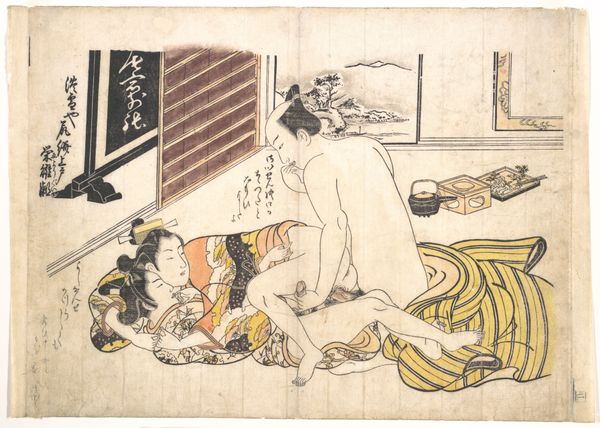
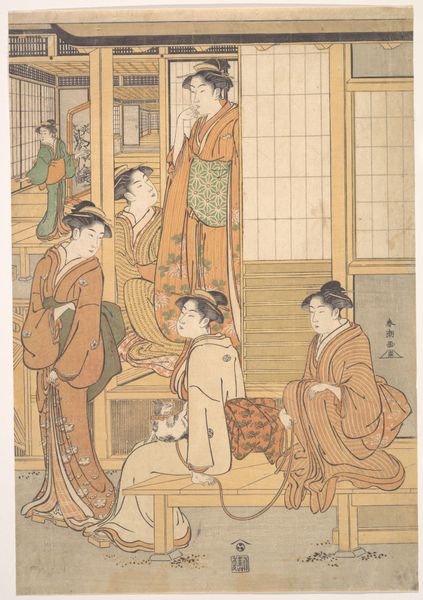
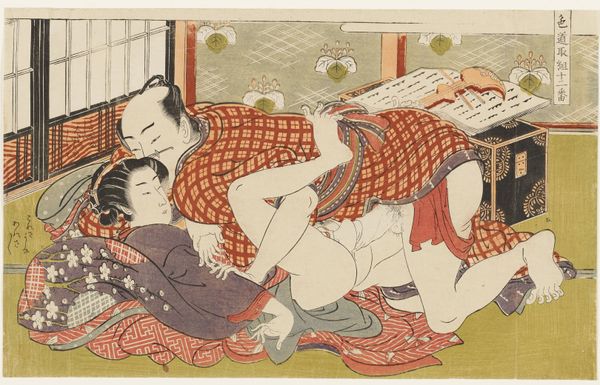
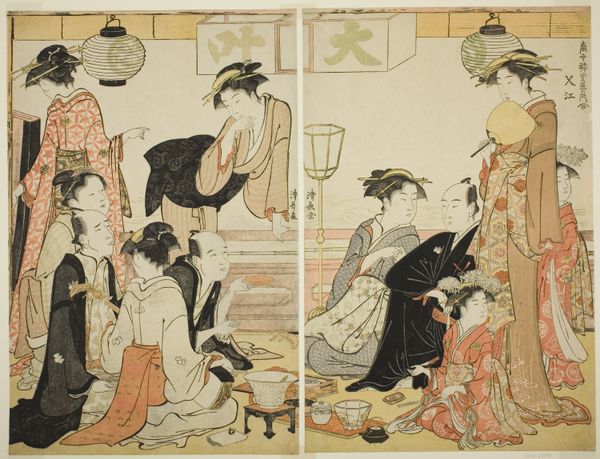
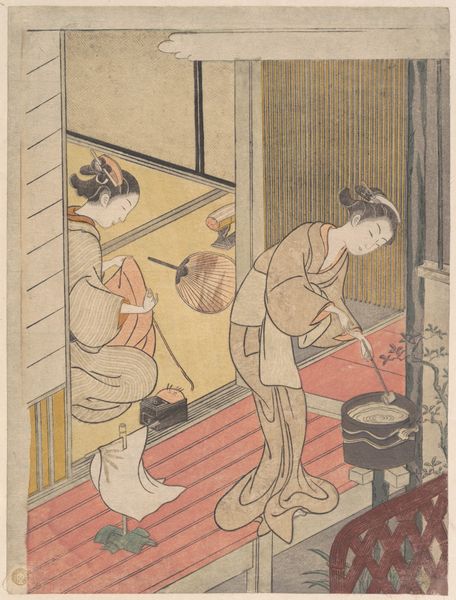
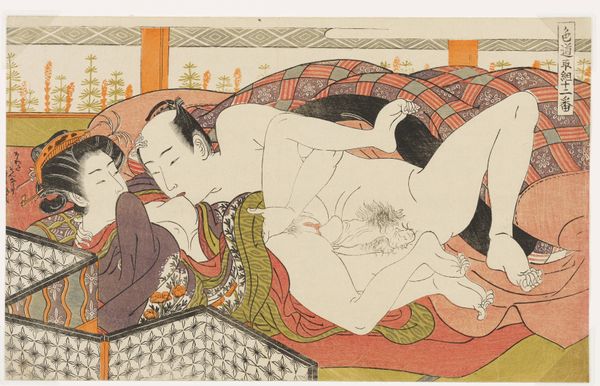
Isoda Koryūsai made this woodblock print called “Bath House” sometime in the 1770s or 80s. Koryūsai was a samurai turned artist, and he offers us here a glimpse into the floating world of Edo period Japan, a world of pleasure and entertainment. The print depicts a group of women, possibly courtesans, relaxing in a bathhouse. In this period, the Yoshiwara district of Edo, present-day Tokyo, was licensed by the government, and bathhouses were just one of the attractions. Koryūsai, and other artists of the Ukiyo-e school, produced images for mass consumption. These prints acted as a kind of advertisement for the pleasure quarters. We can see here how these images, although seemingly innocuous, were deeply embedded in the social and economic structures of their time. They offered an idealized vision of the floating world, but one that was far removed from the realities of many women's lives. To understand this print better, one might research the history of the Yoshiwara district, the role of women in Edo society, and the development of the Ukiyo-e print market.
Comments

minneapolisinstituteofart over 2 years ago
⋮
The last sheet depicts a group of figures on a smaller scale with a similar compositional balance as the first sheet. Even though almost everyone is completely nude, the scene is partially innocent depicting men and women of all ages in a public bath house. A young woman at the far left is enjoying a massage, and returning the favor. At the right is a young man who is aroused by the view and to his side is a fully-clothed older man- most likely the proprietor of the house. There were mixed public bath houses until they were banned during the Kansei Reforms (1787-93).


Join the conversation
Join millions of artists and users on Artera today and experience the ultimate creative platform.
 Collect
More like this