print, engraving
#
comic strip sketch
#
aged paper
#
pale palette
# print
#
caricature
#
old engraving style
#
personal journal design
#
personal sketchbook
#
sketchwork
#
sketchbook drawing
#
genre-painting
#
storyboard and sketchbook work
#
sketchbook art
#
engraving
#
realism
Dimensions: height 215 mm, width 275 mm
Copyright: Rijks Museum: Open Domain
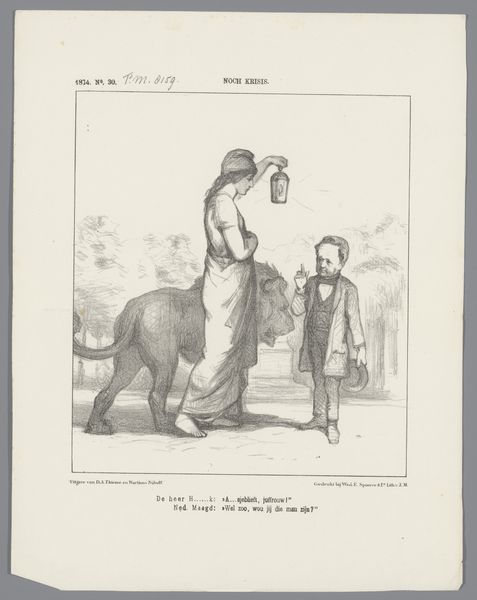
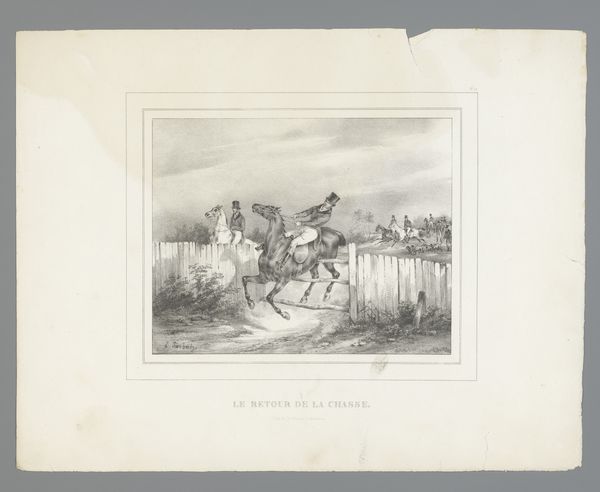
Curator: This print from 1871, by Johan Michaël Schmidt Crans, is titled "Spotprent met Minister van Financiën Blussé." What’s striking to you when you first see it? Editor: The composition is what immediately grabs my attention. The stark lines of the engraving create a visually direct and impactful statement. The pale palette also suggests a certain solemnity. Curator: Indeed. Looking at it through a historical lens, we see that the print is a commentary on the Minister of Finance, Blussé, and likely, on the political climate of the time regarding taxation, capturing anxieties felt by those affected by new income taxes. Editor: I see the figure riding what looks like a rather unusual horse. Its body is marked with the number “10,000,” which must be a reference to wealth or income, perhaps? The gate also is marked with text. How do these function? Curator: Precisely. The "horse" does represent a certain income level, the 10,000 likely designating an upper bracket income, so the horse implies privilege. The gate says "Inkomsten Belasting" or "income tax" and serves as the obstacle that the minister and this privileged class are forced to deal with. Editor: The caricature of the Minister is particularly telling. There's a deliberateness in his stance and facial expression that begs decoding through a semiotic lens. It is far from flattering. Curator: Absolutely. The work is a powerful representation of social tension around new economic policies in the Netherlands, tapping into the era's class divisions. It likely resonates even today. Editor: The simple graphic structure underscores its didactic purpose, its message amplified by the calculated placement of its caricatures. The whole construction has a moral charge to it. Curator: Viewing it now, it speaks to how artistic expression can act as a vehicle for dissent, mirroring timeless socio-economic struggles. Editor: And when viewing it as a series of intersecting lines and textual gestures, the work provides enduring formal insight into effective visual communication.
Comments
No comments
Be the first to comment and join the conversation on the ultimate creative platform.
 Collect
 React
React Comment
More like this