About this artwork
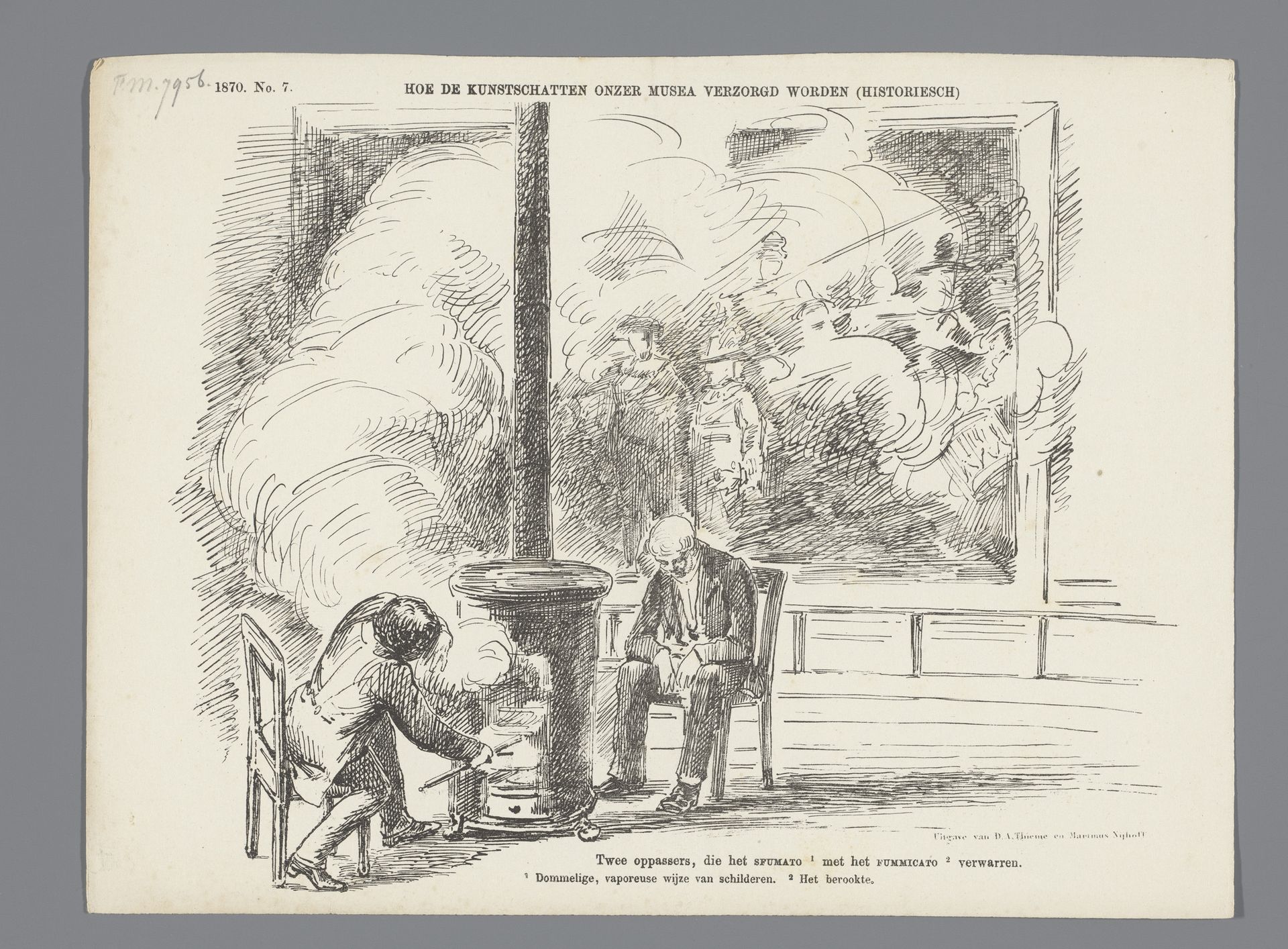
This print, made in 1870 by Johan Michaël Schmidt Crans, captures a moment of irony within the hallowed halls where Rembrandt’s “Night Watch” hangs. The image, rendered in ink, offers a pointed commentary on the state of cultural heritage. In the scene, we see museum attendants tending to a smoking stove, oblivious to the damage their actions inflict upon the masterpiece looming behind them. Here, Crans critiques the perceived negligence in caring for national treasures, literally obscuring the legacy of Dutch art with a cloud of smoke. This satirical portrayal speaks volumes about the cultural priorities of the time, questioning whether the appreciation of art truly aligned with its preservation. The print invites us to consider the value we place on art and the stories it tells about our collective identity, asking who is responsible for safeguarding cultural memory. It is a poignant reflection on the tensions between present needs and the preservation of the past.
Spotprent op de rokende kachels in de zaal waar de Nachtwacht hangt, 1870
1870

Artwork details
- Medium
- drawing, paper, pen
- Dimensions
- height 215 mm, width 275 mm
- Copyright
- Rijks Museum: Open Domain
Tags
Comments
Share your thoughts
About this artwork
This print, made in 1870 by Johan Michaël Schmidt Crans, captures a moment of irony within the hallowed halls where Rembrandt’s “Night Watch” hangs. The image, rendered in ink, offers a pointed commentary on the state of cultural heritage. In the scene, we see museum attendants tending to a smoking stove, oblivious to the damage their actions inflict upon the masterpiece looming behind them. Here, Crans critiques the perceived negligence in caring for national treasures, literally obscuring the legacy of Dutch art with a cloud of smoke. This satirical portrayal speaks volumes about the cultural priorities of the time, questioning whether the appreciation of art truly aligned with its preservation. The print invites us to consider the value we place on art and the stories it tells about our collective identity, asking who is responsible for safeguarding cultural memory. It is a poignant reflection on the tensions between present needs and the preservation of the past.
Comments
Share your thoughts