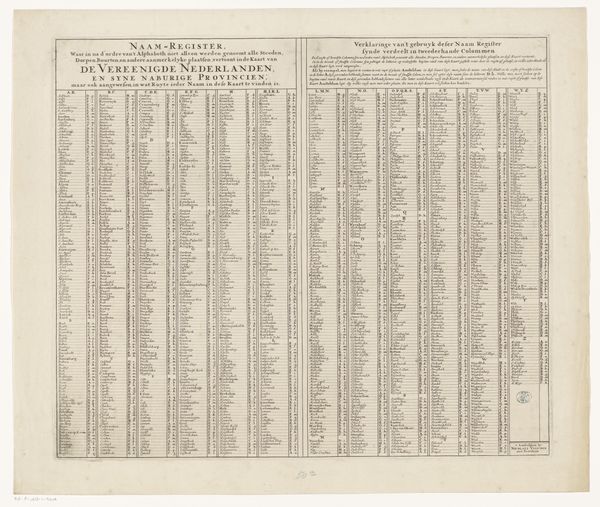
Negen schalen met verschillende metingen en dagen in het jaar c. 1692 - 1695
0:00
0:00

anonymous
Rijksmuseum
graphic-art, print, paper, engraving
#
graphic-art
#
aged paper
#
baroque
# print
#
old engraving style
#
hand drawn type
#
paper
#
stylized text
#
pen work
#
engraving
Dimensions: height 496 mm, width 581 mm
Copyright: Rijks Museum: Open Domain
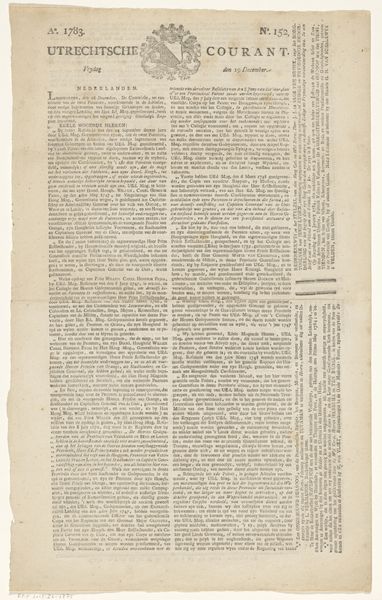
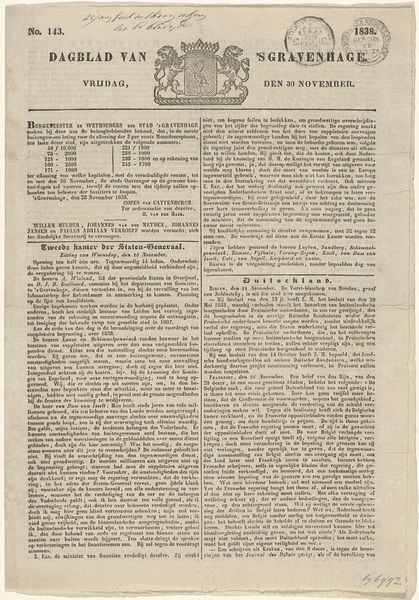
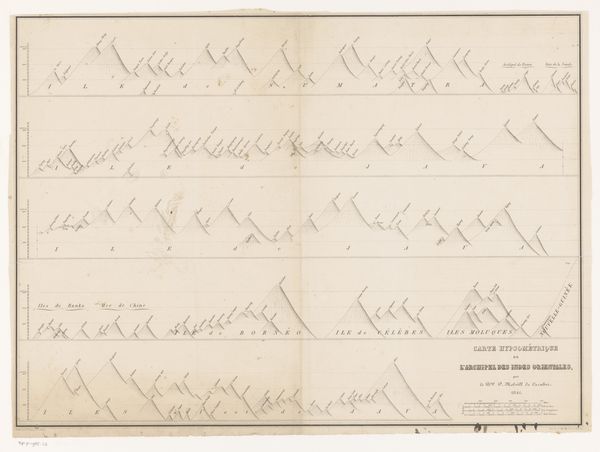
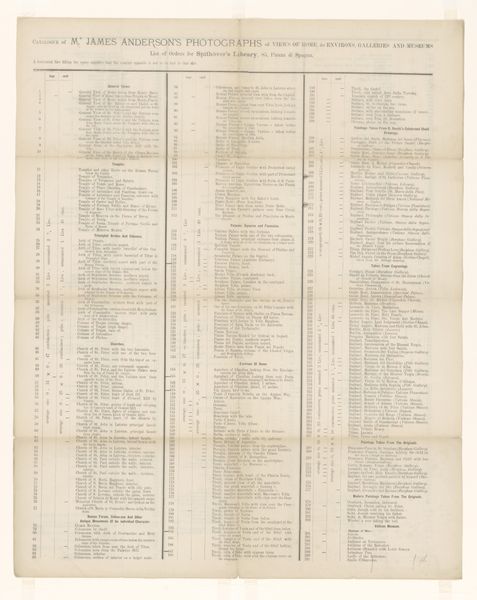
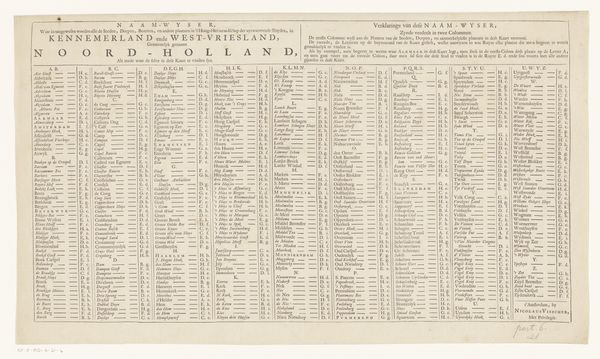
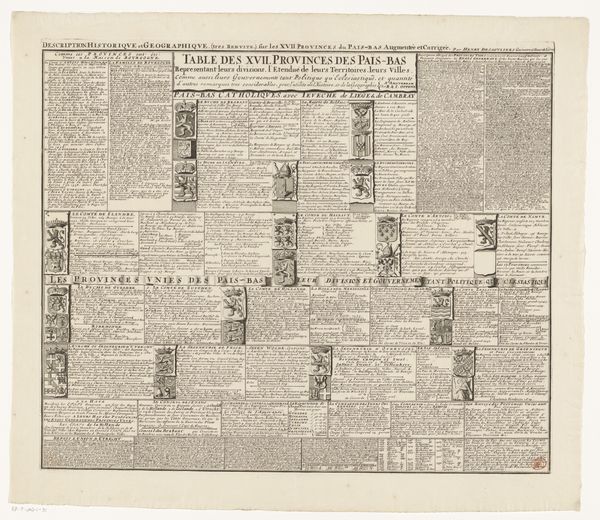
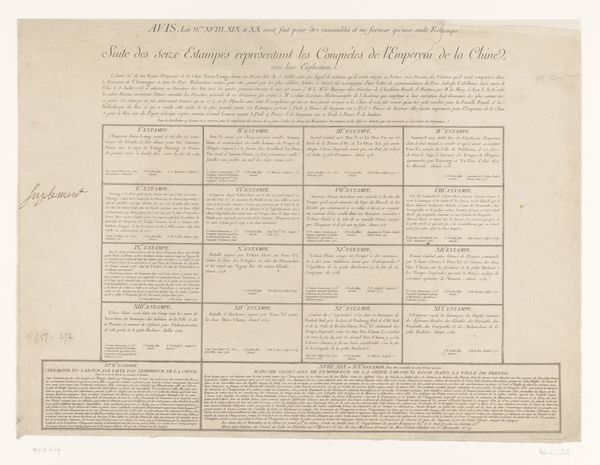
Curator: This engraving from around 1692-1695, currently residing in the Rijksmuseum, is titled "Negen schalen met verschillende metingen en dagen in het jaar," or, in English, "Nine Scales with Various Measurements and Days of the Year." It is an intricate example of early scientific data presentation using graphic art. Editor: Immediately, it evokes a sense of overwhelming organization. The sheer volume of information, densely packed and meticulously rendered, is captivating. It’s like looking at a complex algorithm visualized. What’s the societal drive behind creating such an organized diagram? Curator: It speaks to the burgeoning scientific rationalism of the late 17th century, a time of intense focus on empirical observation and measurement. As part of its social context, one can interpret it as representing both a hope of understanding, and a subtle attempt at mastery, of the natural world. Editor: You are correct. What I find particularly interesting is the presence of both a will for a universal means of calculation—evident in its structured design—and a societal reality of segregated linguistic groups: the titles appear both in Dutch and in French, an acknowledgement of contemporary socio-political powers? Curator: Yes, and it also mirrors the power dynamics of the era, doesn't it? The dual languages demonstrate the cross-cultural exchange of knowledge, which occurred mostly between societal elites, while simultaneously restricting accessibility based on socio-economic position. It becomes quite clear if we compare this artwork with the history of education. Editor: So, even a seemingly objective, data-driven print reveals a hidden socio-political script, a silent echo of societal stratification and restricted means of communication, even in "science." Thinking of its materiality, what statement would you attribute to the piece in terms of aesthetics and communication? Curator: The graphic rendering using engraved lines possesses a visual appeal of stark precision. The stylistic elements create an aesthetic of accuracy and rationality but I agree with you—this, itself, serves as a potent cultural symbol of power structures that silently pervade science, the state, and knowledge. Editor: It provides an unsettling glimpse into how our ancestors organized their world, how meaning was produced, and in which societal environment. Overall, a stimulating work! Curator: Absolutely, one which bridges data visualization and intricate sociopolitical commentary in a deceptively beautiful format.
Comments
No comments
Be the first to comment and join the conversation on the ultimate creative platform.
 Collect
 React
React Comment
More like this