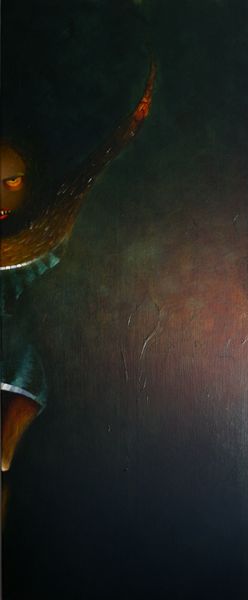
Dimensions: 112 x 302 cm
Copyright: Babak-Matveev,Fair Use
Editor: This is the "Hirst Mausoleum (triptych)" created by Babak-Matveev in 2018, and uses mixed-media. It looks like a series of tanks with sharks in them… and is that the artist in the last panel? It’s unsettling but also has a pop-art vibe to it. What do you make of this piece? Curator: Well, you’ve already keyed into the important tensions. Let's unpack that feeling of unease in the context of Hirst's, perhaps, tongue-in-cheek relationship with mortality and fame. Considering postmodernism’s critique of originality and the spectacle, what's being “memorialized” here? The sharks? A hyper-masculine ego? Editor: I suppose it is about spectacle, almost like a caricature of fame and the male artist's ego. But why the vanitas theme, is it alluding to the fleeting nature of life? Curator: Exactly! It throws into sharp relief the art world’s obsession with eternalization, and, crucially, what it chooses to preserve. Who gets this kind of immortality, and what are the politics surrounding that choice? Look at how gender and power are performed here: a naked artist posing like they have tamed a shark! What statement is made with the triptych and its resemblance to Christian iconography? Editor: Oh wow! I hadn’t noticed how similar it is to religious paintings. Now I am wondering what the meaning of the sharks being behind glass could be? Perhaps safety for some people versus feeling like you’re trapped for the shark? Curator: I think that's a smart observation! By trapping those potentially very dangerous sea animals behind a layer of glass the artist removes agency from something scary to turn it into art. Considering the historical and colonial implications, the ocean and its creatures can also become metaphors. What might those be, if you view those beings through the lens of cultural dominance and subjugation? Editor: This piece really has me thinking differently. I can now recognize the critique on power, legacy, and even the historical baggage of how we categorize and display things! Curator: Exactly! That’s why engaging with art from a critical, contextual perspective can open up so many new avenues of thought.
Comments
No comments
Be the first to comment and join the conversation on the ultimate creative platform.
 Collect
 React
React Comment
More like this