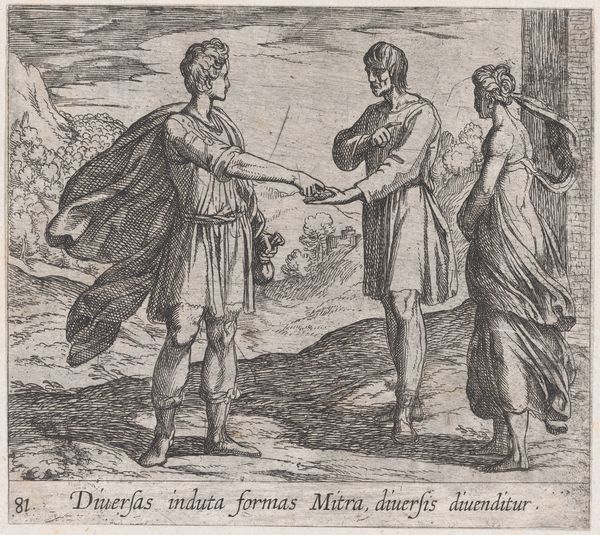
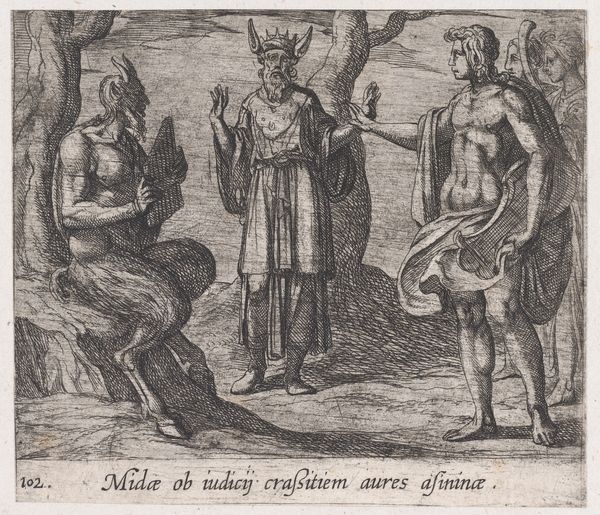
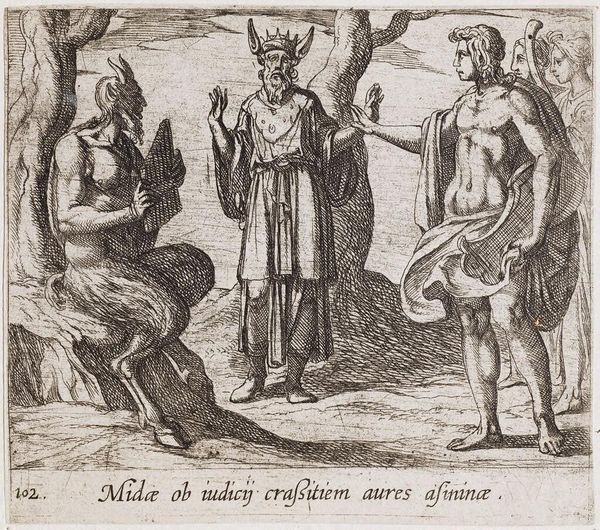
Plate 101: Bacchus Granting Midas's Wish (Ob restitutum Silenum Midae a Baccho Defertur optio), from Ovid's 'Metamorphoses' 1606


drawing, print, engraving
drawing
allegory
landscape
figuration
history-painting
engraving
Dimensions: Sheet: 4 1/8 × 4 5/8 in. (10.5 × 11.8 cm)
Copyright: Public Domain
Curator: We’re looking at Antonio Tempesta’s engraving from 1606, titled "Plate 101: Bacchus Granting Midas's Wish from Ovid's 'Metamorphoses'". Editor: It's a small-scale piece, but intensely detailed. The hatching and cross-hatching build such depth! You can almost feel the roughness of the donkey's fur. Curator: This print depicts a specific moment in Ovid’s narrative. Midas, after returning Silenus to Bacchus, is granted a wish. It speaks to the cultural fascination with classical stories, and how artists used them to explore themes of power, desire, and consequence. Editor: Power indeed! Look at how Tempesta uses the engraving technique to give texture to Midas's crown and the luxurious drape of his robes. It makes you consider the materials of kingship and their cost. All that labor invested just to signify authority. Curator: Absolutely. The story itself is a commentary on wealth and greed. Midas wishes that everything he touches turns to gold, which, of course, proves to be a terrible curse when he can’t eat or drink. This was meant to be didactic and teach morals to the elite. Editor: It’s striking how the artist renders even the background figures with so much attention. But tell me, what was the consumption of prints like? Were these luxury objects accessible only to wealthy collectors? Curator: Printmaking during this period allowed for wider dissemination of images, influencing art and design far beyond the circles of the elite. While the original artworks were accessible to a privileged few, the prints had a broad public appeal. Editor: Thinking about the sheer labor in creating these plates makes you reconsider the artistic hierarchy between the engraver and a painter like Titian, or even goldsmiths or silversmiths who work with luxury metals and courtly clients. Curator: These engravings also facilitated a dialogue among artists. Tempesta's interpretation of Ovid would have circulated widely, influencing subsequent generations of artists, writers, and thinkers. Editor: It brings a certain urgency when we consider the time-consuming processes needed for a single engraving—each line meticulously etched into the metal plate. The value of labor embedded feels so far removed from the rapid dissemination of digital images today. Curator: It really allows one to consider the historical role that artworks have played, from the artist's technique and dissemination methods to its social effect, especially among social and political elites. Editor: Indeed, this small print is a nexus of intertwined narratives, production methods, material explorations, and powerful stories.
Comments
No comments
Be the first to comment and join the conversation on the ultimate creative platform.
 React
React Comment