Copyright: Public domain
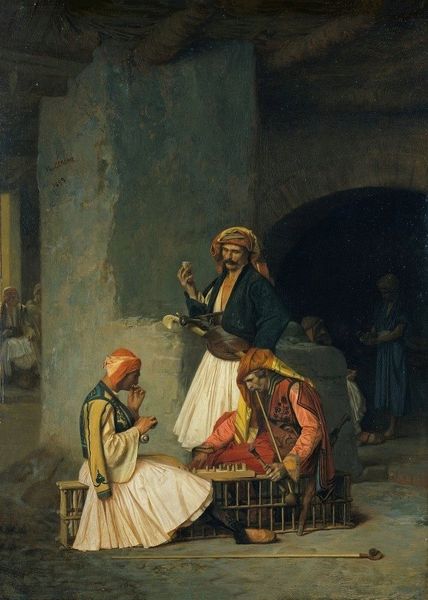
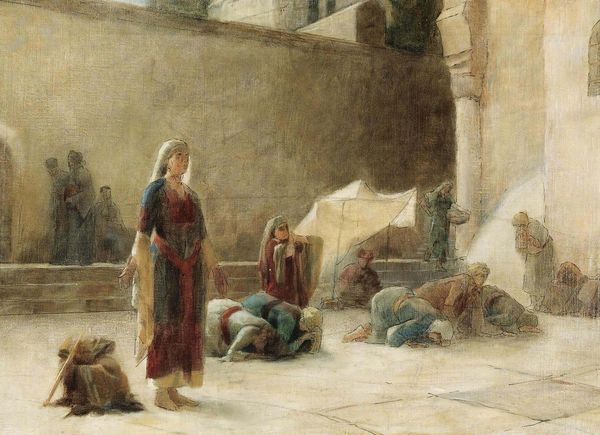
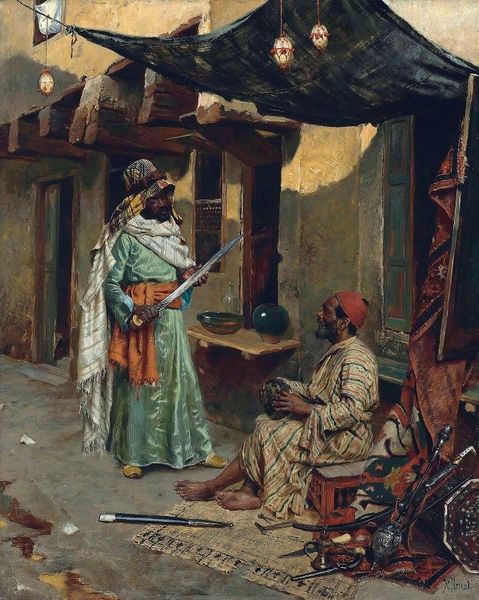
Curator: Alright, let’s take a moment to consider John William Waterhouse's 1872 oil painting, "The Slave," currently held in a private collection. Editor: A heavy stillness settles over me. There's a muted palette at play— browns and grays dominating, except for some vibrant textiles. But the somber mood outweighs any splash of color, the atmosphere heavy with…resignation. Curator: I would suggest that is no coincidence. This piece exemplifies the Orientalist style popular at the time, appropriating imagery from North Africa and the Middle East. The 'slave' is central here—presented in a tableau of languid waiting alongside figures, with the architecture forming an oppressive frame. Note the dark threshold they inhabit. What symbols do you see arising from the composition itself? Editor: Well, the architecture really boxes everyone in, doesn't it? The woman is obviously being looked at, the 'male gaze' if you like. She’s sort of a 'captive bird' symbol—precious but trapped in someone’s collection of…exotic artifacts? It's incredibly discomforting how her humanity seems secondary to her aesthetic value. Curator: Indeed. Waterhouse, known for his Pre-Raphaelite connections and academic art training, carefully constructs a specific cultural narrative here. He weaves historical interpretations with exotic fantasies, resulting in a painting brimming with signifiers. You correctly interpreted it as aestheticizing the 'slave' at the expense of emotional and subjective depth. Editor: Makes you think, what story are we actually supposed to believe here? The surface tells one thing. Dig deeper and... yikes! What really shakes me is recognizing how this sort of objectification lives on even today, but manifested differently in art and media. Curator: I am afraid so; the power of visual language resides not just in representation, but in the endurance of coded assumptions, as seen clearly here, informing perspectives across decades. Editor: Looking back, it's vital we analyze, challenge and learn how these symbols resonate even now. Not to repeat them! I think 'The Slave' gives us a tough but valuable learning opportunity. Curator: I agree; I think the exercise illuminates so many fascinating aspects to be mindful of as viewers of history.
Comments
No comments
Be the first to comment and join the conversation on the ultimate creative platform.
 Collect
 React
React Comment
More like this