About this artwork
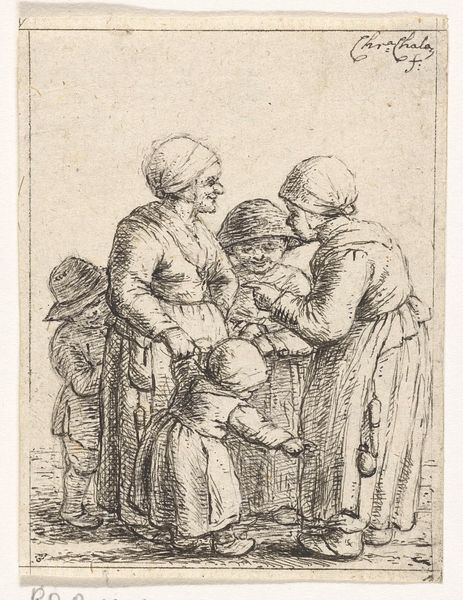
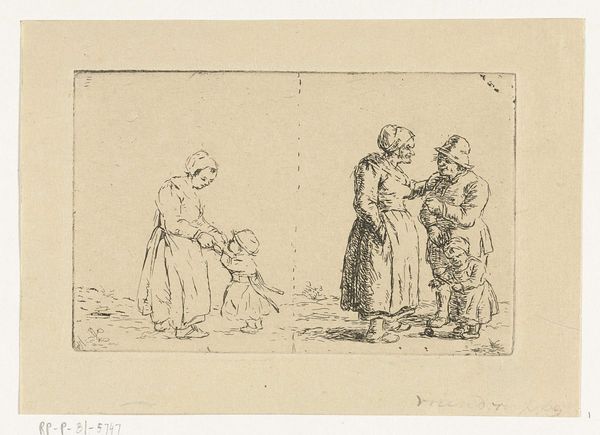
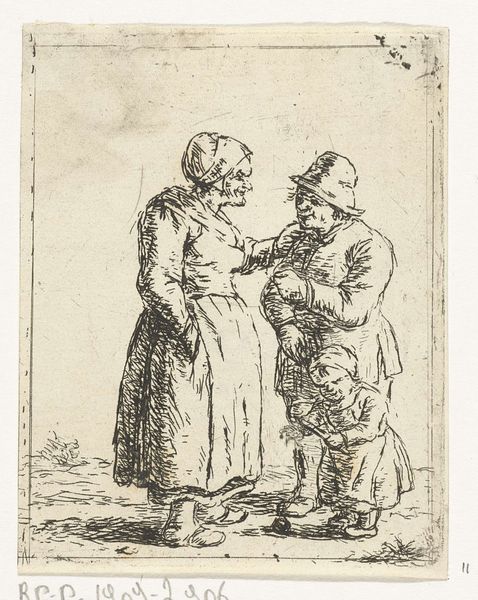
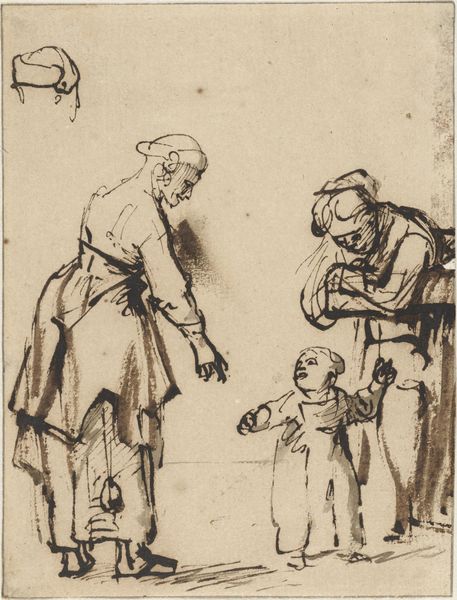
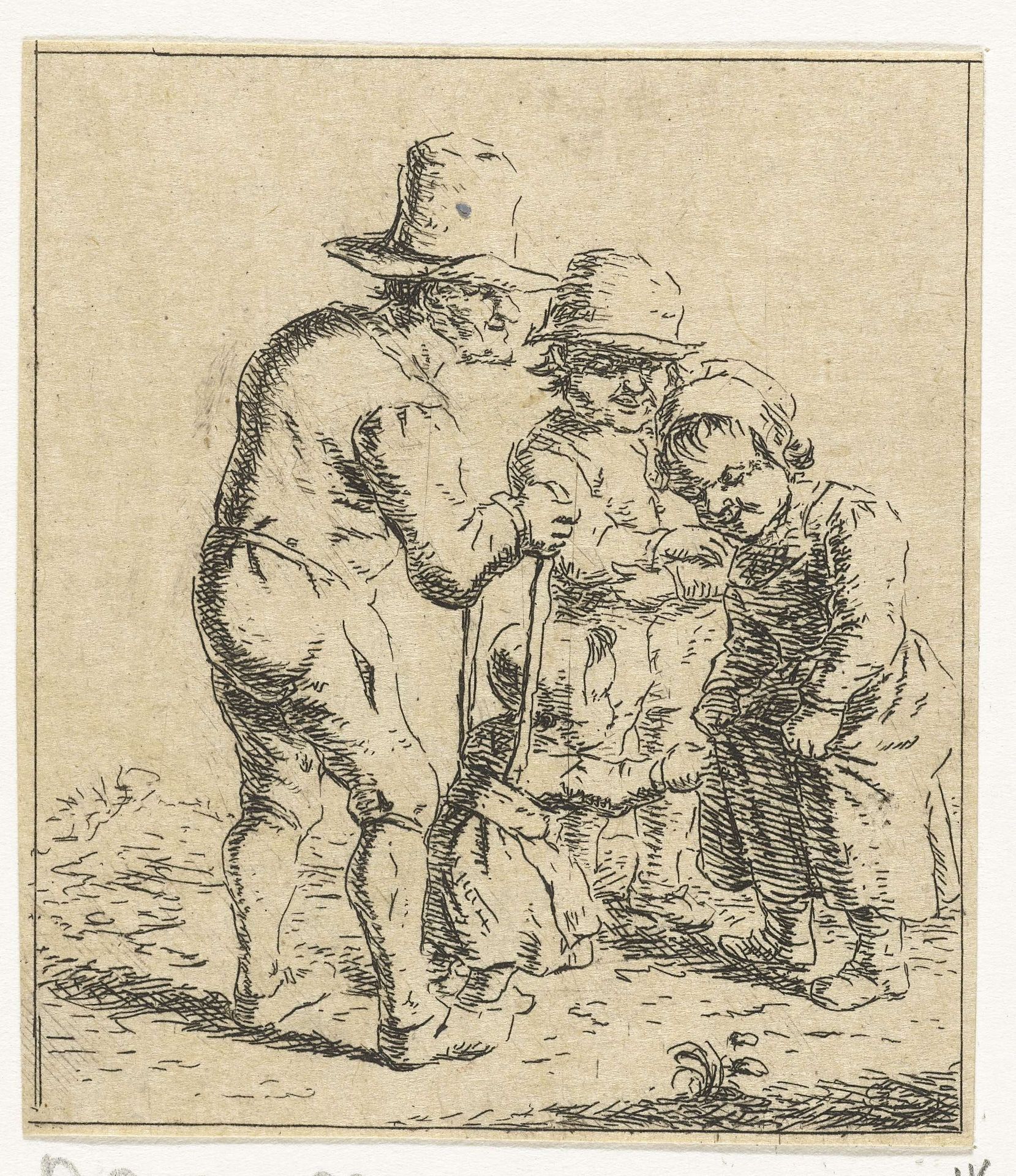
Curator: This is Christina Chalon’s, "Family Teaching a Child to Walk." Created between 1758 and 1808, the Rijksmuseum holds this small drawing made with ink on paper. Editor: It's immediately intimate, don't you think? Rough, almost scratchy lines, but they capture the wobbly uncertainty of that little one perfectly. The paper, you can tell, it’s handled with tenderness. Curator: Indeed. Chalon used line drawing techniques typical of the neoclassical movement—look at the focus on contours, on depicting the human form, although it seems like such a candid depiction of family. The focus is very much on how these kind of genre scenes of learning and nurture offer important insights into social relationships. Editor: It feels incredibly familiar, despite the distance of time. I mean, learning to walk is still messy, awkward, kind of hilarious. It is beautifully universal, even. Do you ever think about what kind of paper an artist like Chalon would have had access to? Curator: Certainly, access was shaped by networks of trade, familial resources, as Chalon came from a family of artists and, relevantly, from a paper manufacturing background. So she probably made her own or otherwise benefitted from family labour and resources. The type of ink, too, would reflect available resources and craftsmanship and, further, trade relationships to get to that point, affecting the lines, the shading, the permanence of the image itself. It brings home that artistic expression isn’t separate from the labor, tools and infrastructures which surround it. Editor: It also occurs to me, just looking, how much care it takes to depict something so ephemeral: the angle of a stumbling foot, a concerned expression of encouragement. All these details immortalized on, you know, family-made paper with specific kinds of ink from 18th century Amsterdam. Curator: Exactly, the act of selecting materials in many ways mirrors the depicted event - in itself highlighting labour and patience. The convergence illuminates values embedded in the art piece, speaking of labour, family, and support. Editor: Thinking about it, I notice the slightly blurred line in their forms, mirroring a kind of impermanence that all existence and moments possess. Beautiful work. Curator: Agreed. A piece that resonates on material and emotional levels, really grounding us in history while still touching upon shared experiences across centuries.

Artwork details
- Medium
- drawing, paper, ink
- Dimensions
- height 64 mm, width 56 mm
- Location
- Rijksmuseum
- Copyright
- Rijks Museum: Open Domain
Tags
portrait
drawing
neoclacissism
figuration
paper
ink
line
genre-painting
Comments
No comments
About this artwork
Curator: This is Christina Chalon’s, "Family Teaching a Child to Walk." Created between 1758 and 1808, the Rijksmuseum holds this small drawing made with ink on paper. Editor: It's immediately intimate, don't you think? Rough, almost scratchy lines, but they capture the wobbly uncertainty of that little one perfectly. The paper, you can tell, it’s handled with tenderness. Curator: Indeed. Chalon used line drawing techniques typical of the neoclassical movement—look at the focus on contours, on depicting the human form, although it seems like such a candid depiction of family. The focus is very much on how these kind of genre scenes of learning and nurture offer important insights into social relationships. Editor: It feels incredibly familiar, despite the distance of time. I mean, learning to walk is still messy, awkward, kind of hilarious. It is beautifully universal, even. Do you ever think about what kind of paper an artist like Chalon would have had access to? Curator: Certainly, access was shaped by networks of trade, familial resources, as Chalon came from a family of artists and, relevantly, from a paper manufacturing background. So she probably made her own or otherwise benefitted from family labour and resources. The type of ink, too, would reflect available resources and craftsmanship and, further, trade relationships to get to that point, affecting the lines, the shading, the permanence of the image itself. It brings home that artistic expression isn’t separate from the labor, tools and infrastructures which surround it. Editor: It also occurs to me, just looking, how much care it takes to depict something so ephemeral: the angle of a stumbling foot, a concerned expression of encouragement. All these details immortalized on, you know, family-made paper with specific kinds of ink from 18th century Amsterdam. Curator: Exactly, the act of selecting materials in many ways mirrors the depicted event - in itself highlighting labour and patience. The convergence illuminates values embedded in the art piece, speaking of labour, family, and support. Editor: Thinking about it, I notice the slightly blurred line in their forms, mirroring a kind of impermanence that all existence and moments possess. Beautiful work. Curator: Agreed. A piece that resonates on material and emotional levels, really grounding us in history while still touching upon shared experiences across centuries.
Comments
No comments