painting, watercolor
#
allegory
#
painting
#
landscape
#
figuration
#
oil painting
#
watercolor
#
symbolism
#
watercolour illustration
#
genre-painting
#
history-painting
#
pre-raphaelites
#
nude
#
watercolor
Copyright: Public Domain: Artvee
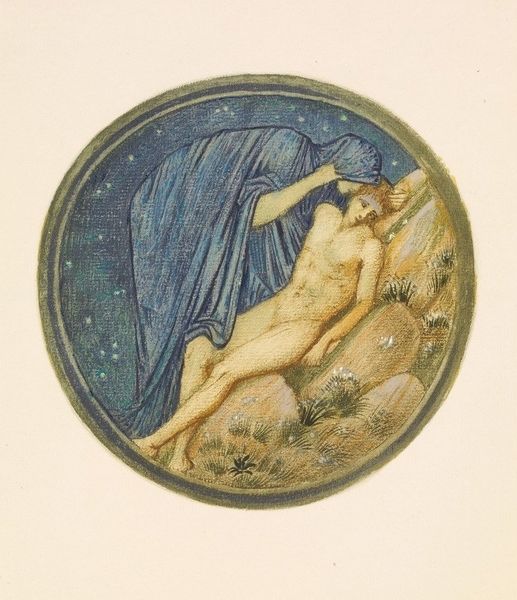
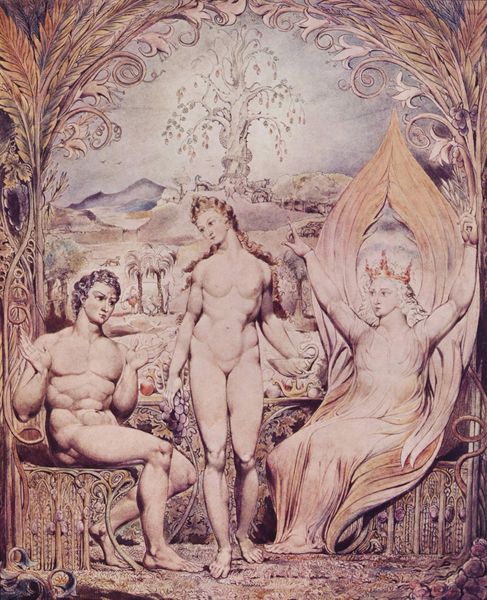
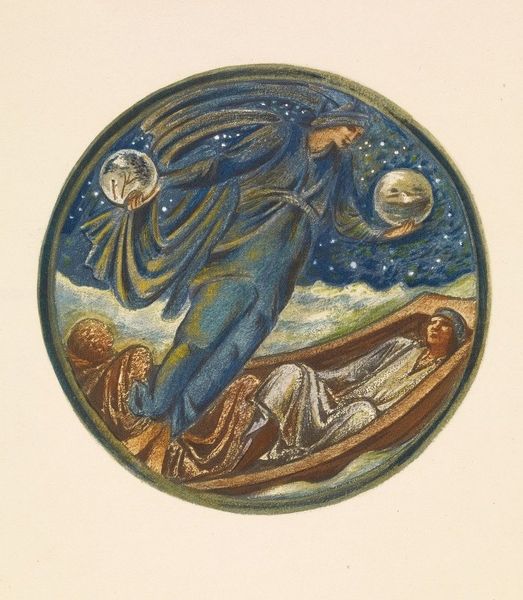
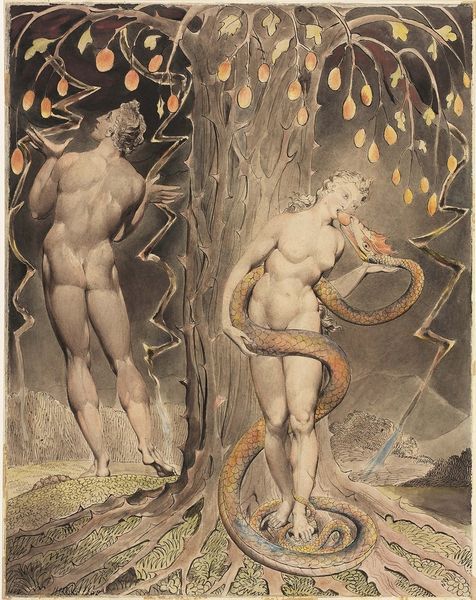
Curator: So here we have Edward Burne-Jones's "Adder's Tongue," painted around 1905. Editor: It's instantly dreamlike. A little garden scene held within what looks like a jewel-toned locket. The colours feel both delicate and a bit ominous, that’s quite a juxtaposition. Curator: It is a symbolic rendition of the Fall, very much in the Pre-Raphaelite aesthetic. We see Adam and Eve rendered with a focus on idealised beauty. Consider the period and its social contexts. Editor: I notice how vulnerable they appear. Like kids playing dress-up with leaves as fig leaves, not fully aware of the weight of the serpent’s advice. I feel their innocent ignorance. Curator: Exactly. It is crucial to see their depiction within larger discussions of gender roles and morality of that era, Burne-Jones certainly positioned the male and female form through symbolic lenses. How might that dialogue shape how we read it now? Editor: It brings up such interesting issues. Burne-Jones certainly wanted to give us beauty to distract from some deeper meaning—this scene looks as if love could overcome death; what it is instead is the origin of both. Curator: Yes! Note too the symbolism of the title, and the potential nod to language itself being part of this original sin and power imbalance! Editor: This circular composition is also key; that cyclical nature to paradise, how every up contains a down and the other way around. How change means something dies and something new emerges. Even looking at it has stirred all of that in me! Curator: Well said. Thinking about art and its relationship to critical discourse invites vital investigations into how our present reinterprets these moments and continues crucial cultural conversations. Editor: Art gives our feelings, especially complicated ones, a place to be born; for me, this piece today reminds me that everything important feels lovely, fragile, and catastrophic, all at once.
Comments
No comments
Be the first to comment and join the conversation on the ultimate creative platform.
 Collect
 React
React Comment
More like this