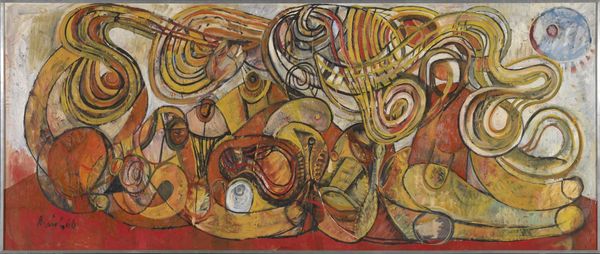
Dive Bomber and Tank 1940
0:00
0:00

joseclementeorozco
Museum of Modern Art (MoMA), New York City, NY, US
painting, oil-paint, mural
#
narrative-art
#
painting
#
oil-paint
#
figuration
#
oil painting
#
geometric
#
mexican-muralism
#
history-painting
#
mural
#
modernism
Dimensions: 275 x 550 cm
Copyright: Public domain
Curator: Standing before us is José Clemente Orozco’s *Dive Bomber and Tank*, painted in 1940 using oil on canvas. It currently resides at MoMA in New York. Editor: Whoa. This just radiates impending doom, doesn’t it? Those massive geometric forms bearing down – the somber greys punctuated by jolts of orange – it’s almost suffocating. I feel trapped just looking at it. Curator: Orozco was a central figure in the Mexican Muralism movement, and you can certainly see the echoes of grand narrative painting here, scaled down for canvas. This was painted at the very start of WWII, and he seemed to be grappling with industrialization and its connection to warfare. Editor: Right, you feel the brute force. I love how the lines kind of stutter. The jagged edges amplify the aggression. It is very claustrophobic: the shapes feel like they are bearing down. The palette is muted; the forms look crushed. The chains… is that a soldier? He's dehumanized. He's lost in the machine, right? Curator: Precisely. The human figure is fragmented, dwarfed, almost consumed by the machinery of war. The repetition of geometric forms, especially those sharp angles, suggests the relentless, impersonal nature of mechanized conflict. It's a powerful visual statement against war's impact on the human spirit. This painting came right after Orozco made murals in the US during the Great Depression. His politics and ideology shine through in his depiction of humanity crushed under machine warfare. Editor: So it’s like, what are we building, and what is it costing us? What is progress at the expense of, literally, our humanity? Very timely. It also is unsettling to realize this work anticipates the worst of war in its relentless pursuit of destruction. Curator: Absolutely. Orozco managed to crystallize that anxiety and disillusionment into a strikingly visceral image, it definitely invites us to reflect on our own moment, too. What does that orange shape represent in this mechanical carnage, right? Is that hope burning up in the chaos, I wonder. Editor: Perhaps. Whatever it is, Orozco is telling us not to trust industrial "progress" at any expense to humanity. Food for thought.
Comments
No comments
Be the first to comment and join the conversation on the ultimate creative platform.
 Collect
 React
React Comment
More like this