About this artwork
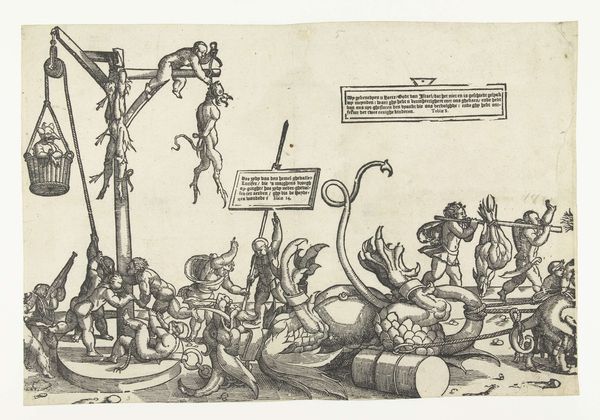
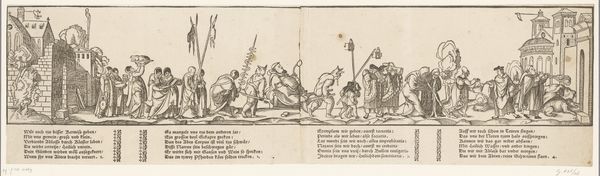
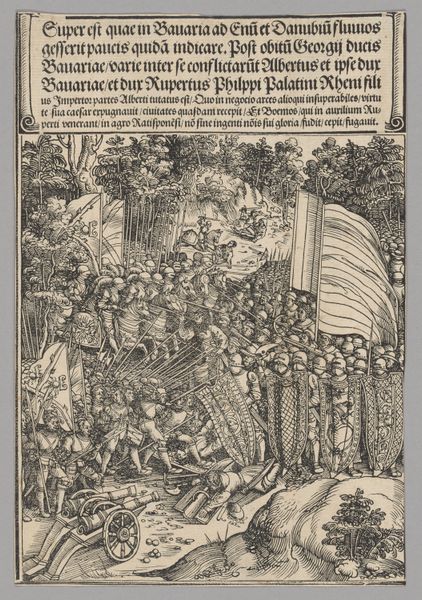
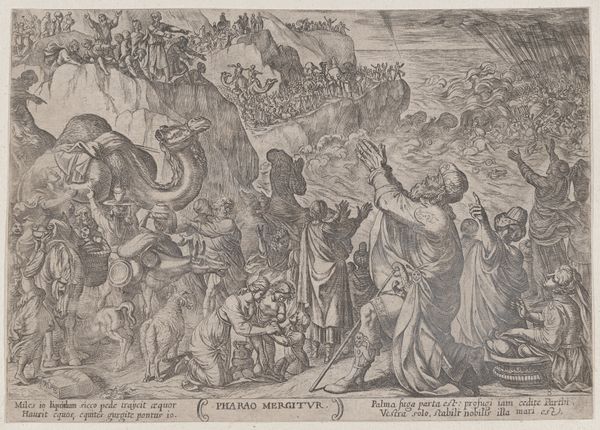
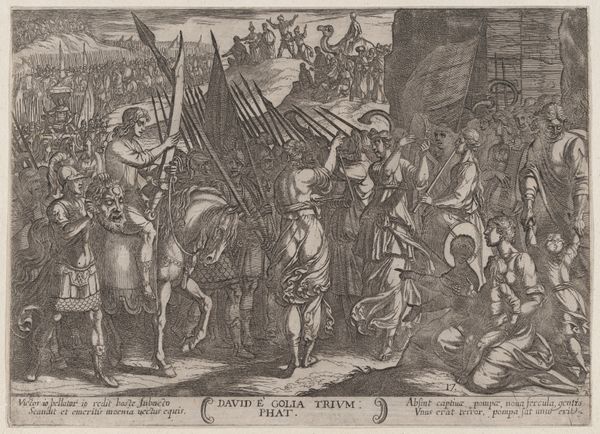
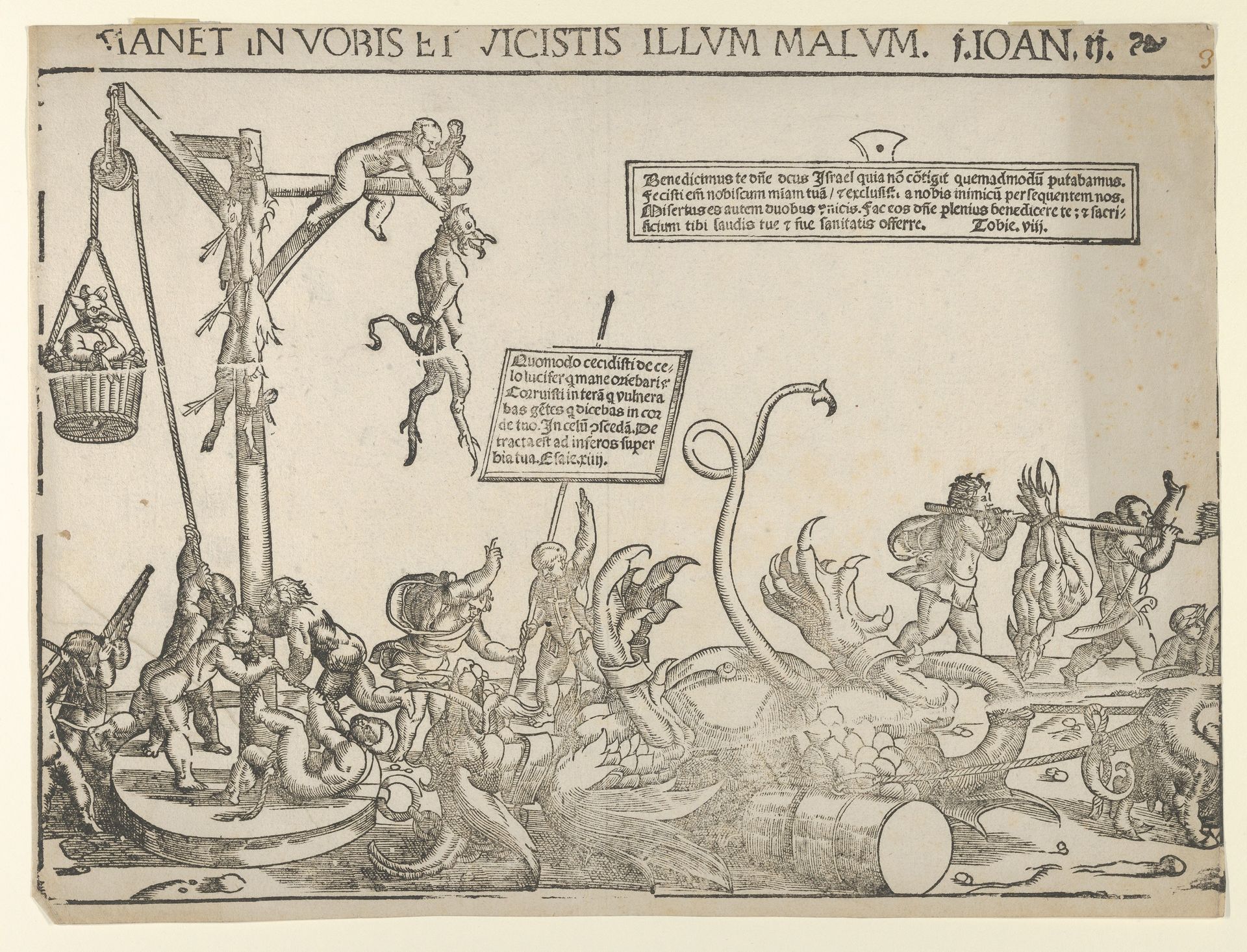
This woodcut, "Children's Crusade," was created around 1515–1550 by the Monogrammist LIW. At first glance, the composition appears chaotic, filled with stark contrasts and a sense of unsettling activity. Dark lines define the figures and objects, creating a tense and busy scene. The print reveals a world turned upside down, a carnivalesque inversion of established order. Look at the figures hoisting other bodies—are they human or demonic?—on makeshift gallows; this challenges our understanding of justice and authority. The artist uses a semiotic system of signs where traditional symbols of power are mocked and destabilized. The formal qualities of the woodcut—its stark lines, crowded composition, and disturbing imagery—reflect a period of intense religious and social upheaval. This artwork's enduring power lies in its ability to challenge fixed meanings, inviting continuous reinterpretation of its unsettling visual language.
Children's Crusade
1545 - 1555


Artwork details
- Medium
- drawing, print, engraving
- Dimensions
- Sheet: 44 7/8 × 11 13/16 in. (114 × 30 cm)
- Location
- Metropolitan Museum of Art, New York, NY
- Copyright
- Public Domain
Tags
drawing
narrative-art
figuration
11_renaissance
northern-renaissance
engraving
Comments
Be the first to share your thoughts about this work.
About this artwork
This woodcut, "Children's Crusade," was created around 1515–1550 by the Monogrammist LIW. At first glance, the composition appears chaotic, filled with stark contrasts and a sense of unsettling activity. Dark lines define the figures and objects, creating a tense and busy scene. The print reveals a world turned upside down, a carnivalesque inversion of established order. Look at the figures hoisting other bodies—are they human or demonic?—on makeshift gallows; this challenges our understanding of justice and authority. The artist uses a semiotic system of signs where traditional symbols of power are mocked and destabilized. The formal qualities of the woodcut—its stark lines, crowded composition, and disturbing imagery—reflect a period of intense religious and social upheaval. This artwork's enduring power lies in its ability to challenge fixed meanings, inviting continuous reinterpretation of its unsettling visual language.
Comments
Be the first to share your thoughts about this work.