1903 - 1910
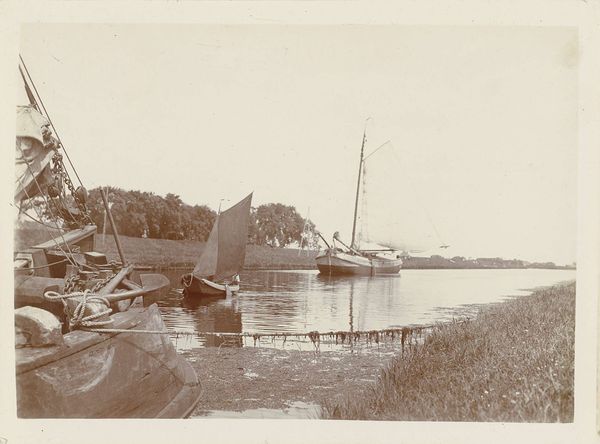
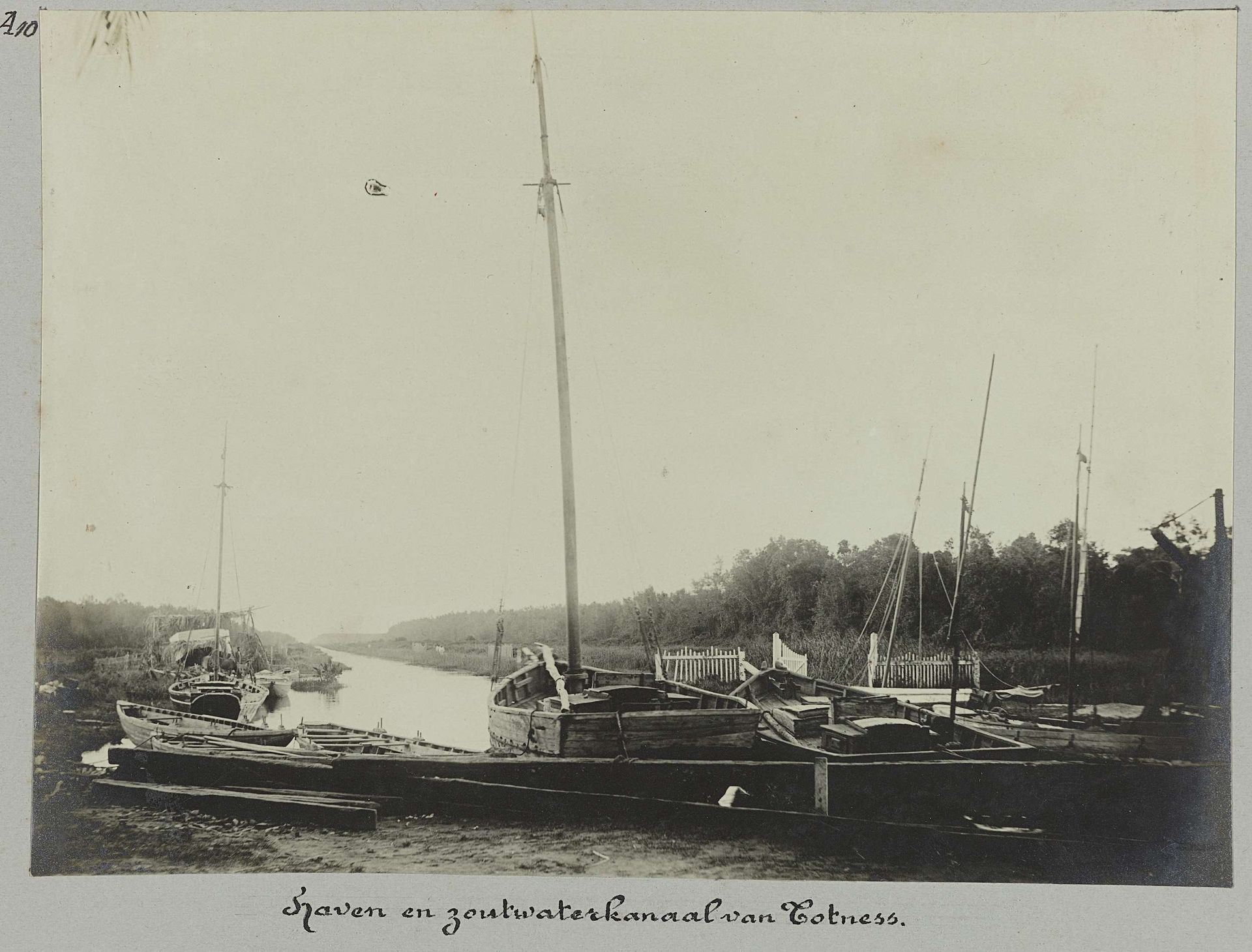
Haven en zoutwaterkanaal van Totness

Listen to curator's interpretation
Curatorial notes
Editor: This is a photograph from somewhere between 1903 and 1910, titled "Haven en zoutwaterkanaal van Totness," or "Harbor and saltwater canal of Totness," by Hendrik Doijer. It features a series of boats, with the canal cutting through the centre. What really stands out to me is the strong diagonal created by the arrangement of boats along the harbor; it creates depth. How do you interpret this composition? Curator: The diagonal is indeed prominent, establishing spatial relationships that guide the eye from the foreground to the hazy distance. Notice how the vertical masts punctuate this horizontal thrust. They introduce a staccato rhythm that interrupts and complicates our reading of space, dividing the composition into distinct planes. It appears almost as a formal experiment, an exploration into pictorial organization and tonal values. Editor: That's a fantastic perspective, talking about how the elements function as parts of the entire work. What effect does the tonality achieve? It seems rather uniform in the midtones. Curator: Precisely! The muted tonality desaturates the scene, directing the viewer’s focus to the arrangement of shapes and lines. What we might consider a ‘lack’ of contrast performs an essential function here, emphasizing the underlying structure and minimizing distraction, the picture plane acting almost as a flattened picture box. How do you feel about that being described as Realism, in terms of style? Editor: That's really insightful! Thinking about it that way, Realism comes across a little too simplistic for what the image accomplishes. The tonal values push it beyond pure representational image making. Thank you for showing me that! Curator: You're most welcome! Analyzing artworks in this manner sharpens our observational abilities and teaches us to recognise and describe an artist’s fundamental decisions in relation to the materiality of the medium.