c. 1835 - 1847
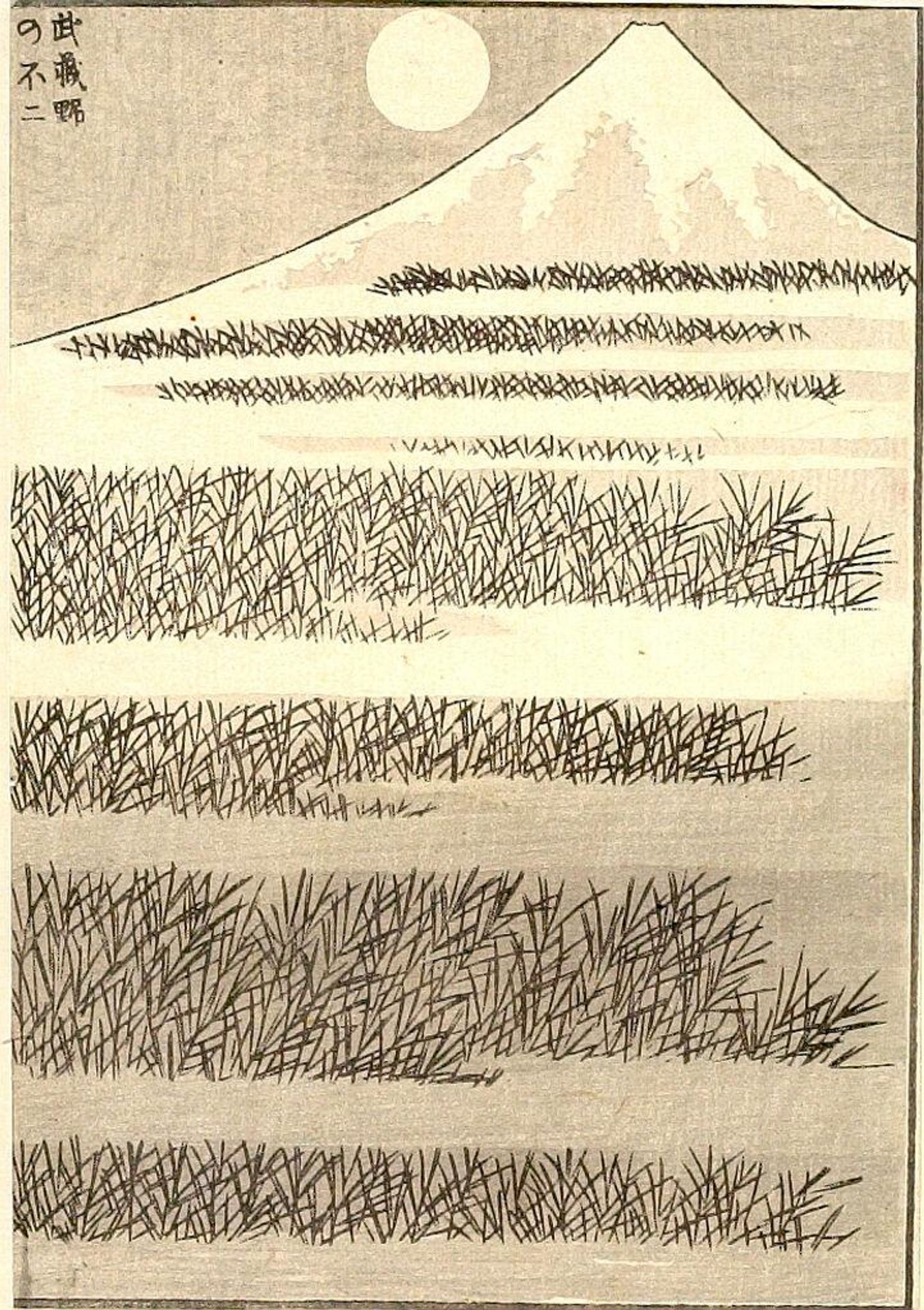
Fuji Seen from Musashino (Musashino no Fuji): Detatched page from One Hundred Views of Mount Fuji (Fugaku hyakkei) Vol. 3


Listen to curator's interpretation
Curatorial notes
Curator: Here we have Hokusai's "Fuji Seen from Musashino," a page from his "One Hundred Views of Mount Fuji." Editor: It has a stark, almost desolate feeling, doesn't it? The repetitive lines of the grass create a powerful sense of isolation. Curator: Yes, but consider Fuji’s symbolic weight. It represents stability and eternity in Japanese culture, a constant in a changing world. Editor: Interesting. The composition is quite simple – mountain, moon, and fields. What I notice is the contrast between the smooth, curving lines of Fuji and the harsh, angular grass. Curator: The stark monochrome emphasizes the enduring presence of Fuji, framed by the transient nature of the landscape. It’s a visual meditation on time and permanence. Editor: I still find it rather bleak, despite the symbolism. Perhaps the lack of color contributes to that. Curator: Perhaps. But it also invites contemplation on the cyclical nature of life, death, and rebirth – themes deeply embedded in Japanese aesthetics. Editor: A different take, indeed. I can definitely see how that reading reveals further layers to the work.