1940
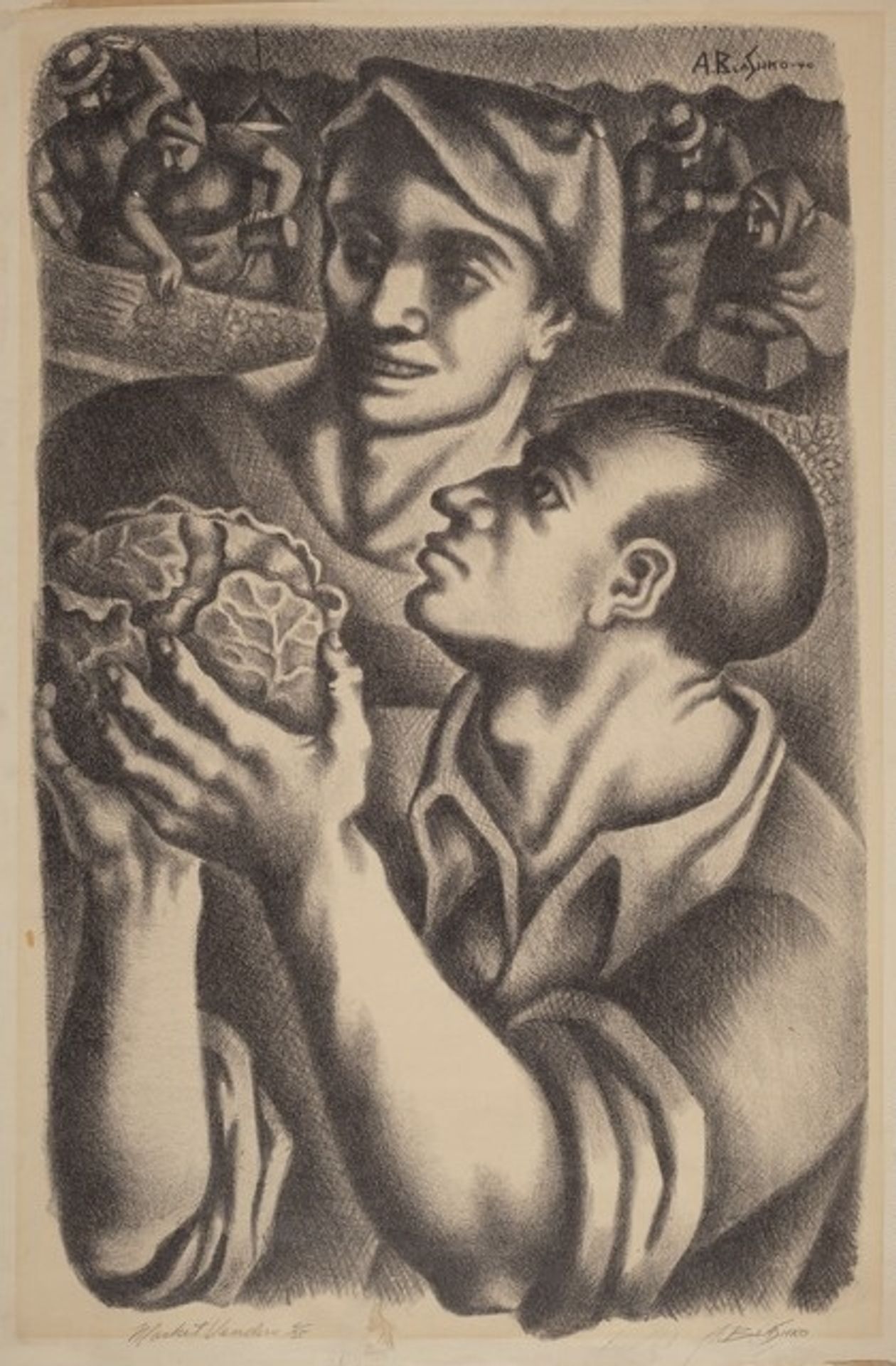
Market Vendors


Listen to curator's interpretation
Curatorial notes
Editor: Here we have Abe Blashko's "Market Vendors," created in 1940, a print employing charcoal and graphite. I'm struck by the composition – the layering of figures and the sharp contrast in light, which gives the scene a sense of gravity. How do you read this piece? Curator: Note how Blashko employs distinct visual planes. The foreground highlights the tactile nature of the vendor holding produce, his upward gaze juxtaposed against the watchful figure looming behind. Observe how the tight handling of the graphite creates a somber mood. Does this contrast contribute to your understanding? Editor: Absolutely, the dark lines amplify the textures, but the formal positioning is curious. The central figure, holding the head of lettuce, seems disconnected from the market activity. Curator: Precisely. We might consider how the artist is structuring a dialogue, or lack thereof, between labor and observation. The lettuce, almost surgically lit, becomes a focal point. Can we read that in terms of value? Consider its form: Does its compact circularity stand in symbolic relation to the background figures? Editor: I hadn't thought about that, but now I see how the forms themselves tell a story. The clustered shapes behind create a sense of communal industry. It suggests an almost diagrammatic layering. The light almost carves each plane out. Curator: Yes. And the textural variations across those planes function as distinct visual signifiers. The interplay of smooth and rough mark-making builds meaning. What have you gained from our formalist investigation? Editor: I appreciate the idea of the contrasting figures symbolizing an observation of labor versus the labour itself, told through lighting, shadow, and how each textural component builds value. Curator: Indeed. Blashko prompts a deeper consideration of social dynamics through the pure articulation of form.