Dimensions: height 289 mm, width 232 mm
Copyright: Rijks Museum: Open Domain
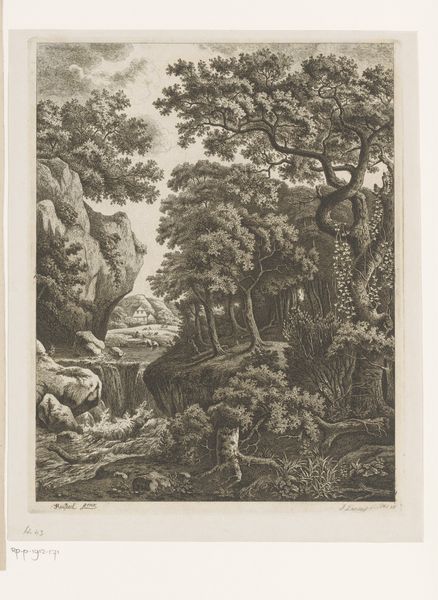
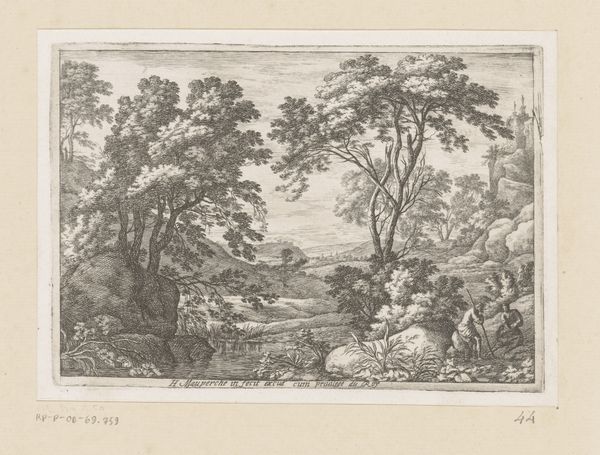
Curator: This etching, dating from 1860, is titled "Landschap met waterval", or "Landscape with Waterfall", by Jean Théodore Joseph Linnig. Editor: It’s immediately striking how intricate the detail is, especially considering it's an etching. There's a sense of depth created by the layering of the forest and the stark contrast with the waterfall. A really peaceful atmosphere comes across too. Curator: Linnig was very interested in Romanticism, and you can definitely see that influence here in the way he idealizes nature, turning an actual landscape into something emotionally heightened. But it’s important to remember that printmaking was also a business. The proliferation of these images helped build a market. Editor: Absolutely, this piece seems designed for a specific type of consumer in mind. I wonder about the socio-economic context. Was it aimed at middle-class homes aspiring to cultivate a sense of refined taste, bringing elements of nature into their newly industrialized spaces through art? Curator: Precisely. The rising bourgeoisie certainly drove much of this demand. And etching was relatively affordable. Notice also how he highlights the textural qualities. You can practically feel the roughness of the rocks, the smoothness of the water, the very paper its printed on, each suggesting different levels of material value and use. Editor: I agree; the composition draws the eye. The small figure of the shepherd and the house in the background create a very nostalgic depiction of pastoral life. Yet the sublime, powerful force of nature, demonstrated through the waterfall, provides a sharp contrast with rural idealism. There's definitely a push-and-pull going on. Curator: I'm curious, too, about the process Linnig used. The quality of line and the subtle tonal variations required significant skill and care. This was not just mass production, but skillful production on a repeatable matrix, adding another layer of value. Editor: Well, by showcasing this type of landscape, printmakers also played a role in defining what “beautiful” meant in their period. They shaped cultural values as much as responding to them. "Landscape with Waterfall" seems emblematic of its time, balancing raw nature and civilized influence. Curator: A lovely point. Seeing this makes you consider not just its production, but how people, places and even politics also shape art making! Editor: It gives you a fresh understanding of art in social context!
Comments
No comments
Be the first to comment and join the conversation on the ultimate creative platform.
 Collect
 React
React Comment
More like this