
Curatorial notes
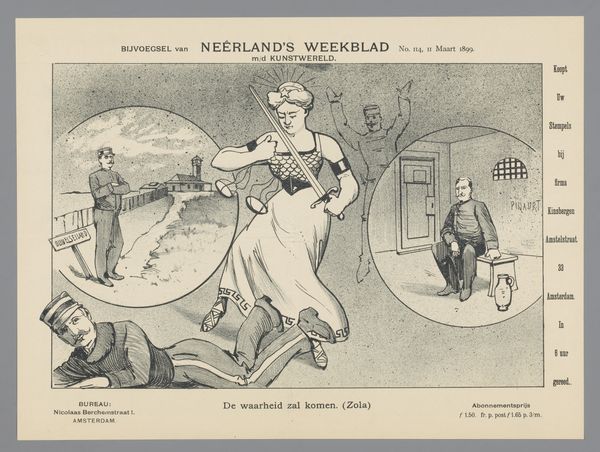
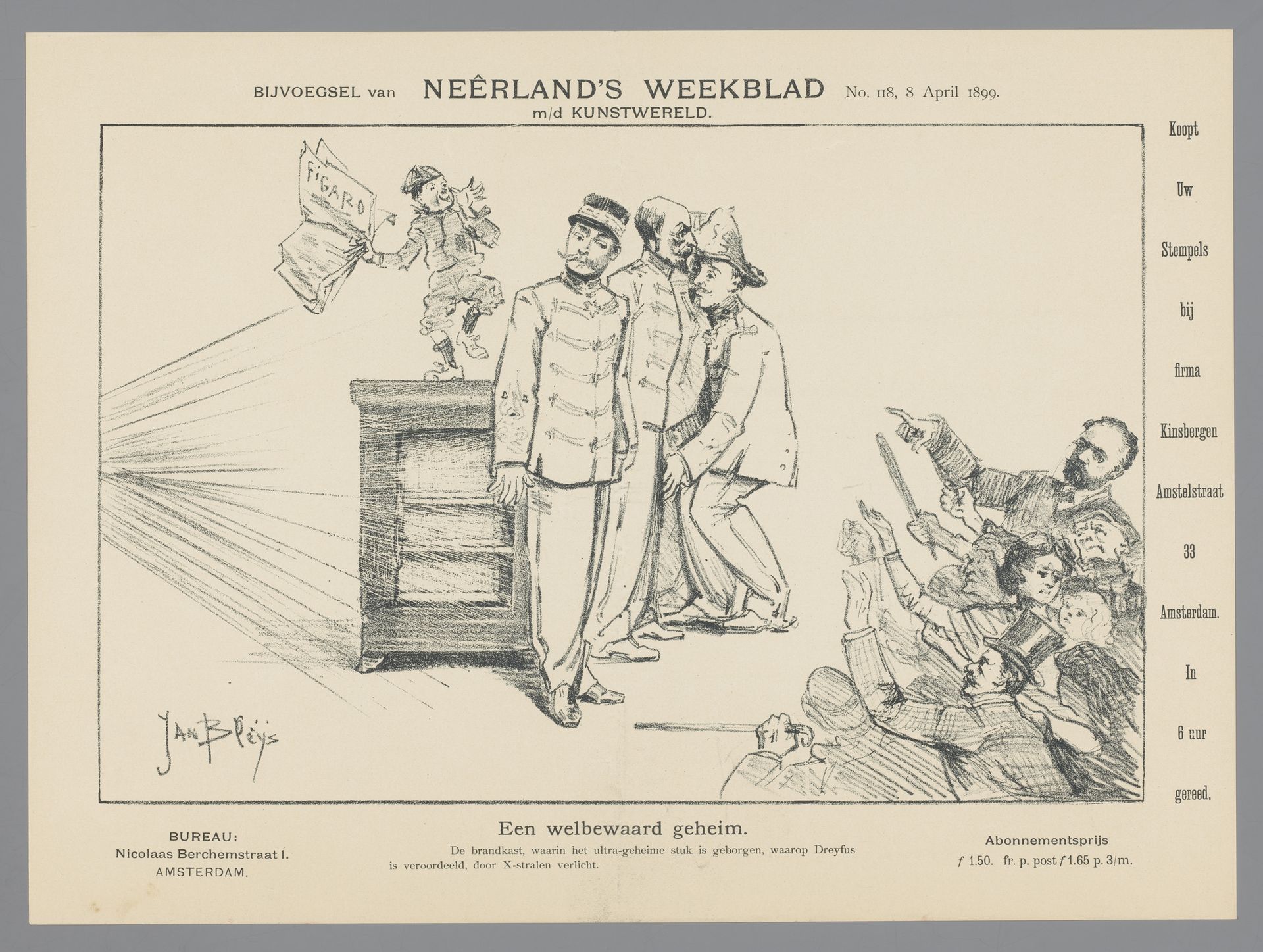
Curator: Welcome. We are looking at "Een welbewaard geheim," or "A Well-Kept Secret," a drawing possibly from 1899 by Jan Bleijs. Editor: It feels theatrical, almost farcical. The frenetic lines convey nervous energy, and the composition, though a simple drawing, is surprisingly dynamic. Curator: Bleijs uses a caricatured style to depict a scene with several figures. On the left, we see a cabinet, emitting rays of light. A small figure, perched on top, waves a newspaper, "Figaro". In the center stand three figures in uniform, and on the right, a crowd gestures excitedly. Editor: The cabinet is clearly the focal point. Radiating light typically represents knowledge or revelation, right? But the small figure gleefully waving the news introduces an element of public spectacle. It appears there's something exposed—or perhaps revealed prematurely. The characters and caricature gives a reference to the Dreyfus affair. Curator: Precisely. The imagery suggests the unearthing of a secret, alluded to in the caption under the picture "De brandkast, waarin het ultra-geheime stuk is geborgen, waarop Dreyfus is veroordeeld, door X-stralen verlicht." This translates to 'The safe, in which the ultra-secret document is kept, on which Dreyfus was convicted, illuminated by X-rays'. The X-rays would've been quite a novelty at the time. Editor: So the image becomes a satirical commentary on the Dreyfus Affair, using symbols like the revealed secret and the excited crowd to critique the atmosphere surrounding the controversial trial. The Dreyfus Affair roiled French society; this imagery offers a strong socio-political undertone within the image's formal arrangement. Curator: It's a clever encapsulation of public opinion and political machinations. Beyond the surface-level narrative, Bleijs employs art nouveau stylistics with curving forms to enhance the frenzied emotions displayed within this seemingly small drawing on paper. The ink's immediacy certainly amplifies that sense of urgency, don't you think? Editor: Absolutely. Looking at the overall organization and symbolism, I am more intrigued now. Its formal features enhance a deeper comprehension, enriching my interpretation as a narrative and cultural document. Curator: Indeed, examining "Een welbewaard geheim" through these lenses provides a fuller understanding of the drawing's intricate structure, composition, and embedded significance.