About this artwork
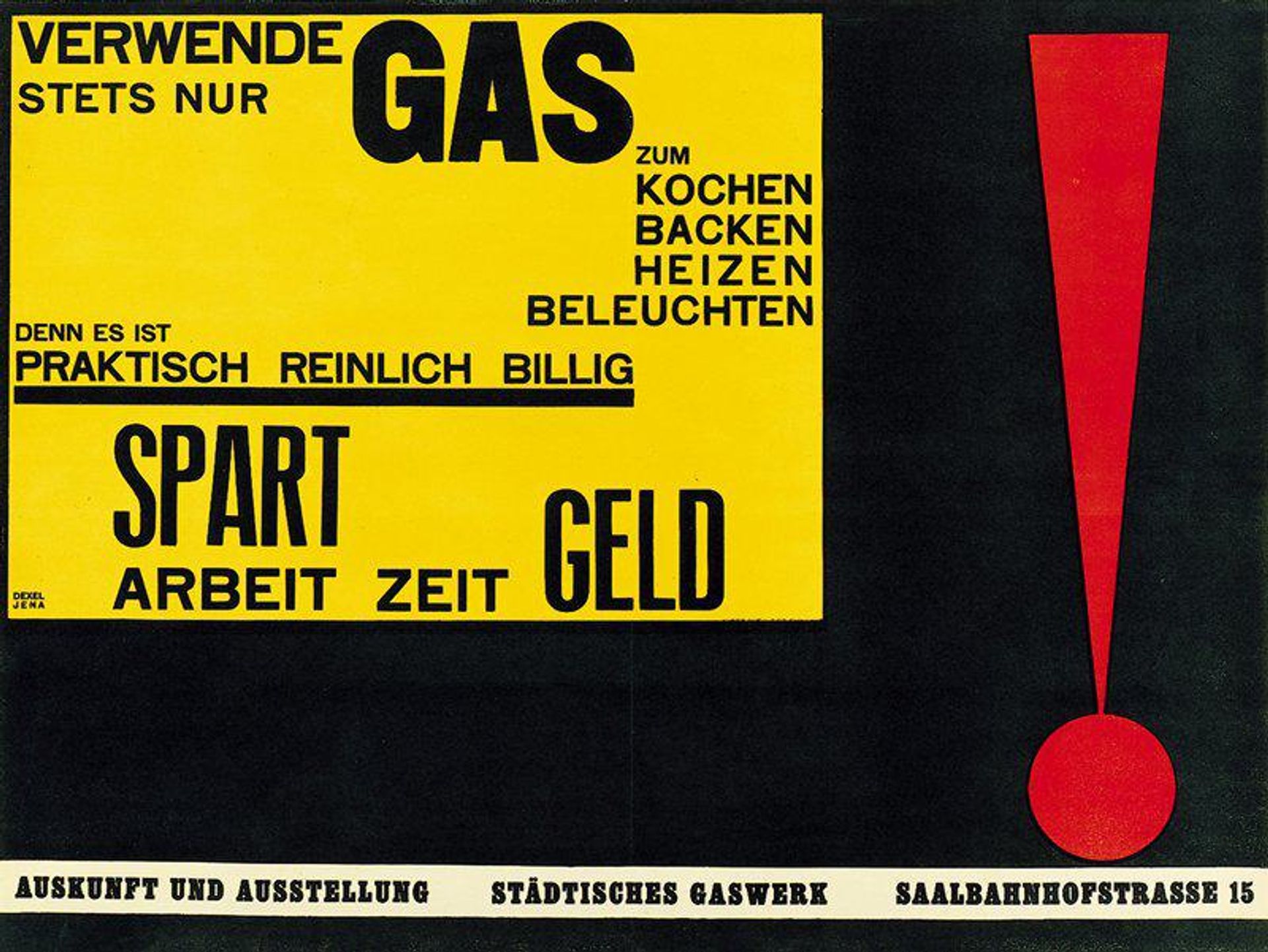
Walter Dexel made this print, Verwende stets nur Gas, with lithographic ink on paper. It’s hard to say exactly when, but he was doing a lot of this kind of work in the 20s. Look at that incredible yellow rectangle, so bright and flat, floating in the black void. It’s like a stage set, or a sign, which, of course, it is. The lettering is so bold, so declarative: “Always use gas.” I love how the message is both commercial and somehow… cosmic. The red exclamation mark is a total power move; a vertical line pointing downwards to a kind of full stop. It's so simple but also so full of urgency. Like a warning, or a celebration? You can see echoes of the Bauhaus here, and maybe a little bit of Russian Constructivism, but Dexel has a thing of his own. It's this particular combination of stark geometry and something… else. Like a feeling. You see it in El Lissitzky too, who he knew. Art’s just one big conversation anyway, right? And this piece is a pretty loud statement.
Verwende stets nur Gas 1924


Artwork details
- Medium
- graphic-art, print, typography, poster
- Dimensions
- 20 1/4 x 26 1/2 in. (51.4 x 67.3 cm) (sheet)27 1/4 x 33 in. (69.22 x 83.82 cm) (outer frame)
- Location
- Minneapolis Institute of Art
- Copyright
- No Known Copyright
Tags
sport poster
art-deco
graphic-art
poster art
film poster
typography
geometric
event poster
poster
modernism
poster
Comments
No comments
About this artwork
Walter Dexel made this print, Verwende stets nur Gas, with lithographic ink on paper. It’s hard to say exactly when, but he was doing a lot of this kind of work in the 20s. Look at that incredible yellow rectangle, so bright and flat, floating in the black void. It’s like a stage set, or a sign, which, of course, it is. The lettering is so bold, so declarative: “Always use gas.” I love how the message is both commercial and somehow… cosmic. The red exclamation mark is a total power move; a vertical line pointing downwards to a kind of full stop. It's so simple but also so full of urgency. Like a warning, or a celebration? You can see echoes of the Bauhaus here, and maybe a little bit of Russian Constructivism, but Dexel has a thing of his own. It's this particular combination of stark geometry and something… else. Like a feeling. You see it in El Lissitzky too, who he knew. Art’s just one big conversation anyway, right? And this piece is a pretty loud statement.
Comments
No comments