Saule Pleureur Imperiale with hidden silhouettes of Napoleon and his family 1830 - 1850
0:00
0:00


drawing, print, engraving
#
portrait
#
tree
#
drawing
#
neoclacissism
# print
#
old engraving style
#
landscape
#
men
#
cityscape
#
history-painting
#
engraving
Dimensions: Sheet: 9 5/16 × 10 7/8 in. (23.6 × 27.7 cm)
Copyright: Public Domain
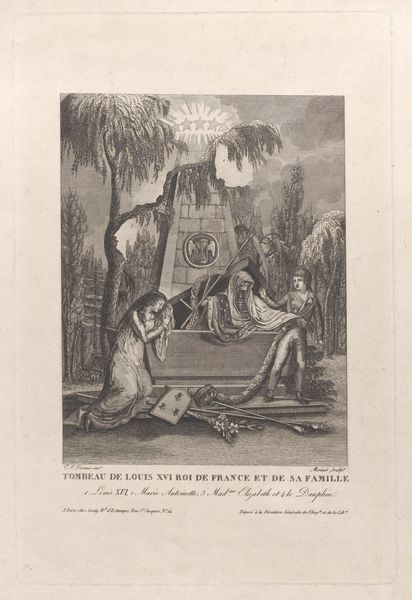
Curator: What strikes you first about this engraving, this "Saule Pleureur Imperial with hidden silhouettes of Napoleon and his family"? It’s dated somewhere between 1830 and 1850. Editor: Oh, instantly? Melancholy. That weeping willow—or *saule pleureur*, rather—drapes such a curtain of sorrow. And all that pale grey, like a faded memory clinging to the page. Is it supposed to be a memorial? Curator: Exactly. It’s laden with coded imagery. Notice the prominent 'N' crowned with a royal diadem on the urn—and if you look closer, hidden faces nestled in the tree's foliage—the silhouettes of Napoleon and his family. The artist utilizes the willow tree as a well-known symbol of mourning and sorrow. Editor: Sneaky, like whispering sedition. Makes you wonder who this artist *was*. Did they admire him, did they hate him? Also, on a purely visual level, that cloudscape teeming with figures almost steals the show. It has an hallucinatory, dramatic feeling. Curator: It's fascinating, isn't it? The composition cleverly utilizes classical elements—an almost Neoclassical clarity. The distant buildings contribute to that serene background…The artist juxtaposes these elements, creating a scene both grand and subtly subversive. He’s manipulating recognizable imagery to express pro-Bonapartist sentiments during a period of strict censorship. Editor: It's an incredibly detailed historical document, as if piecing together forgotten fragments, like trying to read a lost soul’s diary. How would the viewers in those days interpreted such symbols? Did the authorities even try to repress it? Curator: The success of hiding these meanings largely determined the life span and the popularity of such engravings during that era. People fluent in the Napoleonic symbols would read these works with knowing eyes. It helped in keeping the flame of Napoleonic legacy alive in times of great repression after his fall. Editor: Definitely powerful, how artists and even common folk created entire worlds with subversive and revolutionary art. It serves as an art form born of repression, yet overflowing with deep emotional undercurrents. Curator: Absolutely, it reveals the endurance of symbols to hold memories when the direct expression is restricted.
Comments
No comments
Be the first to comment and join the conversation on the ultimate creative platform.
 Collect
 React
React Comment
More like this