About this artwork
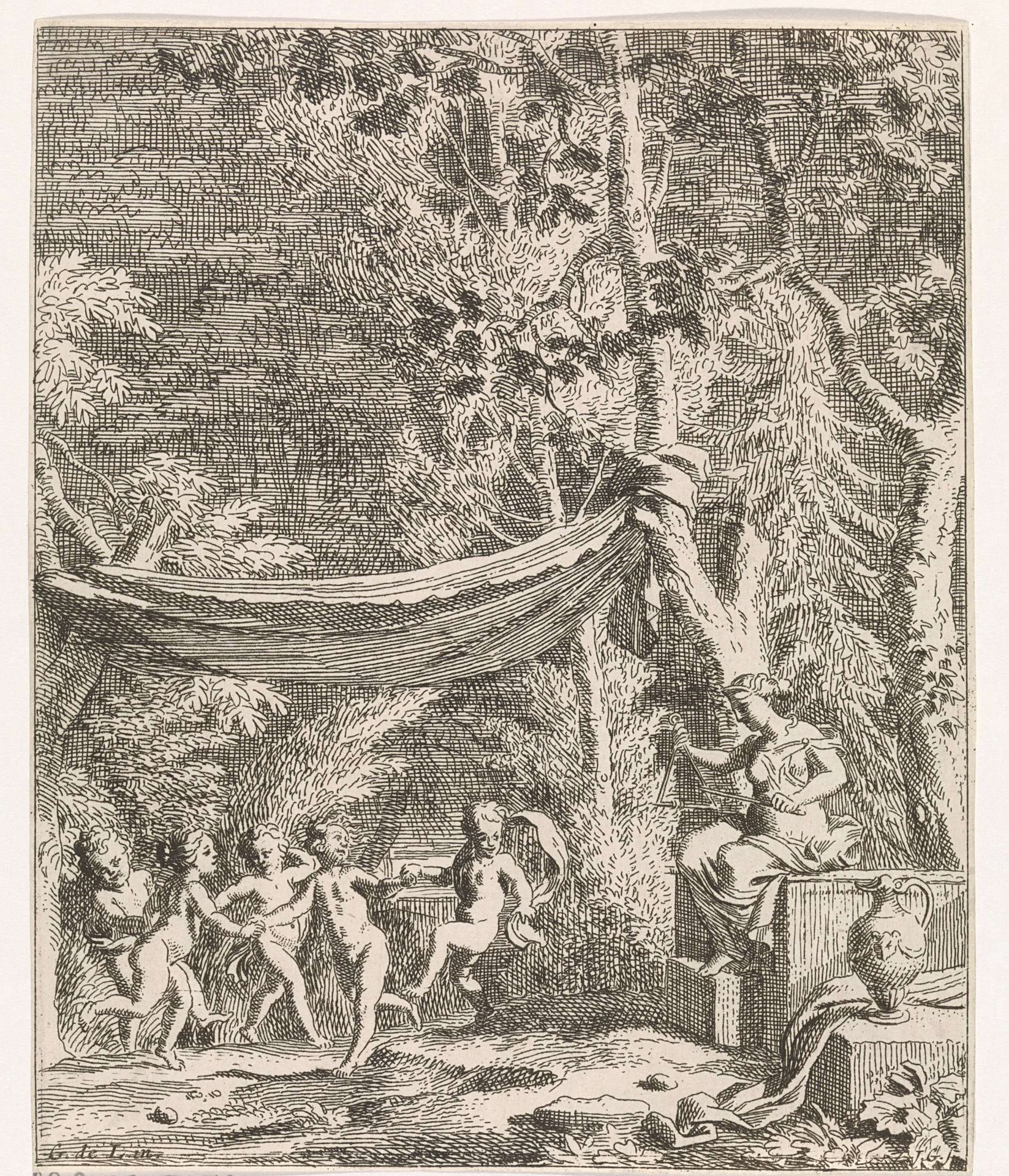
Johannes Glauber etched this whimsical scene, "Five Putti Dancing to the Music of a Triangle," capturing a moment of playful abandon. The putti, or cherubic children, dance in a circle, guided by the music. The dance itself is a motif laden with meaning. From ancient fertility rites to Renaissance celebrations, circling dances evoke unity and cyclical rhythms of life. The triangle, though simple, represents harmony and divine proportions, concepts revered since Pythagoras. Observe how the seated female figure, perhaps a muse or goddess, oversees the revelry. This echoes the classical motif of divine spectatorship, reminiscent of Bacchus and his entourage. The putti, pagan symbols, dancing in a circle of life under the instruction of a higher power, present a synthesis of traditions and beliefs that invite us to explore the subconscious symbols of a collective memory, revealing how deeply embedded these echoes are in our cultural psyche.

Artwork details
- Medium
- print, engraving
- Dimensions
- width 140 mm, height 170 mm
- Copyright
- Rijks Museum: Open Domain
Tags
Comments
Share your thoughts
About this artwork
Johannes Glauber etched this whimsical scene, "Five Putti Dancing to the Music of a Triangle," capturing a moment of playful abandon. The putti, or cherubic children, dance in a circle, guided by the music. The dance itself is a motif laden with meaning. From ancient fertility rites to Renaissance celebrations, circling dances evoke unity and cyclical rhythms of life. The triangle, though simple, represents harmony and divine proportions, concepts revered since Pythagoras. Observe how the seated female figure, perhaps a muse or goddess, oversees the revelry. This echoes the classical motif of divine spectatorship, reminiscent of Bacchus and his entourage. The putti, pagan symbols, dancing in a circle of life under the instruction of a higher power, present a synthesis of traditions and beliefs that invite us to explore the subconscious symbols of a collective memory, revealing how deeply embedded these echoes are in our cultural psyche.
Comments
Share your thoughts