About this artwork
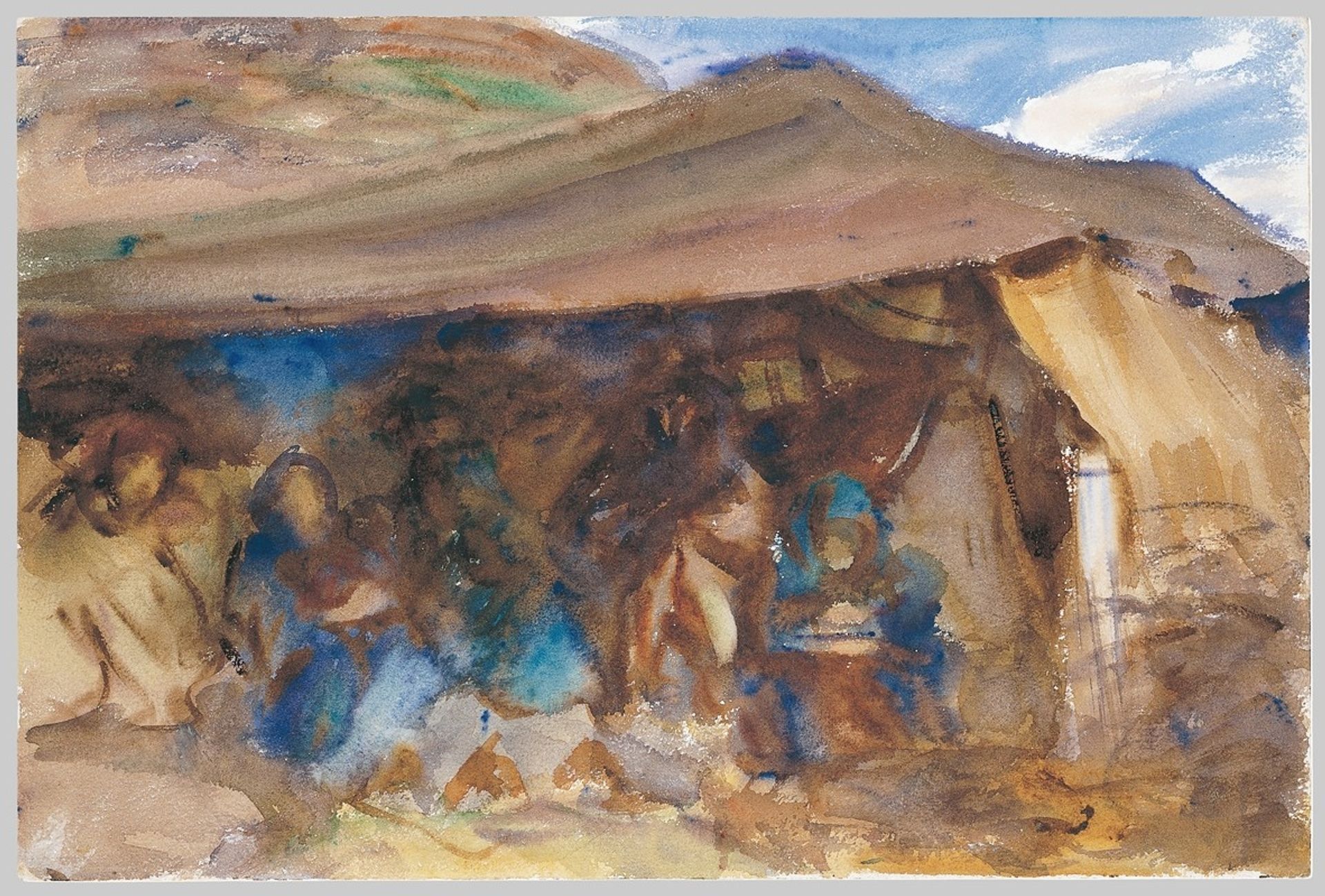
Curator: This evocative watercolor, entitled "Bedouin Tent", was rendered by John Singer Sargent around 1905 or 1906. Notice the fluid brushstrokes and luminous washes that typify his impressionistic style. Editor: It strikes me immediately as a study in contrasts—the vast, sun-drenched exterior versus the cool, dim interior of the tent. It feels both intimate and expansive, if that makes sense. Curator: It does. The formal composition relies heavily on this juxtaposition. The tent’s rough canvas and the figures within form a kind of proscenium arch. It neatly frames and contains the subject. Editor: The material aspect is significant here. Watercolour suggests a certain immediacy and portability. It tells a tale about travel, documentation and a direct engagement with place. Curator: Absolutely. One sees how the materiality of the pigments interacts with the light filtering through the tent’s fabric—rendering both form and a pervasive atmosphere. The canvas breathes and absorbs the tones. Editor: It also says something about access and privilege, doesn’t it? The availability of paints, paper, the leisure to travel. The means to transform a scene into art is not equally distributed. Curator: Yes, certainly. This brings to bear the very nature of impressionism as a construction itself, with the rapid notations implying objective truth but bearing inherent markers of cultural and economic status. What seems effortless belies the conditions which made that freedom possible. Editor: Indeed. Even the genre aspects play with tensions – East and West meet in portable materials that document these figures as if for record while, at the same time, hinting at an informal social engagement. Curator: Precisely. It leaves us to consider that very intersection and that of observation and participation in understanding its semiotic language. Editor: A brief window onto both a constructed scene and the complex mechanics of its depiction— intriguing. Curator: And now an impression made tangible via materiality, viewed in yet another setting! The layers add depth.

Artwork details
- Copyright
- Public Domain: Artvee
Comments
No comments
About this artwork
Curator: This evocative watercolor, entitled "Bedouin Tent", was rendered by John Singer Sargent around 1905 or 1906. Notice the fluid brushstrokes and luminous washes that typify his impressionistic style. Editor: It strikes me immediately as a study in contrasts—the vast, sun-drenched exterior versus the cool, dim interior of the tent. It feels both intimate and expansive, if that makes sense. Curator: It does. The formal composition relies heavily on this juxtaposition. The tent’s rough canvas and the figures within form a kind of proscenium arch. It neatly frames and contains the subject. Editor: The material aspect is significant here. Watercolour suggests a certain immediacy and portability. It tells a tale about travel, documentation and a direct engagement with place. Curator: Absolutely. One sees how the materiality of the pigments interacts with the light filtering through the tent’s fabric—rendering both form and a pervasive atmosphere. The canvas breathes and absorbs the tones. Editor: It also says something about access and privilege, doesn’t it? The availability of paints, paper, the leisure to travel. The means to transform a scene into art is not equally distributed. Curator: Yes, certainly. This brings to bear the very nature of impressionism as a construction itself, with the rapid notations implying objective truth but bearing inherent markers of cultural and economic status. What seems effortless belies the conditions which made that freedom possible. Editor: Indeed. Even the genre aspects play with tensions – East and West meet in portable materials that document these figures as if for record while, at the same time, hinting at an informal social engagement. Curator: Precisely. It leaves us to consider that very intersection and that of observation and participation in understanding its semiotic language. Editor: A brief window onto both a constructed scene and the complex mechanics of its depiction— intriguing. Curator: And now an impression made tangible via materiality, viewed in yet another setting! The layers add depth.
Comments
No comments