print, woodcut
#
medieval
# print
#
pen illustration
#
landscape
#
figuration
#
woodcut
#
line
#
history-painting
#
northern-renaissance
Dimensions: height 235 mm, width 210 mm
Copyright: Rijks Museum: Open Domain
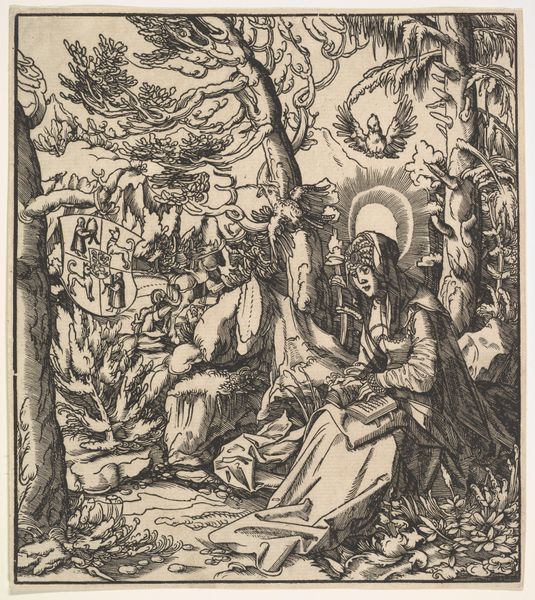
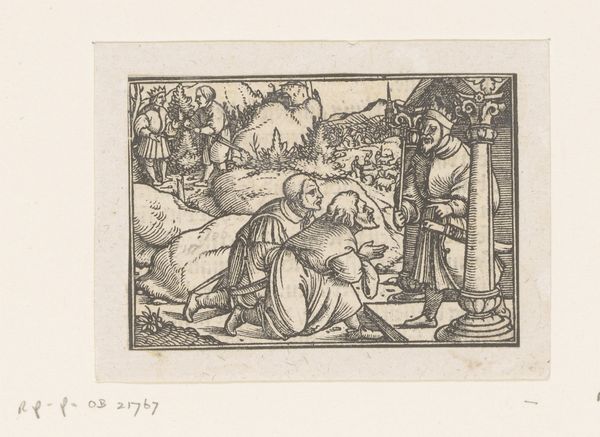
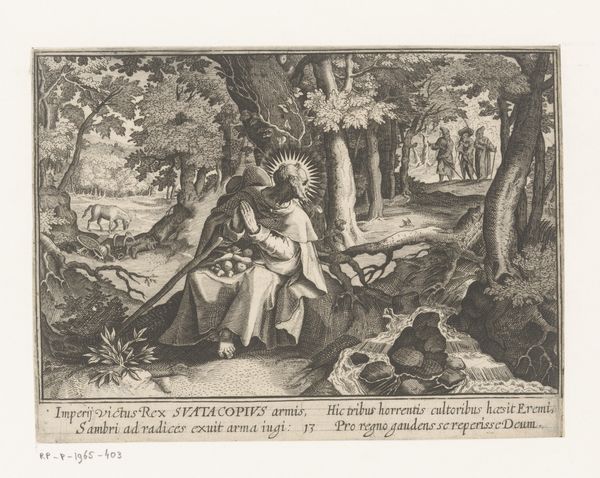
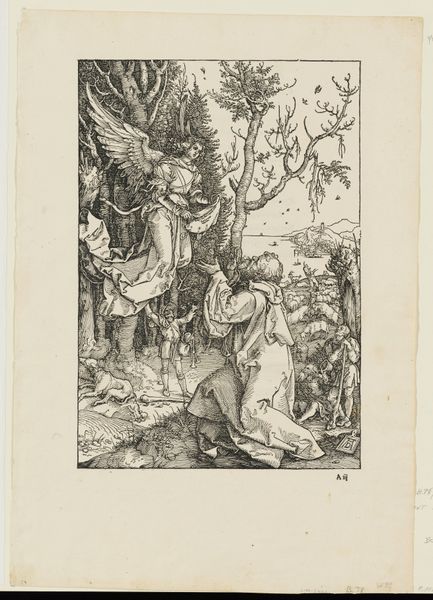
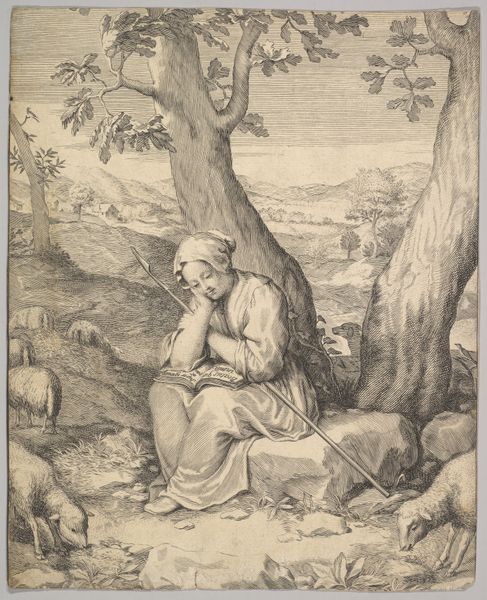
Editor: This is *Heilige Wendelinus*, or Saint Wendelin, a woodcut by Cornelis Liefrinck created between 1516 and 1518. The level of detail achieved through what appears to be exclusively lines is striking. It almost looks like pen illustration. What story do you think Liefrinck is trying to tell? Curator: Ah, yes, Wendelin! The patron saint of shepherds. Look at him there, amongst the trees with his flock – and his very chill looking dog. To me, it's more than just a story, but an idealized vision, a return to simplicity in a world rapidly changing, perhaps even a touch of that back-to-nature sentiment we all wrestle with when the Wi-Fi gets spotty. See how neatly the details are etched? It's less about photographic realism and more about conveying a sense of ordered tranquility. Almost like a very complex doodle, wouldn't you agree? What does it evoke for *you*? Editor: I see your point! The tranquility does emanate strongly now that you mention the idealized aspect. Also, the shield seems quite strategically placed, doesn’t it? It appears as though Liefrinck really wants us to remember that the saint comes from nobility. Curator: Exactly! And think about it, the Northern Renaissance loved contrasting such simple scenes against the trappings of court. But there's something innately relatable to Saint Wendelin that speaks to humanity across time, wouldn't you say? That gentle shepherd who communes with animals is as much a hero of yesteryear as he could be of today. Editor: This has given me so much more to think about. I definitely wasn’t picking up on that contrast. Curator: Well, to paraphrase the good saint – there’s always something new to discover when you take the path less trod.
Comments
No comments
Be the first to comment and join the conversation on the ultimate creative platform.
 Collect
 React
React Comment
More like this