About this artwork
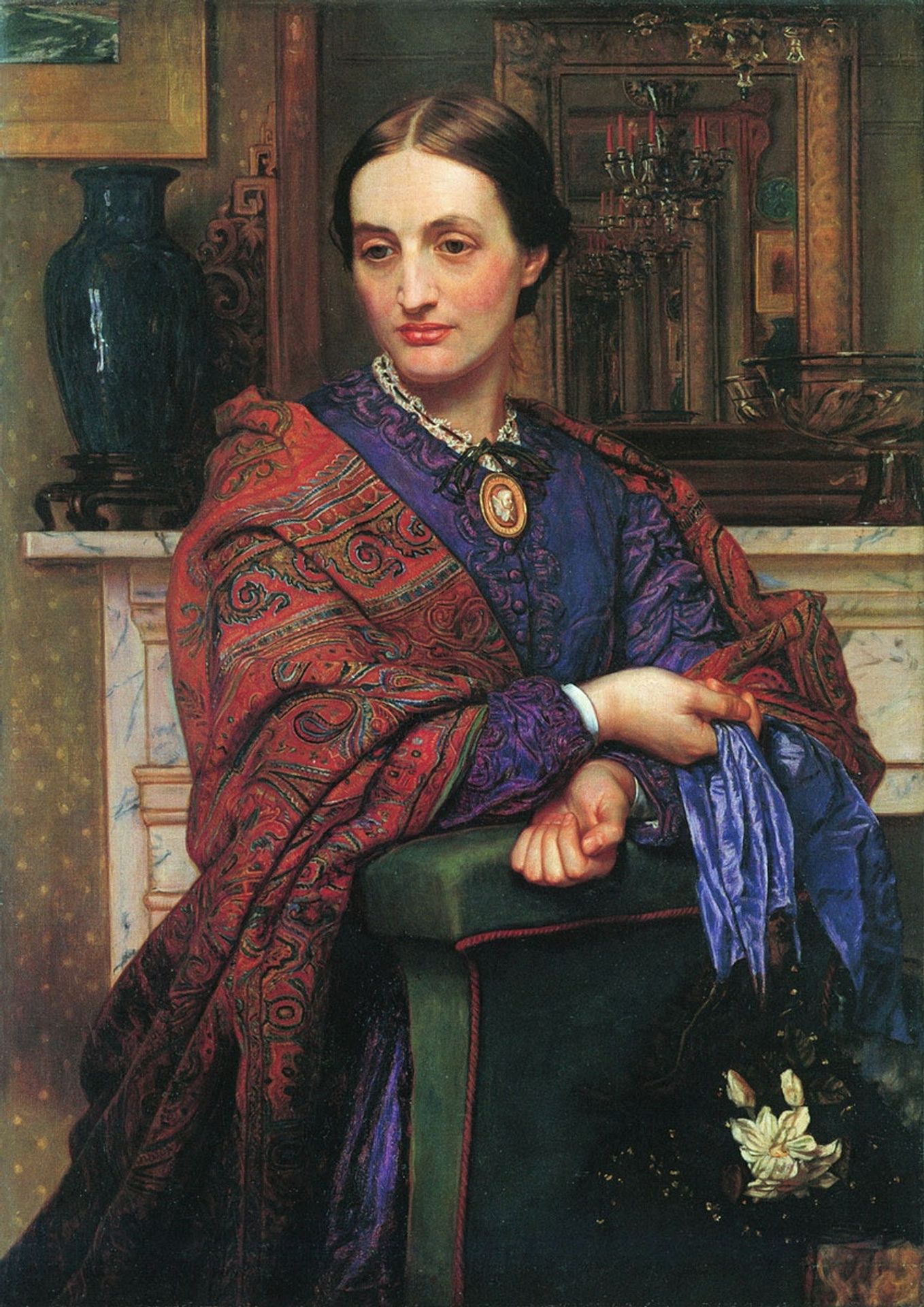
Editor: We’re looking at William Holman Hunt’s "Portrait of Fanny Holman Hunt," created in 1868 with oil paint. It's quite a detailed painting, and there's a sort of melancholic feeling to it. How do you interpret this work, especially given Hunt's ties to the Pre-Raphaelites? Curator: What immediately strikes me is the layered symbolism, a hallmark of Pre-Raphaelite art. The paisley shawl, for instance, would have been recognized as a symbol of worldly travel and exoticism, perhaps referencing a broader colonial context and Victorian-era fascination with the ‘Orient.’ Editor: Oh, I didn't realize paisley had such specific connotations. Curator: Indeed. And consider the cameo she wears. It's an image within an image, referencing classical antiquity and a sort of timeless ideal of beauty. Note also the flowers - those tiny, precious details placed on the armrest, just beyond her hands... what might they suggest? Editor: Perhaps, a symbol of fragility or a fleeting moment? Given the painting's somber tone. Curator: Precisely! Flowers often function as memento mori, a reminder of mortality. All of this symbolism, woven together, speaks to a cultural memory of beauty, loss, and a yearning for something beyond the everyday. Does knowing this change how you view the portrait? Editor: Definitely. It's more than just a pretty face; it’s a window into Victorian society and its values. I see a new layer of complexity in it. Curator: The artist gives us clues that we need to actively decipher. This type of iconography allows a deeper understanding, not just of the artist’s intent, but also of the world he was painting for. Editor: I will never look at a shawl the same way again. Thanks so much for pointing all of this out.

Artwork details
- Dimensions
- 73.5 x 106.5 cm
- Location
- Private Collection
- Copyright
- Public domain
Comments
No comments
About this artwork
Editor: We’re looking at William Holman Hunt’s "Portrait of Fanny Holman Hunt," created in 1868 with oil paint. It's quite a detailed painting, and there's a sort of melancholic feeling to it. How do you interpret this work, especially given Hunt's ties to the Pre-Raphaelites? Curator: What immediately strikes me is the layered symbolism, a hallmark of Pre-Raphaelite art. The paisley shawl, for instance, would have been recognized as a symbol of worldly travel and exoticism, perhaps referencing a broader colonial context and Victorian-era fascination with the ‘Orient.’ Editor: Oh, I didn't realize paisley had such specific connotations. Curator: Indeed. And consider the cameo she wears. It's an image within an image, referencing classical antiquity and a sort of timeless ideal of beauty. Note also the flowers - those tiny, precious details placed on the armrest, just beyond her hands... what might they suggest? Editor: Perhaps, a symbol of fragility or a fleeting moment? Given the painting's somber tone. Curator: Precisely! Flowers often function as memento mori, a reminder of mortality. All of this symbolism, woven together, speaks to a cultural memory of beauty, loss, and a yearning for something beyond the everyday. Does knowing this change how you view the portrait? Editor: Definitely. It's more than just a pretty face; it’s a window into Victorian society and its values. I see a new layer of complexity in it. Curator: The artist gives us clues that we need to actively decipher. This type of iconography allows a deeper understanding, not just of the artist’s intent, but also of the world he was painting for. Editor: I will never look at a shawl the same way again. Thanks so much for pointing all of this out.
Comments
No comments