About this artwork
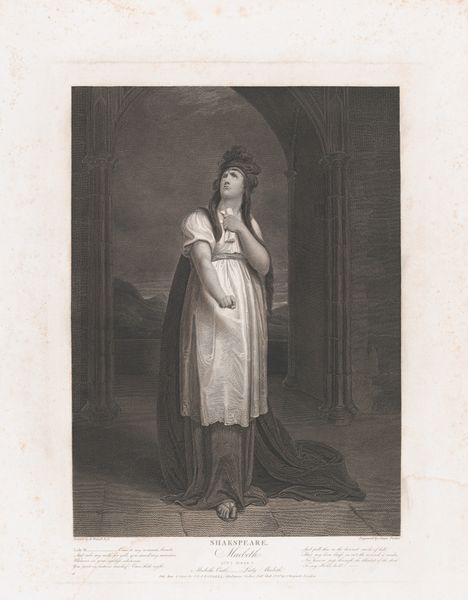
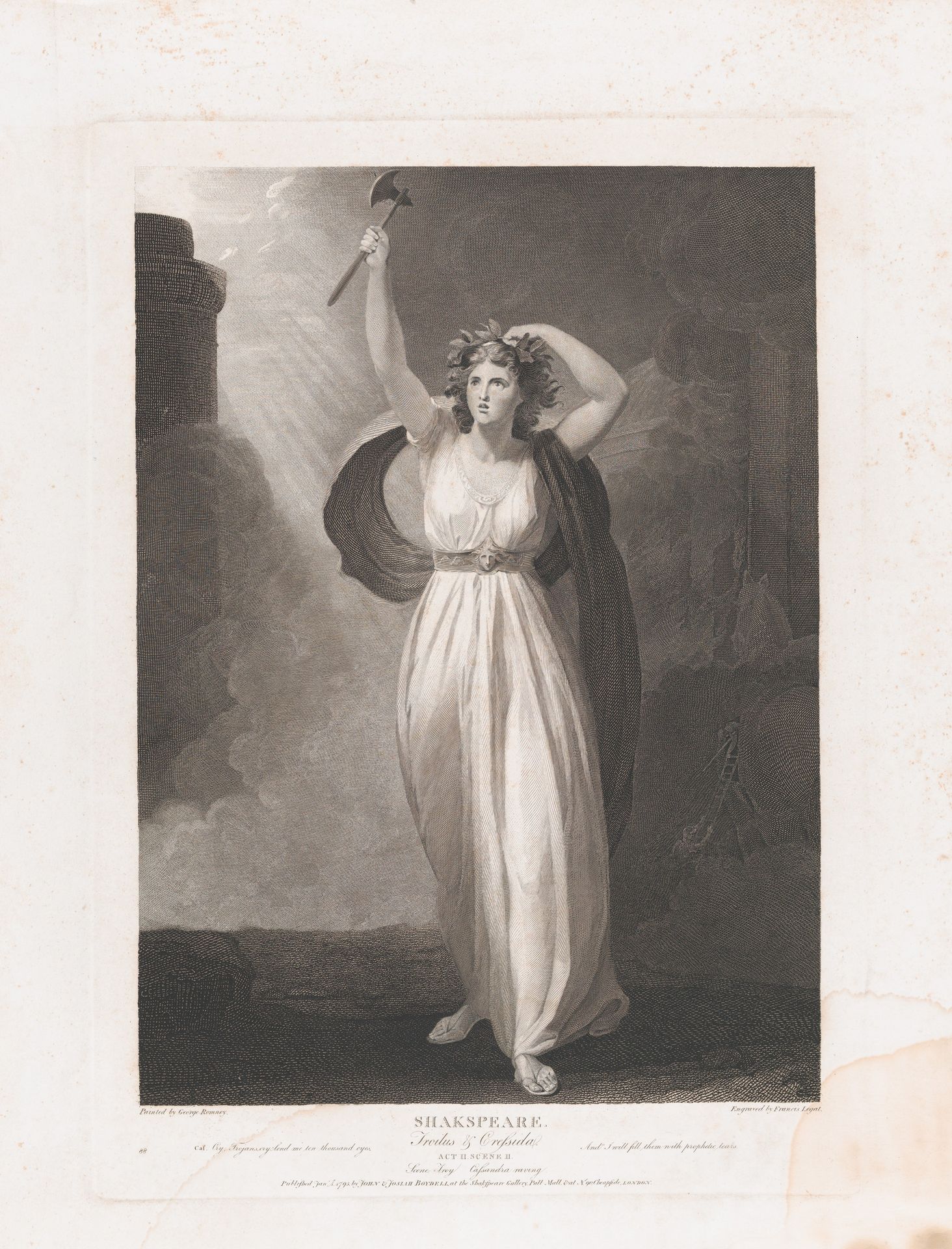
Editor: Here we have Francis Legat's engraving, "Cassandra Raving" from 1795-1852, illustrating Shakespeare's "Troilus and Cressida." The figure of Cassandra is so striking; her pose is dramatic, yet her expression feels almost vacant. How do you interpret this work? Curator: This engraving, situated within Neoclassicism, provides a powerful lens through which to view the silencing of marginalized voices. Cassandra, the prophetess cursed to be disbelieved, becomes a potent symbol. Consider the context: late 18th century, burgeoning patriarchal structures. How does Legat visually represent Cassandra's powerlessness despite her knowledge? Is she truly raving, or is this a portrayal of a woman whose truth is simply unwelcome? Editor: I hadn’t thought of it that way. The classical style initially made me think of grand narratives and heroism, not powerlessness. Is that why she holds the axe? As a rejected symbol? Curator: Precisely! What does it mean to wield a weapon and still be powerless? To hold the tools of destruction while being unable to change the course of events? Look at her drapery, clinging yet restrictive; this creates a tension. In considering this, are we also examining how women’s knowledge and insights are dismissed in favor of male authority? Editor: That really changes my perspective. So, her supposed madness is perhaps a reflection of societal unwillingness to listen to marginalized perspectives? Curator: Exactly. Legat's "Cassandra Raving" challenges us to examine not just the individual, but the system that silences her. The art asks that we give value to experiences discounted as 'mad.' Editor: I’m glad you pointed that out; I was really stuck on the classicism, the aesthetic of it all. This engraving pushes past appearances to say much more! Curator: And hopefully, this discussion reminds us to continually question dominant narratives within both historical and contemporary contexts.
Cassandra Raving (Shakespeare, Troilus and Cressida, Act 2, Scene 2)
1795 - 1852


Artwork details
- Medium
- drawing, print, engraving
- Dimensions
- Plate: 22 9/16 × 16 1/16 in. (57.3 × 40.8 cm) Sheet: 27 13/16 × 21 15/16 in. (70.7 × 55.8 cm)
- Location
- Metropolitan Museum of Art, New York, NY
- Copyright
- Public Domain
Tags
Comments
Share your thoughts
About this artwork
Editor: Here we have Francis Legat's engraving, "Cassandra Raving" from 1795-1852, illustrating Shakespeare's "Troilus and Cressida." The figure of Cassandra is so striking; her pose is dramatic, yet her expression feels almost vacant. How do you interpret this work? Curator: This engraving, situated within Neoclassicism, provides a powerful lens through which to view the silencing of marginalized voices. Cassandra, the prophetess cursed to be disbelieved, becomes a potent symbol. Consider the context: late 18th century, burgeoning patriarchal structures. How does Legat visually represent Cassandra's powerlessness despite her knowledge? Is she truly raving, or is this a portrayal of a woman whose truth is simply unwelcome? Editor: I hadn’t thought of it that way. The classical style initially made me think of grand narratives and heroism, not powerlessness. Is that why she holds the axe? As a rejected symbol? Curator: Precisely! What does it mean to wield a weapon and still be powerless? To hold the tools of destruction while being unable to change the course of events? Look at her drapery, clinging yet restrictive; this creates a tension. In considering this, are we also examining how women’s knowledge and insights are dismissed in favor of male authority? Editor: That really changes my perspective. So, her supposed madness is perhaps a reflection of societal unwillingness to listen to marginalized perspectives? Curator: Exactly. Legat's "Cassandra Raving" challenges us to examine not just the individual, but the system that silences her. The art asks that we give value to experiences discounted as 'mad.' Editor: I’m glad you pointed that out; I was really stuck on the classicism, the aesthetic of it all. This engraving pushes past appearances to say much more! Curator: And hopefully, this discussion reminds us to continually question dominant narratives within both historical and contemporary contexts.
Comments
Share your thoughts