1614
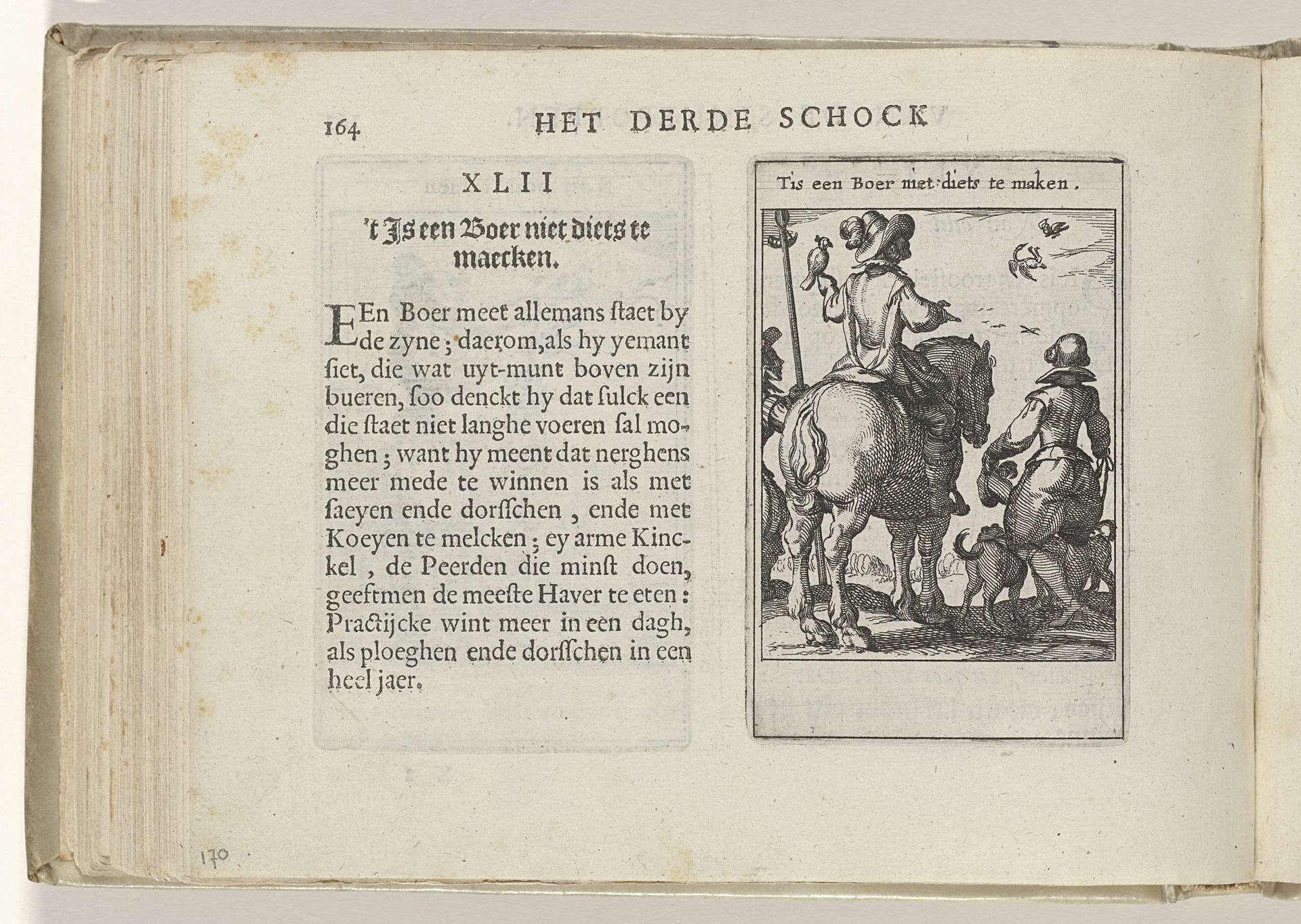
XLII Tis een Boer niet diets te maken

Roemer Visscher
1547 - 1620Location
RijksmuseumListen to curator's interpretation
Curatorial notes
Curator: Here we have a print from 1614, entitled “XLII ‘Tis een Boer niet diets te maken’,” currently held at the Rijksmuseum. It's an engraving by Roemer Visscher. Editor: It strikes me as a sort of sardonic rural tableau—like a slice of life seen through a rather jaundiced lens. Everything's a little bit askew, don't you think? A touch… mocking? Curator: Indeed. The composition follows a distinctly Baroque structure, though pared down to the stark contrast only afforded by the engraving medium. The subjects are framed almost as though arranged for the stage. Note the balanced disposition of figures around the central equestrian. Editor: That central figure… Is he meant to be the ‘Boer’—the farmer—of the title? Perched on that horse, bird on his wrist like some nobleman… But there's a clumsy heaviness to him, even from the back. And that little dog yapping at the other figure’s heels feels more like an annoyance than affection. Curator: Consider the deliberate contrasts Visscher sets in motion. The print medium itself, allowing for wide circulation of this visual 'proverb' to reach a broader audience. It encapsulates both genre painting through its depiction of daily life, while utilizing the narrative structure found commonly across different schools. Editor: So, he's commenting on… well, what exactly? The pretensions of the working class? Or perhaps the inherent inequalities of labour. This is very classist! Curator: Perhaps Visscher wanted to hold a mirror to society, questioning both rural and urban values and vanities through the composition itself, while the textural details serve more as a vehicle than a key element in creating emotional context for this. Editor: Hmmm… well I think you're right. Maybe he captures something more timeless and subtle. Makes you ponder the dance of labor and status, ambition and contentment. That is, to wonder, perhaps that is a trap of sorts? Curator: It's certainly a work that offers up further avenues to explore with repeated analysis! Editor: Yes. Every glance presents an invitation for new readings, and that’s rather lovely for this very short time we get to see and talk about it.