print, etching
#
dutch-golden-age
# print
#
etching
#
landscape
#
orientalism
#
cityscape
#
genre-painting
Dimensions: height 310 mm, width 492 mm
Copyright: Rijks Museum: Open Domain
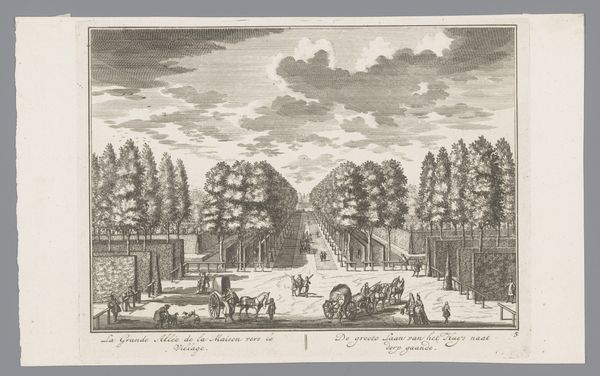
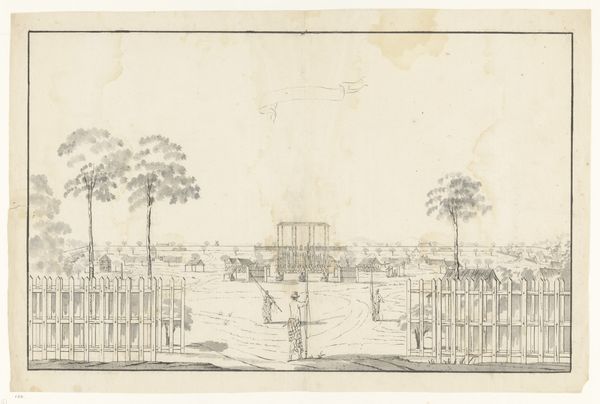
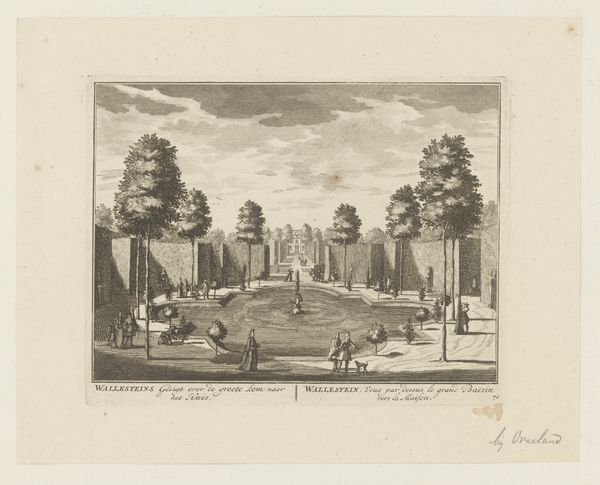
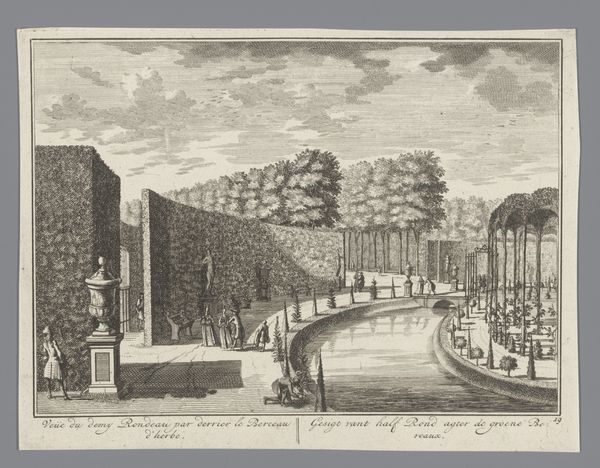
Curator: Welcome. Here we have Johannes Rach's etching, "Gezicht op landhuis Weltevreden te Batavia," created between 1765 and 1775. Editor: The first impression is striking. A pronounced emphasis on perspective funnels the viewer's gaze down this meticulously ordered pathway, flanked by ornate structures and lush trees, towards a building in the distance. The print feels deliberately composed. Curator: Indeed. The formal arrangement speaks volumes. The strong horizontal lines of the foreground are balanced by the towering verticals of the trees and architectural features. Note how the artist uses light and shadow to create depth, pulling the eye into the composition. It presents an almost theatrical space. Editor: And consider "Weltevreden" itself - it translates to "well-content" or "at peace." But I wonder, for whom was this 'peace' intended? Batavia, now Jakarta, was then the capital of the Dutch East Indies, a place of colonial power. The idyllic setting might obscure a more complicated truth of the time. Curator: An excellent point. The iconography is subtle but persistent. Those meticulously manicured gardens, for instance, are symbols of control and order, indicative of a specific societal viewpoint imposing structure upon nature, as well as the lives within that place. The presence of figures is also key to how we understand it. Editor: Precisely. The figures within the scene appear almost staged, adding to that theatrical sensibility. Their inclusion highlights the colonial presence but also seems to downplay their everyday impact. Is this the 'Orientalism' at work in presenting a tamed vision of the Dutch East Indies? Curator: The linear precision of the etching technique itself adds to this sense of controlled observation. Each line serves a function, delineating form and shadow with incredible efficiency. It is as if Rach aimed to capture not just a place but a specific idea of it. Editor: Looking closer at the banner at the end of the corridor that contains the text “WELTEVREDEN,” it almost reads as an advertisement. Perhaps, one could perceive the piece as a statement from the colonizers projecting a specific lifestyle rather than the everyday existence experienced in Batavia. Curator: So, the formal composition, with its calculated perspective, mirrored the controlled environment of colonial Batavia itself. Editor: A controlled vision, meticulously etched, yes. A piece that encourages us to question whose peace and contentment are truly represented here.
Comments
No comments
Be the first to comment and join the conversation on the ultimate creative platform.
 Collect
 React
React Comment
More like this