drawing, watercolor
drawing
art-nouveau
narrative-art
figuration
watercolor
symbolism
watercolour illustration
Dimensions: 22 x 21.2 cm
Copyright: Public domain
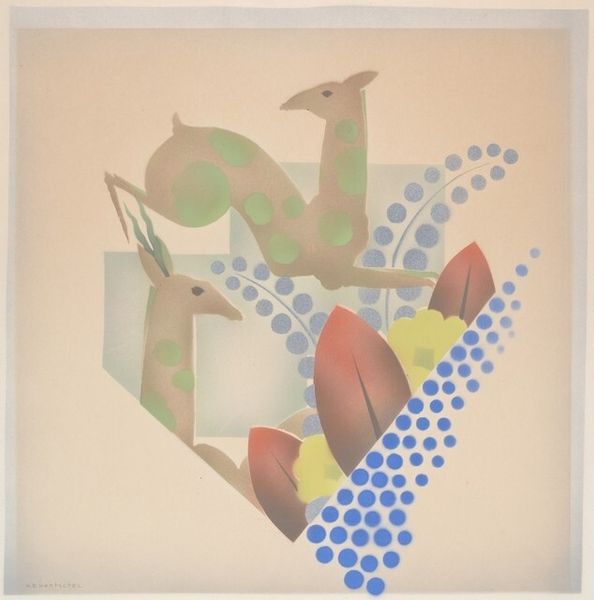
Curator: Here we have Koloman Moser’s "Picture Book for the Niece of Ditha Mautner von Markhof," created around 1904. It appears to be a watercolor and drawing combination. My initial impression is one of slightly unnerving playfulness—almost a whimsical anxiety. Editor: Whimsical anxiety? An interesting paradox. I’m drawn to the stark simplicity of the figures—the repeated motif creates a rhythm, almost a dance, but a rather angular, stylized dance. Note the deliberate composition—the placement of each figure in a way that activates the negative space, enhancing the dynamism. Curator: It is an unsettling image. Knowing its context offers a perspective: commissioned as a children's book for a prominent Austrian-Jewish family. The repetitive figures could be seen as a reflection of the anxieties present in early 20th-century Vienna, a society on the brink of upheaval, especially for Jewish communities. The scissors each character carries hint at both creative potential and a latent threat of disruption or castration anxiety if you will. Editor: That is compelling, however let’s consider this image purely through form. See how Moser simplifies human anatomy. The flat color planes and the outlined figures emphasize surface over depth, consistent with Art Nouveau's aesthetic principles. Notice also the palette—restrained and minimal—contributing to a flattened perspective. It all points to symbolism at play. Curator: Absolutely. The figures aren’t mere decoration. Think about how these repeating figures in their strange garb could allude to the masked social performances and societal roles that were so central to the era's debates around identity and belonging. Were Moser's patrons of the jewish faith feeling unsettled when considering societal "cutting", for example via public discrimination and social policies, due to historical narratives? Editor: You bring forth interesting observations and parallels that cannot be disregarded in viewing and interpreting the artwork! Considering our own exchange I feel the visual language speaks as vividly as any narrative might. Perhaps, art truly reflects the society from which it emerges and it has been a delight understanding the history and form it occupies. Curator: It is a delight indeed and may it serve as reminder that at its core art is never truly divorced from history, from context, from identity. These characters' dance on the page echoes larger movements—of progress, but also potential persecution.
Comments
No comments
Be the first to comment and join the conversation on the ultimate creative platform.
 React
React Comment