mixed-media, collage, painting
#
mixed-media
#
pasteup
#
collage
#
painting
#
figuration
#
paste-up
#
abstraction
#
painting art
#
watercolor
Copyright: Le Corbusier,Fair Use
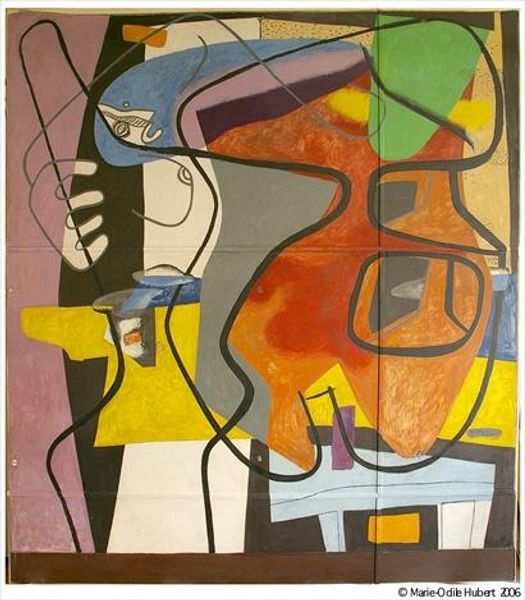
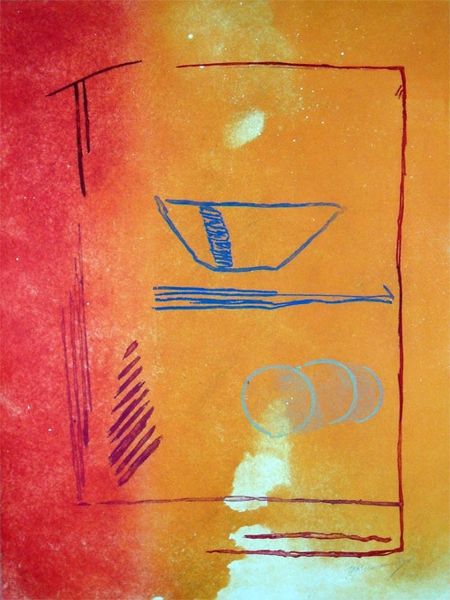
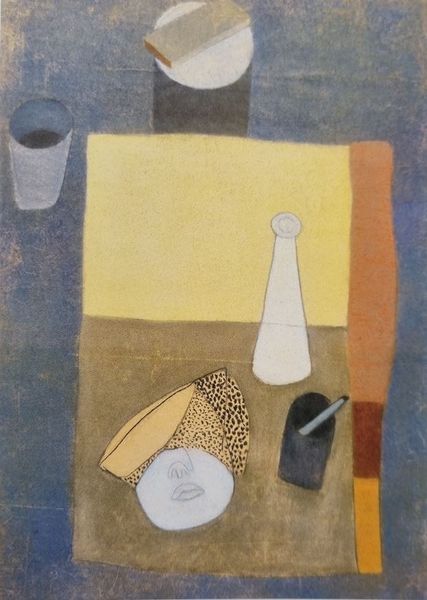
Curator: Let’s turn our attention to Le Corbusier’s "Madame, la table est dressée" from 1961, a mixed-media piece employing collage, watercolor, and paint. What’s your initial take? Editor: It's striking. There's a tension between the domesticity suggested by the title—"Madame, the table is set"—and the fragmented, almost unsettling composition. The juxtaposition of still life elements and a nude figure creates a very curious visual dialogue. Curator: Indeed. The work operates on multiple levels, both celebrating and subverting traditional notions of the domestic sphere and the female form. Le Corbusier often incorporated the female form, the 'Modulor woman', into his work. It's fascinating to consider this artwork through a feminist lens and how it positions women in relation to domestic space and artistic representation. Editor: Absolutely, and let's consider the socio-political backdrop. This piece emerges in the early 1960s, a period of significant shifts in gender roles and societal expectations. The collage elements—the layering of different materials—speak to the fragmented nature of identity and the constructedness of the domestic ideal. Curator: Looking at this painting from the view point of someone studying visual and cultural dynamics, I can certainly see your points. Consider the institutional frameworks framing its presentation. How might the work's meaning shift if displayed in a private collection versus a public museum? The artwork, through exhibition and discourse, can actively challenge power structures. Editor: Good question, in this particular case, if the painting were shown at MoMA vs. a private gallery in Paris it will be presented to very different viewers that will bring unique viewpoints that must be taken into account when analyzing its message and cultural reach. And for those who see this piece, the impact lies in its capacity to disrupt familiar narratives. It asks us to reconsider how we perceive space, gender, and the very act of representation. Curator: Well said. By situating "Madame, la table est dressée" within its historical context, it provides such a powerful reminder of art’s ability to ignite critical reflection and social change. Editor: And perhaps, on a simpler level, to just appreciate its compelling, if somewhat unnerving, beauty. Thank you for this enlightening conversation.
Comments
No comments
Be the first to comment and join the conversation on the ultimate creative platform.
 Collect
 React
React Comment
More like this