About this artwork
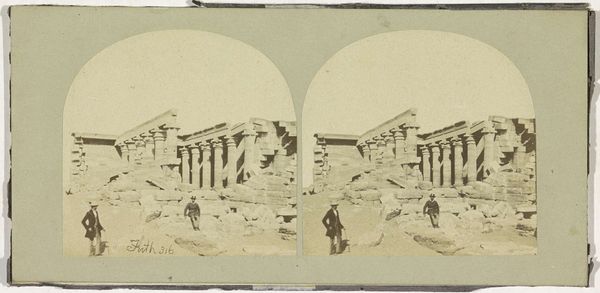
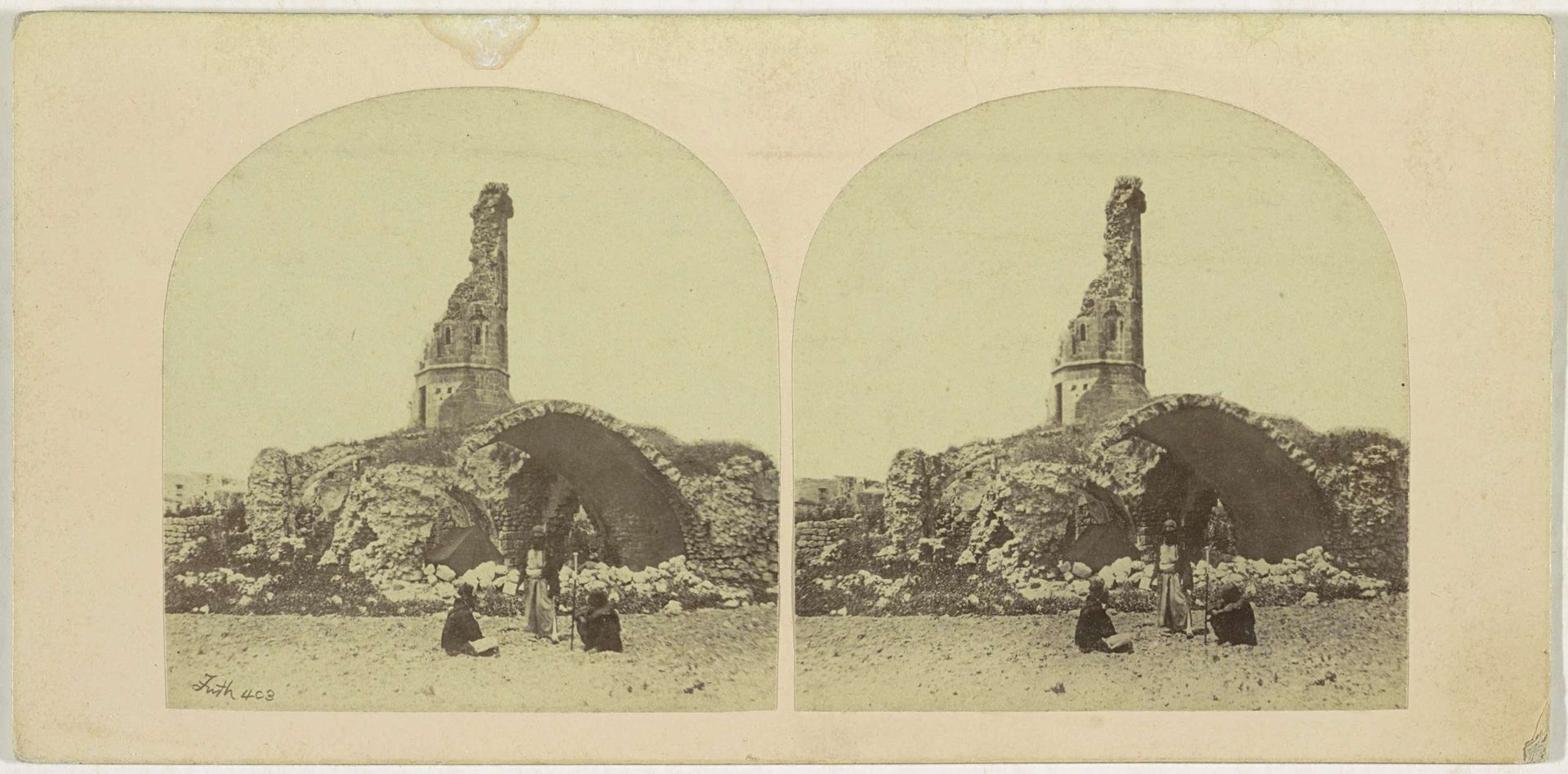
Editor: This is a gelatin silver print by Francis Frith, taken between 1859 and 1861, titled 'View of the Ruins of a Mosque in Ramla, Israel'. The ruins themselves create a somber, almost desolate feeling. What historical layers do you see embedded in this image? Curator: This photograph, beyond its aesthetic value, exists within a complex colonial narrative. Frith, like many photographers of his time, was documenting the "Orient" for a Western audience, reinforcing existing power dynamics. Consider how the framing, the focus on ruins, potentially serves to create an image of a crumbling, "past" civilization, implicitly contrasting it with the supposedly modern West. How might that contribute to the justification of colonial intervention? Editor: That's a really interesting point about the composition and its impact. I hadn’t considered how the "ruin" itself might be a loaded symbol. It also feels like the individuals in the photograph are positioned to emphasize the monumentality of the space and create a humanizing aspect to this historic landmark. Curator: Precisely. These individuals are framed to illustrate an imagined authentic connection to this space, and become features in the landscape – reduced to near props within the frame. What does it mean for Frith, as a Western photographer, to be mediating this "authentic" encounter with a "foreign" place for his European viewers? Is there perhaps an erasure of individual identities for the purposes of his commercial endeavour? Editor: I see what you mean. It highlights how photography can be both a record and a construction of reality. I'm leaving with so much to contemplate. Curator: Indeed. Let’s remember to ask critical questions about the images we consume and consider whose perspectives they represent and reinforce.
Gezicht op de ruïne van een moskee in Ramla, Israël
1859 - 1861

Francis Frith
1822 - 1898Location
RijksmuseumArtwork details
- Medium
- print, photography, gelatin-silver-print
- Dimensions
- height 84 mm, width 173 mm
- Location
- Rijksmuseum
- Copyright
- Rijks Museum: Open Domain
Tags
Comments
Share your thoughts
About this artwork
Editor: This is a gelatin silver print by Francis Frith, taken between 1859 and 1861, titled 'View of the Ruins of a Mosque in Ramla, Israel'. The ruins themselves create a somber, almost desolate feeling. What historical layers do you see embedded in this image? Curator: This photograph, beyond its aesthetic value, exists within a complex colonial narrative. Frith, like many photographers of his time, was documenting the "Orient" for a Western audience, reinforcing existing power dynamics. Consider how the framing, the focus on ruins, potentially serves to create an image of a crumbling, "past" civilization, implicitly contrasting it with the supposedly modern West. How might that contribute to the justification of colonial intervention? Editor: That's a really interesting point about the composition and its impact. I hadn’t considered how the "ruin" itself might be a loaded symbol. It also feels like the individuals in the photograph are positioned to emphasize the monumentality of the space and create a humanizing aspect to this historic landmark. Curator: Precisely. These individuals are framed to illustrate an imagined authentic connection to this space, and become features in the landscape – reduced to near props within the frame. What does it mean for Frith, as a Western photographer, to be mediating this "authentic" encounter with a "foreign" place for his European viewers? Is there perhaps an erasure of individual identities for the purposes of his commercial endeavour? Editor: I see what you mean. It highlights how photography can be both a record and a construction of reality. I'm leaving with so much to contemplate. Curator: Indeed. Let’s remember to ask critical questions about the images we consume and consider whose perspectives they represent and reinforce.
Comments
Share your thoughts