About this artwork
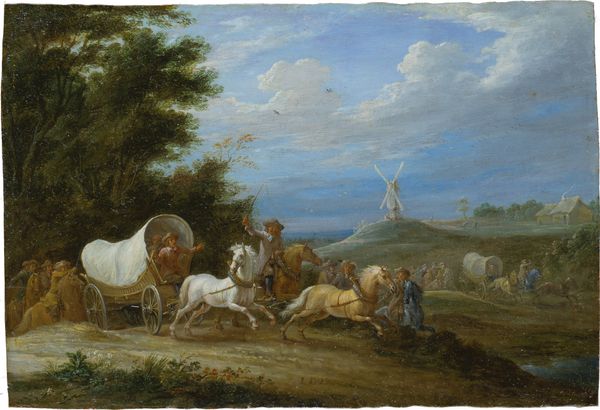
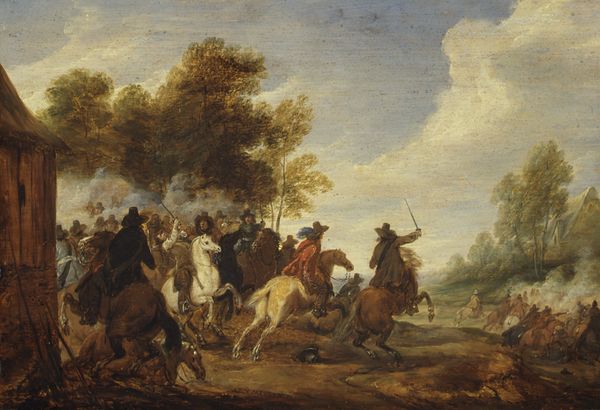
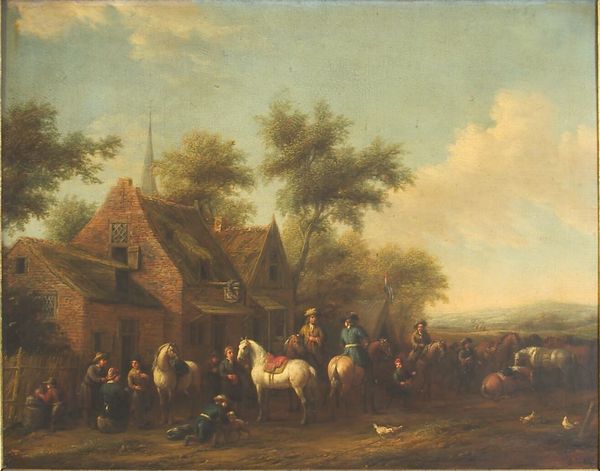
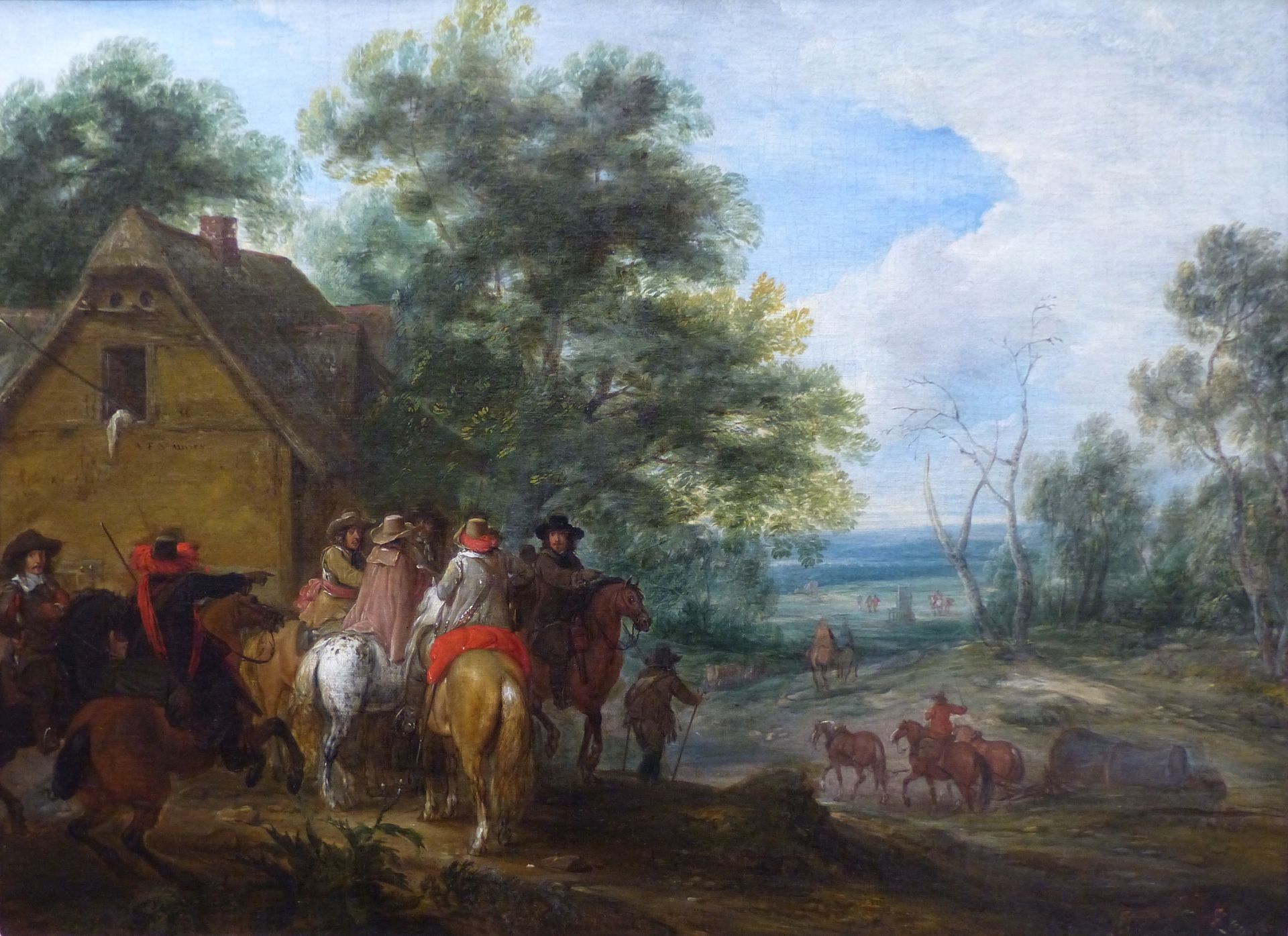
Editor: Here we have Adam van der Meulen’s "Halte De Cavaliers" from 1660, painted in oil. I'm immediately drawn to how it depicts both a scene of leisure and what feels like preparation for something. It's a rather busy composition. What strikes you when you look at this piece? Curator: It's important to consider the conditions of its making. Van der Meulen was often commissioned to create propagandistic depictions of Louis XIV's military campaigns. While this genre scene appears less overtly political, the quality of the materials – the costly oil paints, the fine linen canvas – speak to the patronage system and the artist's role within a specific economic and social structure. Editor: So, even without explicitly depicting Louis XIV, the artwork still reflects the power structures of the time? Curator: Precisely. The landscape itself, and how it is portrayed, can be understood as a resource – land controlled, traveled through, potentially conquered. Think about the materiality of landscape painting itself: pigments derived from the earth used to represent…the earth. Editor: That's a fascinating point. The creation of the painting, the pigment and canvas production, reflect a type of economic landscape. Does that change the way we view the narrative aspects, like the riders? Curator: I think it forces us to recognize that these seemingly 'natural' or leisurely scenes are still products of a specific social order, facilitated by networks of labor, trade and power. The artist's hand is also a labor here. This wasn't just some aesthetic experience; it was a crafted object reflecting a structured exchange. Editor: I hadn't considered that perspective before. Seeing it as a document of labor and material relationships gives it a whole new layer of meaning. Curator: Exactly, by looking closely at how things are made, who makes them, and what purpose they ultimately serve, we gain a more complete picture of not just the art, but the era itself.
Halte De Cavaliers
1660

Adam van der Meulen
1632 - 1690Location
Musée Fabre, Montpellier, FranceArtwork details
- Medium
- painting, oil-paint
- Location
- Musée Fabre, Montpellier, France
- Copyright
- Public domain
Tags
Comments
Share your thoughts
About this artwork
Editor: Here we have Adam van der Meulen’s "Halte De Cavaliers" from 1660, painted in oil. I'm immediately drawn to how it depicts both a scene of leisure and what feels like preparation for something. It's a rather busy composition. What strikes you when you look at this piece? Curator: It's important to consider the conditions of its making. Van der Meulen was often commissioned to create propagandistic depictions of Louis XIV's military campaigns. While this genre scene appears less overtly political, the quality of the materials – the costly oil paints, the fine linen canvas – speak to the patronage system and the artist's role within a specific economic and social structure. Editor: So, even without explicitly depicting Louis XIV, the artwork still reflects the power structures of the time? Curator: Precisely. The landscape itself, and how it is portrayed, can be understood as a resource – land controlled, traveled through, potentially conquered. Think about the materiality of landscape painting itself: pigments derived from the earth used to represent…the earth. Editor: That's a fascinating point. The creation of the painting, the pigment and canvas production, reflect a type of economic landscape. Does that change the way we view the narrative aspects, like the riders? Curator: I think it forces us to recognize that these seemingly 'natural' or leisurely scenes are still products of a specific social order, facilitated by networks of labor, trade and power. The artist's hand is also a labor here. This wasn't just some aesthetic experience; it was a crafted object reflecting a structured exchange. Editor: I hadn't considered that perspective before. Seeing it as a document of labor and material relationships gives it a whole new layer of meaning. Curator: Exactly, by looking closely at how things are made, who makes them, and what purpose they ultimately serve, we gain a more complete picture of not just the art, but the era itself.
Comments
Share your thoughts