About this artwork
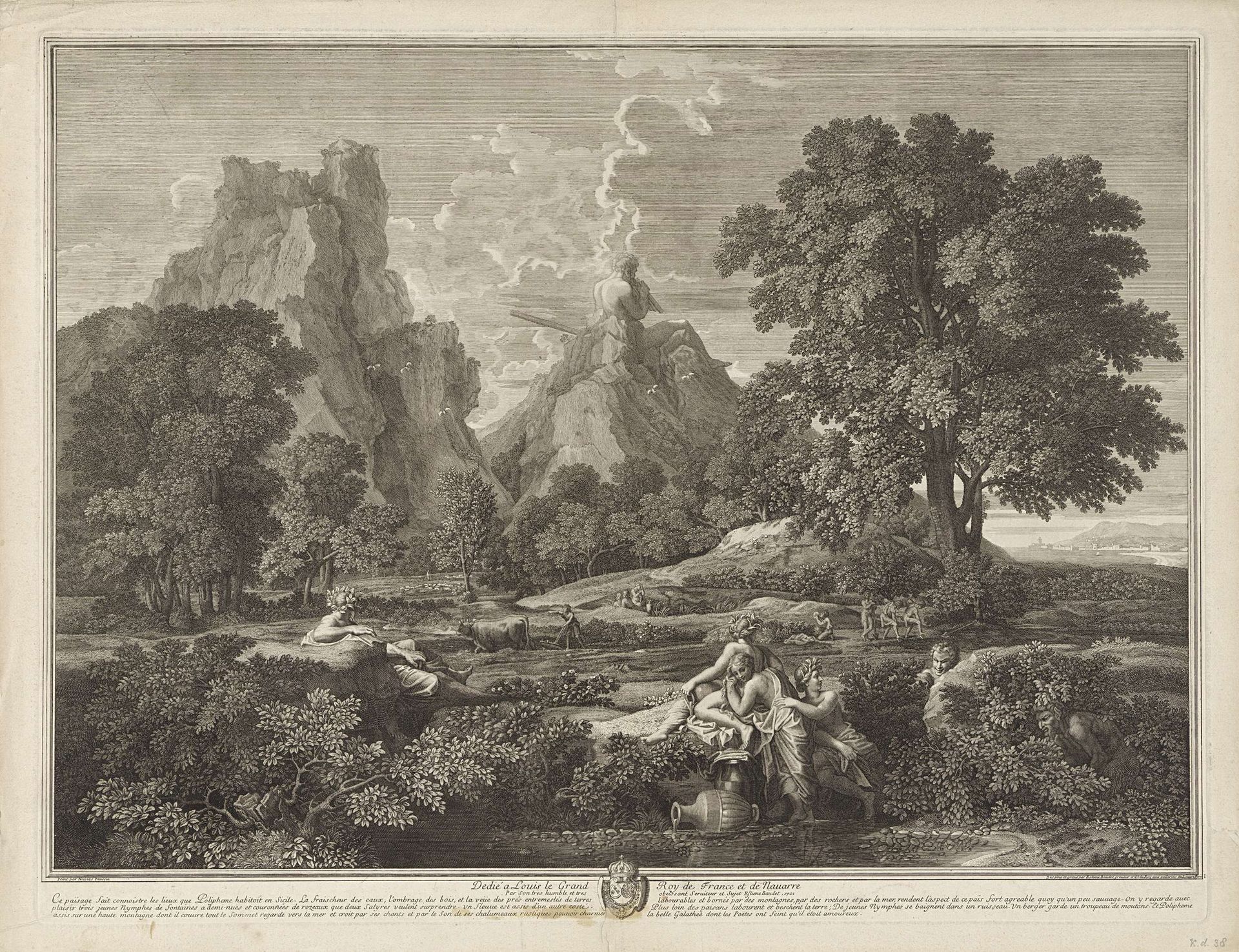
Editor: This is "Landscape with Polyphemus, Nymphs, and Fauns," an engraving by Etienne Baudet, dating back to 1701. It’s a beautifully detailed scene, but there’s something unsettling about that giant figure looming in the background. What do you see in this piece, looking at its layers of symbolism? Curator: The engraving presents a carefully constructed Arcadia. But that pastoral ideal is shadowed by Polyphemus, isolated on the clifftop, representing a kind of untamed, pre-civilized state. Notice the nymphs and fauns in the foreground, these embody a playful, sensual connection to nature. But the cultural memory tied to Polyphemus tells of a disruption, of a savage intrusion. Editor: So, there's a contrast between the idyllic and something darker… How does Baudet convey this through the imagery? Curator: Consider the composition: the careful arrangement of the foreground figures leads our eye towards the distant, looming Polyphemus. Light plays a crucial role. The idyllic figures are bathed in light, yet Polyphemus emerges from a darker, more rugged terrain, emphasizing his separation and inherent threat. Are you familiar with the stories associated with Polyphemus? Editor: Vaguely. He's a Cyclops, right? Known for his brute strength, and his encounter with Odysseus… Curator: Exactly. Baudet draws upon that established symbolism, tapping into our collective understanding of Polyphemus as a disruptive force. He's not merely a giant, but a symbol of untamed passion and primal urges set against the cultivated order of the nymphs' realm. Editor: It is unsettling how those two narrative spaces – one of safety, the other fraught – abut. Thanks! This really clarifies how a landscape can carry such psychological weight. Curator: Precisely! And the persistence of those images demonstrates the enduring power of cultural memory and how artists continuously reinvent the symbols inherited from it.

Artwork details
- Medium
- engraving
- Dimensions
- height 577 mm, width 757 mm
- Copyright
- Rijks Museum: Open Domain
Tags
Comments
Share your thoughts
About this artwork
Editor: This is "Landscape with Polyphemus, Nymphs, and Fauns," an engraving by Etienne Baudet, dating back to 1701. It’s a beautifully detailed scene, but there’s something unsettling about that giant figure looming in the background. What do you see in this piece, looking at its layers of symbolism? Curator: The engraving presents a carefully constructed Arcadia. But that pastoral ideal is shadowed by Polyphemus, isolated on the clifftop, representing a kind of untamed, pre-civilized state. Notice the nymphs and fauns in the foreground, these embody a playful, sensual connection to nature. But the cultural memory tied to Polyphemus tells of a disruption, of a savage intrusion. Editor: So, there's a contrast between the idyllic and something darker… How does Baudet convey this through the imagery? Curator: Consider the composition: the careful arrangement of the foreground figures leads our eye towards the distant, looming Polyphemus. Light plays a crucial role. The idyllic figures are bathed in light, yet Polyphemus emerges from a darker, more rugged terrain, emphasizing his separation and inherent threat. Are you familiar with the stories associated with Polyphemus? Editor: Vaguely. He's a Cyclops, right? Known for his brute strength, and his encounter with Odysseus… Curator: Exactly. Baudet draws upon that established symbolism, tapping into our collective understanding of Polyphemus as a disruptive force. He's not merely a giant, but a symbol of untamed passion and primal urges set against the cultivated order of the nymphs' realm. Editor: It is unsettling how those two narrative spaces – one of safety, the other fraught – abut. Thanks! This really clarifies how a landscape can carry such psychological weight. Curator: Precisely! And the persistence of those images demonstrates the enduring power of cultural memory and how artists continuously reinvent the symbols inherited from it.
Comments
Share your thoughts