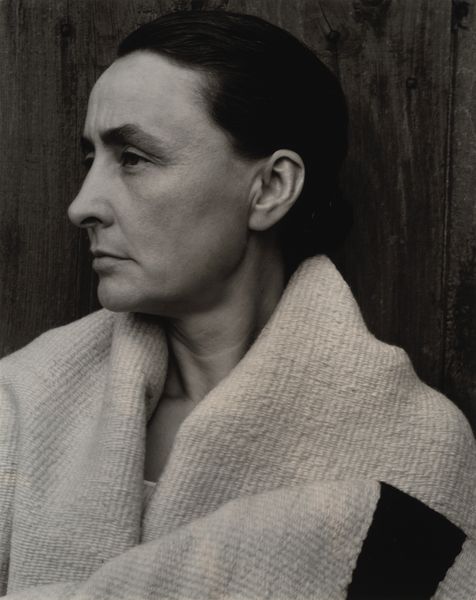
Dimensions: support: 375 x 374 mm
Copyright: © Robert Mapplethorpe Foundation | CC-BY-NC-ND 4.0 DEED, Photo: Tate
Editor: This is Robert Mapplethorpe’s photograph, "Louise Bourgeois". It’s undated and held at the Tate. The composition is really striking; the contrast of textures between Bourgeois's fur coat and the sculpture she holds is quite something. What do you see in this piece, formally? Curator: The photograph's strength lies in its interplay of textures and forms. Observe how Mapplethorpe uses light to accentuate the organic shapes of Bourgeois's sculpture against the sharp lines of her face and the softness of the fur. The monochrome palette emphasizes these contrasts, creating a visual tension that draws the viewer in. Editor: So it’s the formal elements that communicate the most? Curator: Precisely. The arrangement, the tonal range, the textures – these are all carefully orchestrated to convey a sense of the artist's presence and the power of her work. Editor: That’s a helpful way to think about it. I was so focused on the subject, I nearly missed the artistry in the visual relationships.
Comments

tate 11 months ago
⋮
http://www.tate.org.uk/art/artworks/mapplethorpe-louise-bourgeois-ar00215


Join the conversation
Join millions of artists and users on Artera today and experience the ultimate creative platform.
tate 11 months ago
⋮
In this black and white portrait photograph the French-American artist Louise Bourgeois (1911–2010) stands slightly to the right of the frame against a plain grey background. She is shown from her waist up with her body in three quarter profile, and her face turned towards the camera. She wears a dark, tufted monkey fur coat and has one of her sculptures tucked under her right arm, holding it in place with her right hand. This phallic shaped sculpture, Fillette, which translates as ‘little girl’ in French, is a plaster work covered in latex made fourteen years earlier. Bourgeois smiles somewhat mischievously at the camera.
 Collect
More like this