print, engraving
#
portrait
#
baroque
# print
#
old engraving style
#
engraving
Dimensions: height 166 mm, width 91 mm
Copyright: Rijks Museum: Open Domain
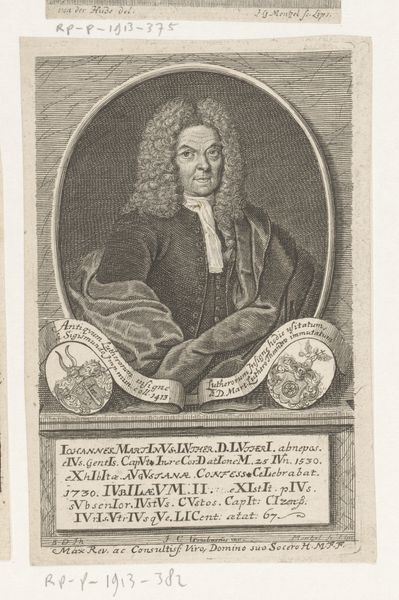
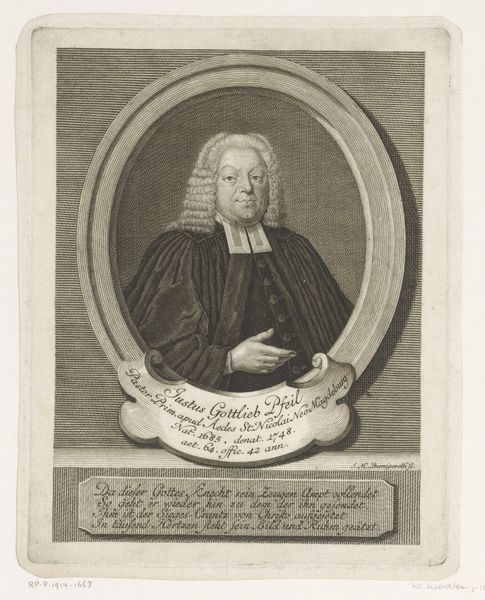
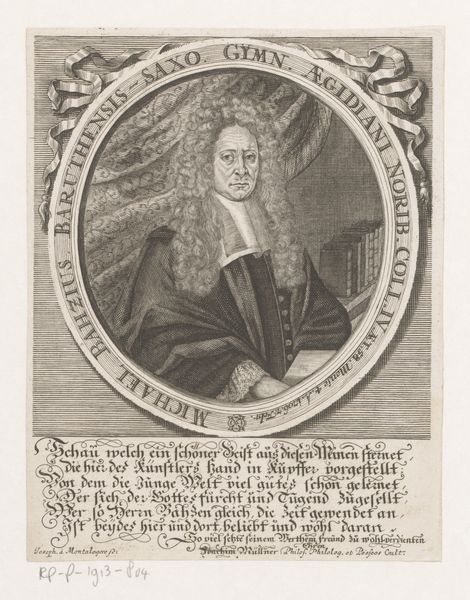
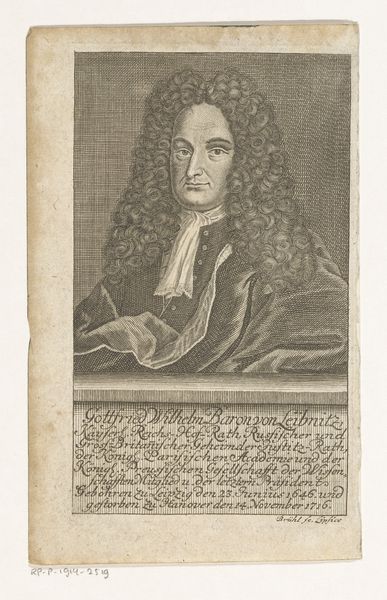
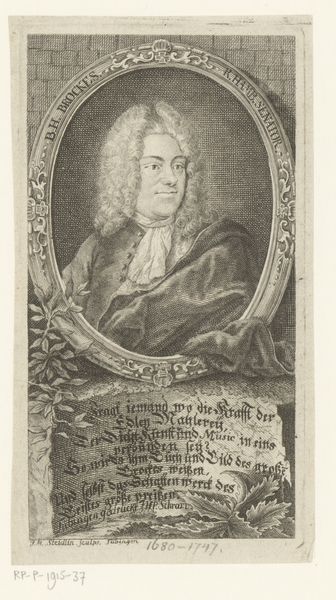
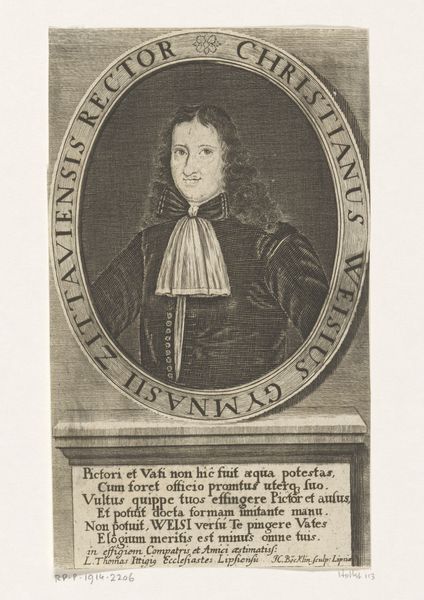
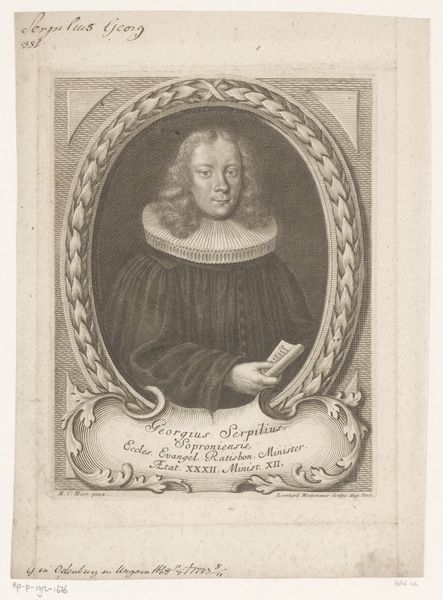
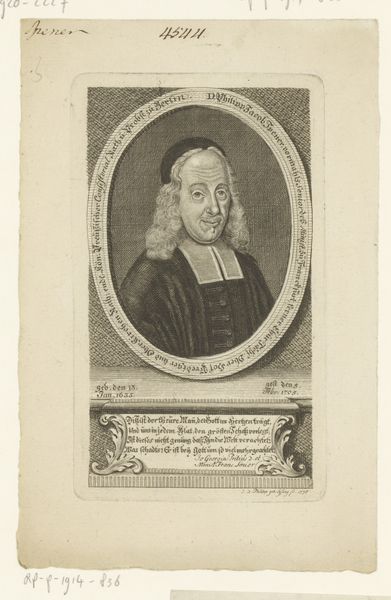
Curator: Here we have Johann Christoph Boecklin's 1703 engraving, "Portret van Paul Rabe," housed in the Rijksmuseum. Editor: It’s immediately striking how ornate it is! The texture and sheer volume of the wig, balanced with the meticulous details of the lettering… there's an imposing quality, even within this small print. Curator: The medium itself, engraving, is key. Consider the labour involved in producing these fine lines. The act of engraving elevates the sitter. It wasn't simply about replicating an image; it was about imbuing status. And of course, paper itself became an important substrate and vector for distributing such representations to the masses. Editor: The wig, without question, becomes symbolic. Not just of status, but of the cultural moment. These elaborate hairstyles visually signaled membership in a specific intellectual and social strata. This portrait solidifies Rabe within that context. We can consider how the specific style conveys particular associations, possibly even political allegiances or preferred virtues. Curator: Precisely. The means of production reflects that societal stratification. While an engraver like Boecklin possessed skilled labour, the elite – people like Rabe– dictated the style and what kind of image had market currency. Note how his dress also is more subdued in the portrait, placing importance not on the body but rather in intellectual life—it reflects this division between those who toil versus those who are perceived to exist beyond such concerns. Editor: You know, that tension between artifice and representation makes this more than a simple portrait. The text beneath the image itself contributes to his public image, reinforcing his title and place in society. Curator: In thinking about art and production, consider the supply chain involved in creating and circulating these images. From paper makers and ink producers, these economic infrastructures, the networks for distributing engravings— all these underpin this single, arresting image. Editor: Reflecting on that distribution, the accessibility afforded by prints like this suggests an attempt to project Rabe's image beyond his immediate circle, imbuing him, and perhaps the institutions he represented, with a sense of permanence. Curator: Seeing Boecklin's engraving alongside your observation on Rabe’s image reinforces the way in which early printmaking wasn’t merely representational – it played a part in creating the visual identity of a new kind of elite, of which paper and production both held very important weight. Editor: Ultimately, this close look at "Portret van Paul Rabe" offers a richer insight into the enduring interplay between symbolism and human aspirations.
Comments
No comments
Be the first to comment and join the conversation on the ultimate creative platform.
 Collect
 React
React Comment
More like this