drawing, coloured-pencil, pencil
#
drawing
#
coloured-pencil
#
charcoal drawing
#
figuration
#
pencil
#
genre-painting
#
post-impressionism
Copyright: Public domain
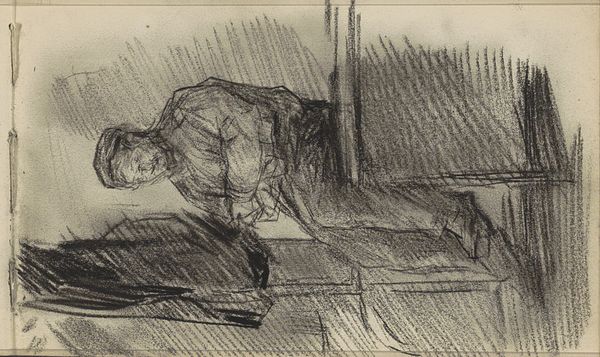
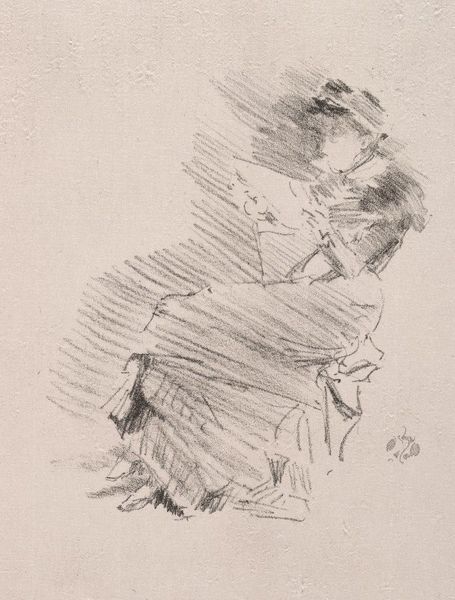
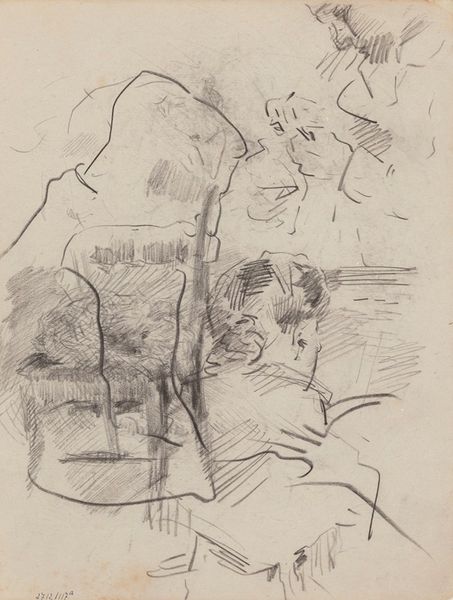
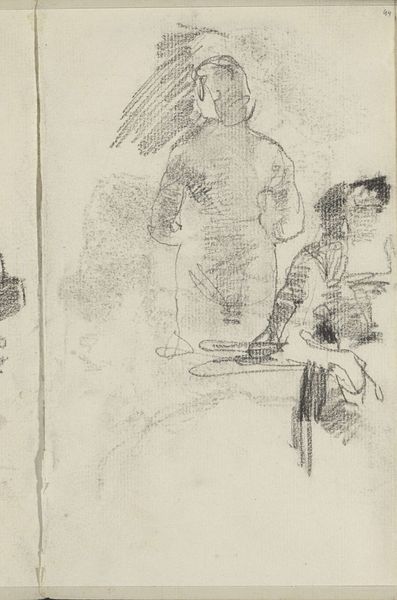
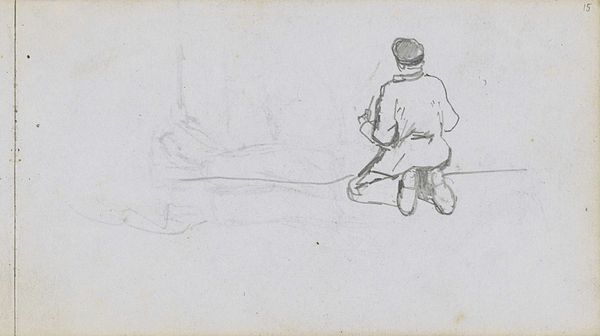
Curator: Look, here we have Georges Seurat's "Soldier Fencing, Another Reclining," created around 1880. What strikes you most about this drawing? Editor: The vulnerability. There’s an almost dreamlike fragility to the scene, especially given its subject matter. I immediately notice the tension, the raw immediacy suggested by the scratchy, broken lines. It makes me think of the impermanence of life and of the artistic moment itself, really. Curator: The rapid, sketchy application of the colored pencils definitely adds to that. But I find it intriguing that Seurat would even choose such an informal, readily available material. The medium itself challenges this concept of “high art”, right? The red and blue in the pencils feels particularly evocative considering the context. Editor: Absolutely. Seurat probably encountered such everyday pencils throughout his life; considering their purpose—for routine writing, maybe simple record-keeping—adds another dimension. It forces us to question why an artist, on witnessing this spectacle of potential combat and defeat, selected *this* medium. There’s this sense of rapid observation, maybe, which colored pencil easily conveys. Curator: I completely agree. It’s also worth noting Seurat’s ability to suggest depth and space using very few lines, very subtle tonal gradations in the colored pencil strokes. This gives this image an incomplete feeling—as though there's a background the artist never fully conceived, almost like an imagined history of struggle beyond the paper. It lends a peculiar charge to this intimate, tense encounter between soldiers. Editor: Well said. It makes me wonder about the societal implications, especially those of the French military at the time. Were soldiers able to procure similar writing tools on the front? Who controlled the distribution, and to what end? To examine the *why* here adds real significance, don't you think? It turns this sketch into something far more substantial. Curator: Certainly something far beyond a mere illustration of a duel; rather, an artifact teeming with the echoes of societal realities, power dynamics, and even economic disparity. Food for thought indeed! Editor: Right! Let’s think about that more!
Comments
No comments
Be the first to comment and join the conversation on the ultimate creative platform.
 Collect
 React
React Comment
More like this