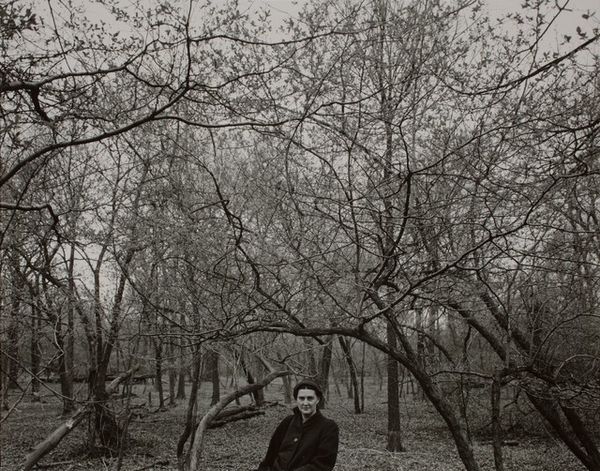
Benjamin Boofer with his Wife, Shenango Ingot Molds (Working People series) 1977


photography, gelatin-silver-print
portrait
photorealism
landscape
social-realism
photography
black and white
gelatin-silver-print
monochrome photography
ashcan-school
monochrome
realism
monochrome
Dimensions: image: 17.1 x 17.6 cm (6 3/4 x 6 15/16 in.) sheet: 25.3 x 20.3 cm (9 15/16 x 8 in.)
Copyright: National Gallery of Art: CC0 1.0
Curator: Here we have Milton Rogovin's gelatin silver print, "Benjamin Boofer with his Wife, Shenango Ingot Molds," taken in 1977. It's part of his series "Working People". Editor: Oh, it has this beautiful stark quality—a portrait amidst this... almost severe landscape. It’s both intimate and strangely exposed. What’s an ingot mold? Curator: Those are large metal containers used to cast molten metal, common in steel mills, that's the man's occupation. Rogovin’s "Working People" is about honoring labor and those who perform it. He focused on the often overlooked. Editor: And he finds poetry there. You see it in their faces, in the setting...they seem connected to that industrial landscape even in repose, though posed as in a studio photograph. But it makes me think, how are the politics of such photographs influenced by exhibition? Are the subjects participants or viewed as spectacles by gallery-goers? Curator: That’s something Rogovin grappled with. He wasn’t just documenting; he sought collaboration. He aimed to portray the dignity and resilience of working-class individuals facing economic hardships, which ties into social realism and even the Ashcan School. What do you make of the lighting? Editor: The stark contrast certainly underscores their solidity. The bare trees mirroring a sense of fragility. It speaks of impermanence juxtaposed against the permanence of their work and existence, documented here for posterity. How has our changing relationship with industry affected the way viewers experience these images today, versus in '77? Curator: Profoundly. The decline of American manufacturing casts a long shadow. Now, images like these function as records, documents of what's been lost, what labor movements have fought for, or the human cost of that struggle. It’s heavy, seeing what changed after that historical instant. Editor: And Rogovin makes it real. You feel that sense of place, the weight of lives lived, documented by the weight of metal work, within lives of great social, industrial transition. This isn’t detached photography. You can sense the depth of his respect. Curator: Absolutely. It leaves you reflecting on our values, doesn’t it?
Comments
No comments
Be the first to comment and join the conversation on the ultimate creative platform.
 React
React Comment