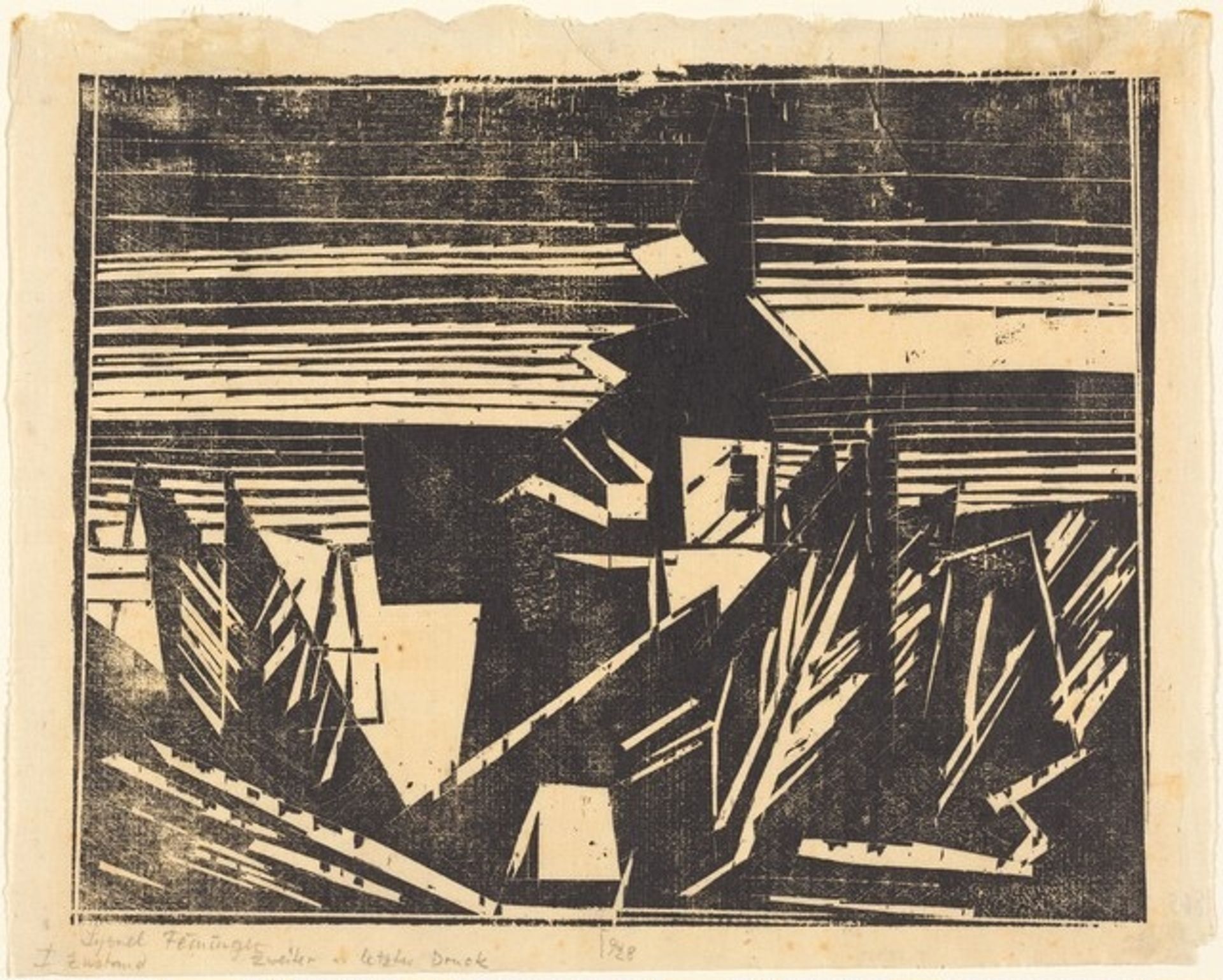
1919
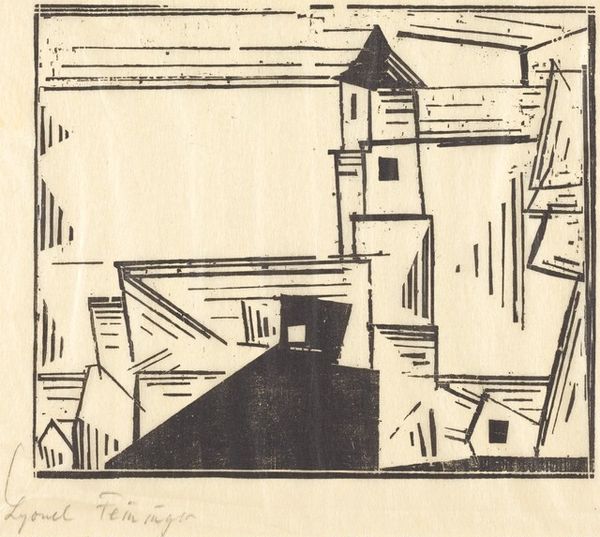
Benz, 2


Listen to curator's interpretation
Curatorial notes
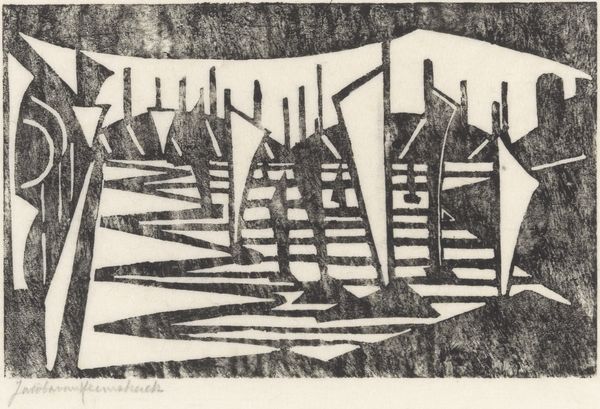
Editor: We’re looking at Lyonel Feininger’s “Benz, 2,” a woodcut print from 1919. It’s a stark black and white image of what seems like a cityscape, but fragmented and abstracted. The heavy lines create this somewhat chaotic feel. What stands out to you in this piece? Curator: Well, beyond the immediate starkness – it hits you like a dissonant chord, doesn't it? – I see Feininger wrestling with the fractured realities of his time. This is post-World War I Germany, a period ripe with disillusionment and a yearning for… something. Look at the sharp angles; they could be shards of glass, reflections of a broken world. The geometric forms aren’t just aesthetic; they are emotionally charged. What kind of emotions does this evoke in you? Editor: I get a sense of unease, maybe even anxiety, looking at it. The lines feel almost violent. I can definitely see how that would reflect the postwar mood. Curator: Exactly! And consider that German Expressionism was all about inner emotion made visible. This wasn't about painting pretty pictures, but about externalizing turmoil. This fractured cityscape – a sort of crystalline Cubism meeting Northern angst, if you will – becomes a mirror reflecting back the artist's, and perhaps a nation's, internal state. You feel it in your gut, no? Editor: Absolutely, that’s a fascinating connection. It's more than just an image; it’s a feeling materialized. I wouldn't have made that connection without you. Curator: Precisely, isn’t that the beauty of it? Art is a conversation, a whisper across time. And sometimes, those whispers can roar. Editor: That’s a fantastic way to look at it, and gives me so much to consider about artmaking after major world events. Thanks for your insights!