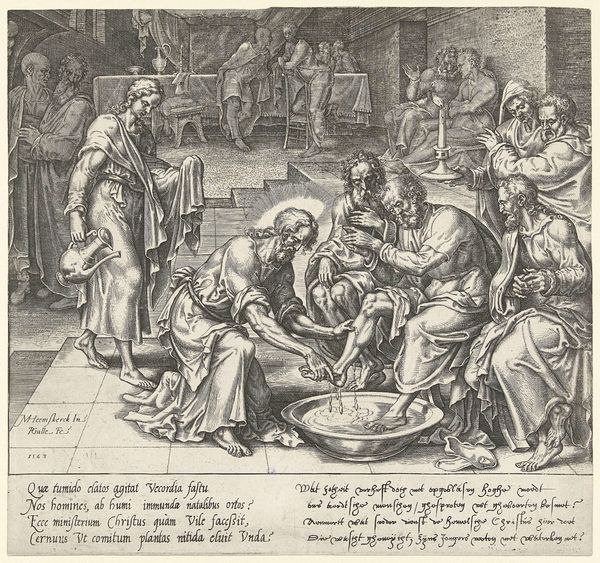
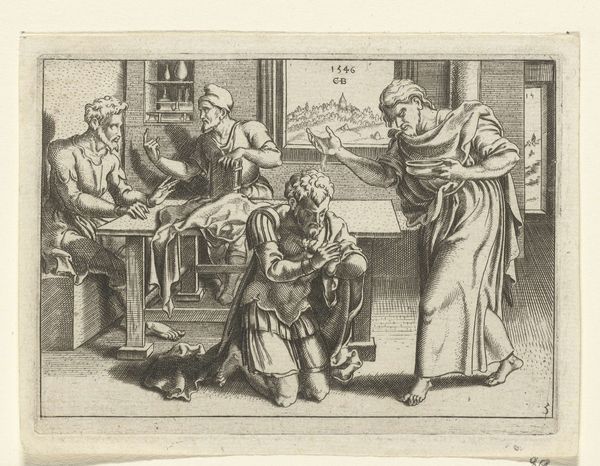
print, engraving
#
narrative-art
#
baroque
# print
#
pen sketch
#
figuration
#
genre-painting
#
history-painting
#
engraving
Dimensions: height 82 mm, width 115 mm
Copyright: Rijks Museum: Open Domain
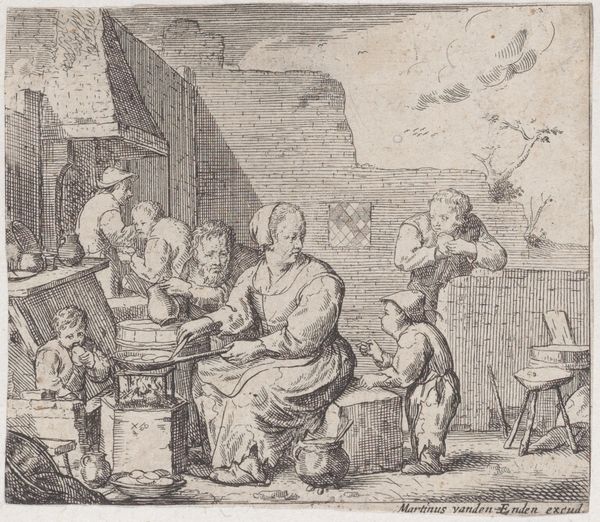
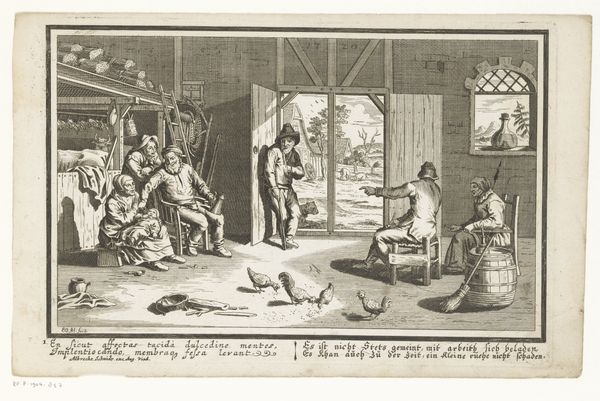
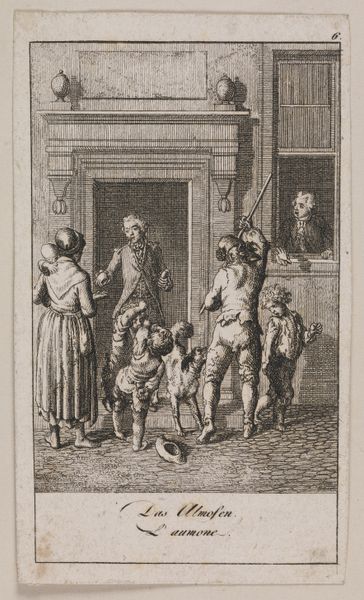
Curator: Welcome! Today, we are exploring "Blind Men Eating Before an Inn," an engraving dating back to 1629. Editor: Immediately striking. It has a stark quality due to the density of lines, a baroque study of form expressed in this monochromatic way. There’s almost a Breughelian earthiness in the presentation, would you agree? Curator: Absolutely. It’s baroque in its bustling composition and dramatic, if somewhat crude, realism. Note how the artist manipulates light and shadow to create depth, and consider the use of line to delineate the figures. Editor: Right, this crude but fine method gives it so much character, it’s full of so many tiny deliberate hatchings; given its focus on disabled individuals, were prints more accessible for distribution, maybe cheaper materials at the time? Is it for the masses? How does the chosen form affect the narrative's accessibility, would you argue? Curator: An astute point. Prints such as this engraving could be produced relatively quickly and affordably compared to paintings or tapestries. It broadens who would be consuming this art and is therefore accessible at the time, maybe in line with its lower subject and setting. This would contribute to the image's reception. Note that the linear quality reinforces the plane while subtly hinting at spatial recession. The foreground figures possess remarkable tonal modeling. Editor: It’s curious the interplay of high and low art being depicted simultaneously in that way, its materiality creates a paradox; considering all the textural details and layers of print production: The choice of pen rather than, say, ink is also crucial here, I suppose? Curator: A possibility that resonates. It certainly enhances its narrative impact, doesn't it? By pushing this print-making process, our perceptions can extend beyond this moment to include considerations of societal structures within. Editor: Very compelling; reflecting on the dialogue, the density invites prolonged viewing, and the materiality of the print challenges conventional notions of what is and isn't valuable and visible, I suppose. Curator: Precisely. The contrast in rendering styles combined with the thematic focus on marginal figures sparks intriguing dialogues, then and now, about value, labour, and looking closely.
Comments
No comments
Be the first to comment and join the conversation on the ultimate creative platform.
 Collect
 React
React Comment
More like this