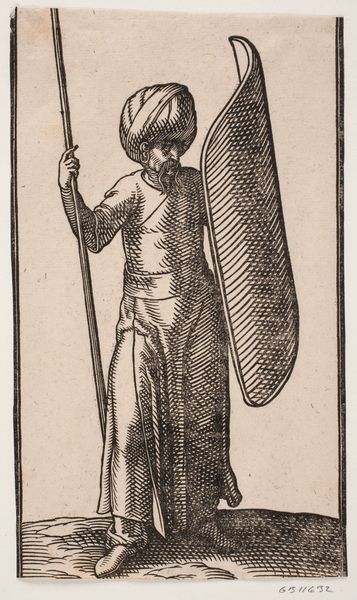
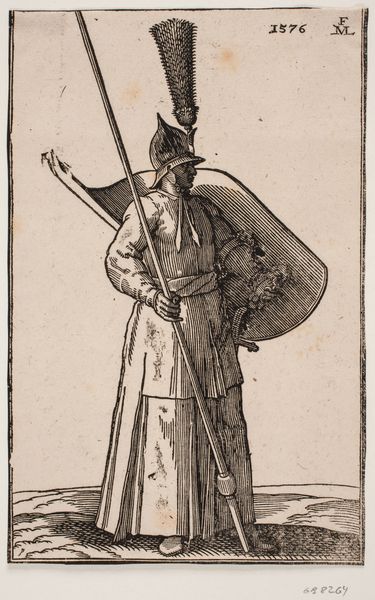
Stående soldat, vendt mod h.; på hovedet turban, i h. hånd en løftet lanse med vimpel under spidsen; på v. arm et skjold med en stofomviklet fjerbusk 1576
0:00
0:00


print, woodcut
#
portrait
# print
#
figuration
#
woodcut
#
history-painting
#
northern-renaissance
Dimensions: 194 mm (height) x 138 mm (width) (bladmaal)
Editor: Right, next up we have a print called "Standing Soldier, facing right" by Melchior Lorck, from 1576. The medium is listed as woodcut. I find it really striking - almost severe. The detail is incredible for a print, particularly the texture in the clothing. What's your take on it? Curator: Well, placing it in its historical context, it's crucial to remember the 16th century was a period of intense cultural exchange and conflict between Europe and the Ottoman Empire. Lorck, significantly, served as an envoy to the Ottoman court. This print, likely part of a series, is not just a depiction of a soldier. It's a document, almost an ethnographic study made for a European audience hungry for information about the "exotic" East. Do you see how carefully Lorck renders the details of the turban, the weaponry, the shield? Editor: I do. It's very precise. So it's less about glorifying war, and more about documentation? Curator: Exactly. The Northern Renaissance was very much concerned with a faithful rendition of reality, of using art for scholarly pursuits. Prints were a perfect medium for disseminating information. Who would have been the primary audience for something like this, do you think? Editor: Probably other artists, scholars, maybe even political figures? Someone who'd want a reliable image of an Ottoman soldier, but perhaps wouldn’t be traveling to Turkey themselves? Curator: Precisely! And the circulation of these images had a profound impact on European understanding—or misunderstanding—of the Ottoman world. What do you make of his stance, though? It doesn’t seem particularly…threatening. Editor: No, not at all! He almost looks like he's posing for a photograph. That definitely brings the "documentation" idea home, it's meant to record, not to provoke an emotional response. I didn't realize there was so much wrapped up in this single image! Curator: And that's the beauty of art history! Everything is connected, socially, culturally, politically. It makes you consider the motivations and implications behind artistic choices.
Comments
No comments
Be the first to comment and join the conversation on the ultimate creative platform.
 Collect
 React
React Comment
More like this