Dimensions: Sheet: 5 1/2 x 7 7/16 in. (14 x 18.9 cm)
Copyright: Public Domain
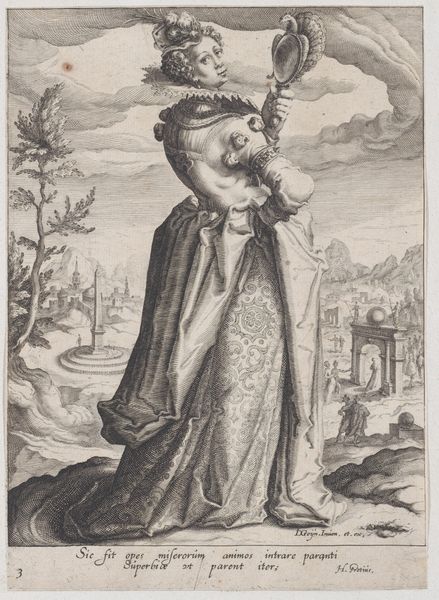
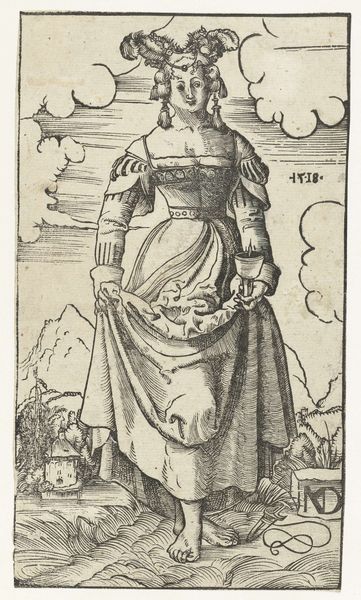
Editor: Here we have Pietro Bertelli’s print "Courtesan and the blind cupid", dating from about 1583 to 1593. It's an engraving, and the stark black lines against the white create an intriguing sense of texture, especially in the courtesan’s dress and that feathery fan. The landscape almost looks like a stage set. How do you read this composition? Curator: What strikes me immediately is the sharp delineation of forms. Consider the courtesan's attire: each fold of her skirt, every pleat of the ruff, meticulously rendered. The use of line dominates the space; the landscape elements are defined by their stark outlines. This treatment suggests an allegorical intention, doesn’t it? Editor: Definitely. I noticed Cupid, he's up to no good, shooting his arrows from the sky even though he’s supposedly blind. Is the tension between the sharp lines of the foreground figure and the receding landscape significant, visually? Curator: Precisely. It posits a spatial disjuncture that highlights artifice. Ask yourself: does the crispness of line undermine the depth it attempts to create? Is it truly a landscape or a symbolic backdrop? The artist privileges the linear over atmospheric perspective, creating a pictorial tension. This emphasizes the symbolic weight each element carries. The figure, landscape and even Cupid lack true atmospheric unity, yet exist harmoniously. What does the symbolism elicit? Editor: It’s like…the sharp definition brings out the layers of meaning, even at a distance. The artist draws our attention to detail so it evokes a deeper sense. Thank you, that gave me much to ponder! Curator: Indeed. This underscores the value of a rigorous, formal reading: recognizing the intrinsic visual properties unlock further possibilities.
Comments
No comments
Be the first to comment and join the conversation on the ultimate creative platform.
 React
React Comment