fibre-art, weaving, textile
#
fibre-art
#
weaving
#
textile
#
yoruba-art
#
decorative art
Dimensions: 98 × 70 1/4 in. (248.92 × 178.44 cm)
Copyright: No Known Copyright
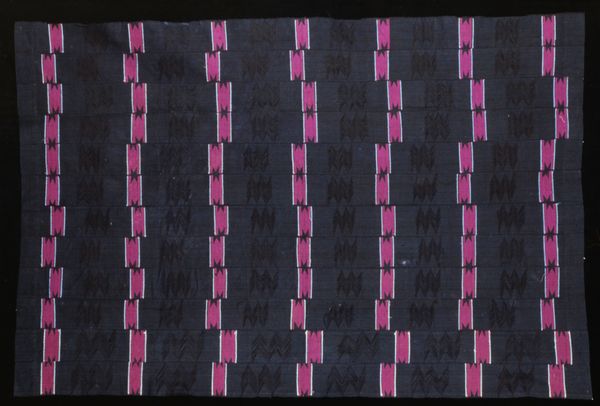
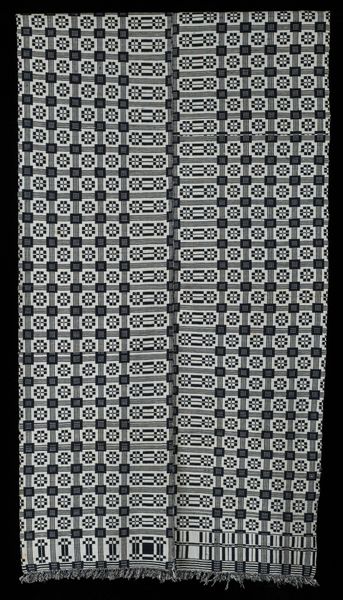
Curator: This is a man's toga cloth from the Yoruba people, likely made in the 20th century. It's currently held here at the Minneapolis Institute of Art. Editor: My first impression is of intense order and meticulous design. The stark contrast of dark indigo with the precise linear patterns creates a visual rhythm, almost a coded message. Curator: Precisely! The composition relies heavily on these strong vertical lines and blocks of colour, wouldn't you agree? The structure is quite assertive. Editor: Yes, there's something very purposeful about its aesthetic. Do you think these lines and shapes might convey status or lineage? It reminds me of early forms of writing where patterns served as records of identity. Curator: It’s tempting to dive into interpretations immediately, but let's first consider the cotton weaving itself. The skill involved in maintaining such even lines and complex interwoven sections, all within a repeating motif, suggests mastery. The material speaks. Editor: Agreed, but the very choice of indigo speaks volumes too. It has long been associated with wealth and power among the Yoruba. The toga, a significant garment, becomes even more potent imbued with this colour. Perhaps, in its visual vocabulary, we can begin to unpack what roles this garment performed for the original wearer. Curator: And let's note how the geometry engages within the woven fibers; it's a perfect dialogue between the organic quality of the cotton and the planned, imposed order of the design. The variations in line thickness and spacing establish a definite hierarchy within the composition, making certain motifs prominent over others. Editor: I find it incredible how a single cloth, through its symbolism, its colour and weave, manages to communicate the complexities of an individual's place within an entire society. It almost feels like a portrait painted not with pigment, but with threads of meaning. Curator: Yes, quite profound, and formally compelling from all visual parameters. Thank you for opening that doorway into meaning. Editor: It's been my pleasure. To consider an artifact’s original cultural framework can only enhance appreciation of design.
Comments
No comments
Be the first to comment and join the conversation on the ultimate creative platform.
 Collect
 React
React Comment
More like this