graphic-art, print, etching, engraving
#
portrait
#
graphic-art
# print
#
etching
#
old engraving style
#
genre-painting
#
engraving
#
realism
Dimensions: height 127 mm, width 87 mm
Copyright: Rijks Museum: Open Domain
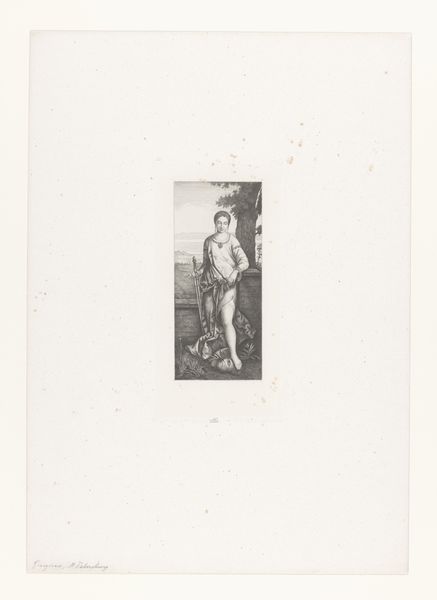
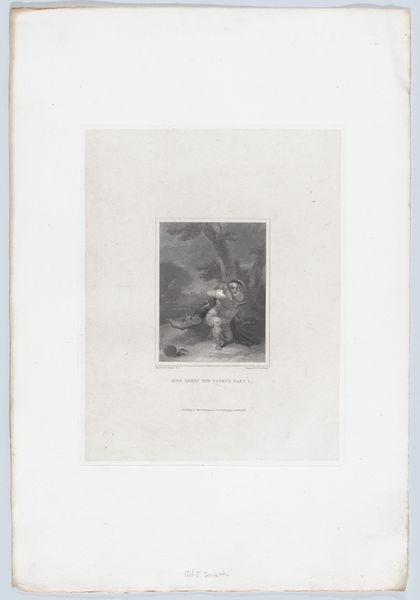
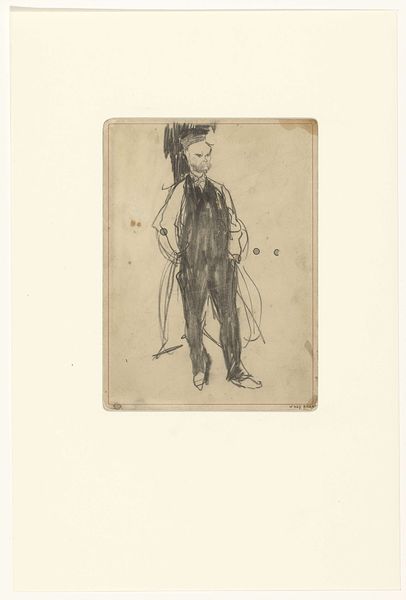
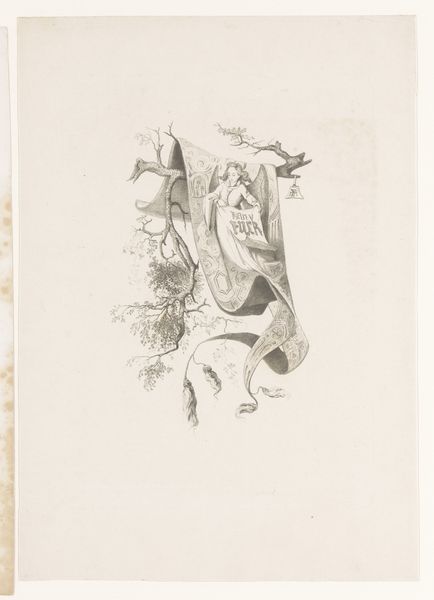
Editor: Here we have Louis Jaugey's "Man toont verschillende vissoorten in een net," which translates to "Man showing different types of fish in a net," created sometime between 1850 and 1899 using graphic arts, specifically print and etching. The composition strikes me as quite unusual with its combination of marine life, the central figure, and almost surreal details. What's your interpretation of this engraving? Curator: It's fascinating how Jaugey employs the visual language of realism to subtly question the colonial narratives of resource extraction and maritime power. The seemingly straightforward portrayal of fishing, with its display of varied species, becomes complicated when you consider the period's intense exploitation of marine resources and the labor often invisibilized within such "objective" depictions. Editor: Could you elaborate on that? I hadn’t immediately connected it to colonial exploitation. Curator: Consider the netting, the "catch," the human figure framed within this imposed structure: is it merely descriptive, or does it also subtly convey the trapping and commodification of the natural world? Furthermore, the almost grotesque arrangement of sea creatures might serve as a critique of the insatiable desire to categorize and control nature. How does it resonate with current debates about environmental justice and the legacy of extractive industries? Editor: So you're suggesting it’s not just a simple genre scene, but possibly a commentary on the relationship between humanity and the natural world in a colonial context? I didn’t consider it like that! Curator: Precisely. Jaugey prompts us to consider who benefits from this "catch," whose stories are erased, and what the long-term consequences of such exploitation might be. The inclusion of what appears to be a snake adds a layer of suspicion. Is the snake merely part of this "net," or is it symbolic of danger, poison and betrayal? How can our contemporary understanding of eco-criticism shed light on this 19th-century piece? Editor: That completely shifts my understanding of the piece. I’m leaving with so much more to think about. Curator: It is precisely by making these connections and critical interventions that we start understanding the rich artistic and political contexts interwoven within seemingly traditional artworks.
Comments
No comments
Be the first to comment and join the conversation on the ultimate creative platform.
 Collect
 React
React Comment
More like this