About this artwork
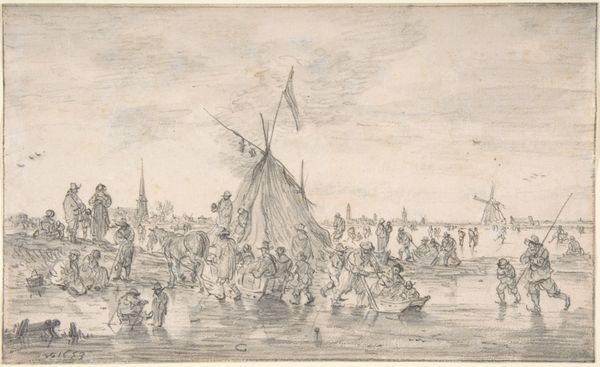
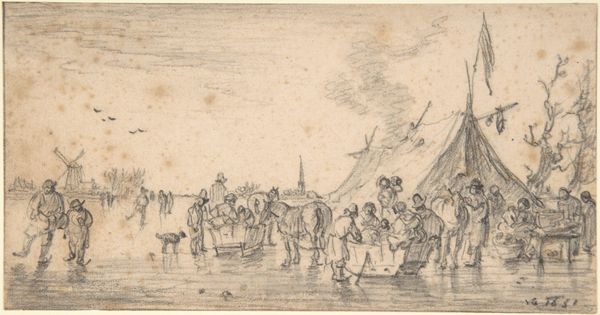
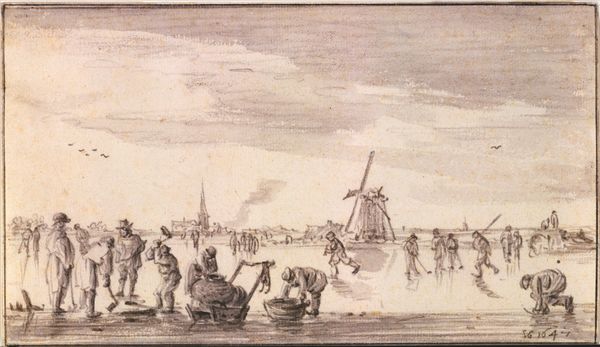
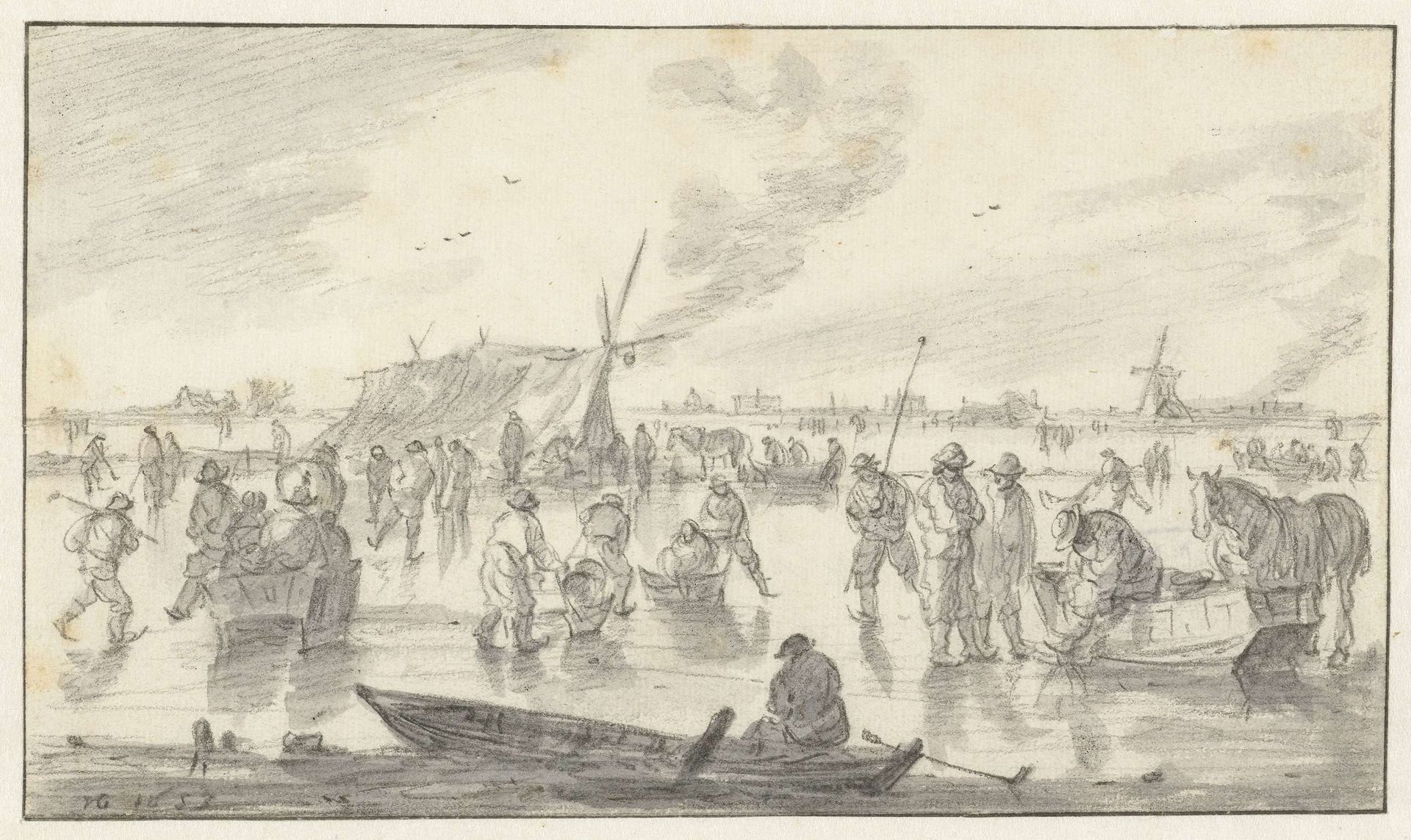
Curator: This sketch, rendered in pencil, pen and gray ink, is entitled "IJsvermaak op een brede rivier", which translates to "Ice Skating on a Wide River." Jan van Goyen created this genre scene in 1653. Editor: There's a coldness that emanates from this drawing, even just in the limited tonal range. I’m also immediately drawn to the material properties suggested: the slick, glassy surface of the ice, the coarse cloth of the figures’ garments, even the smoke seems gritty. Curator: It evokes a quintessential Dutch winter scene, capturing a moment of leisure. But if you look closely at all those people populating the landscape, I notice they are busily occupied. Winter for the Dutch often signifies commerce and travel along waterways when frozen over. Editor: Precisely. The means of transportation becomes novel and changes. Here, boats slide across the frozen water rather than floating in it; the social utility shifts from sailing to skating or pulling others on sleds. Van Goyen seems interested in showing us the seasonal occupation that dictates a different usage of those materials. Curator: These activities symbolize more than mere utility; they carry strong cultural and social implications. The ice, often a symbol of danger and fragility, here transforms into a place for communal gathering, suggesting resilience in the face of harsh nature, in what some have called a "frozen" Golden Age of painting. Editor: So much cultural import derived from simple tools--sleds, skates, even the winter clothes they sport speak of functional adaptation and economic survival within very specific weather constraints. We understand the culture via how they respond materially. Curator: Absolutely, we find how cultural values shape artistic expression. A seemingly straightforward scene reveals complex ties to the Dutch experience, told economically using only the tools needed. Editor: Indeed, a study in how an artist uses basic means to showcase adaptation to environmental and economic needs, reflecting their culture to the very last, economical line.

Artwork details
- Medium
- drawing, pencil
- Dimensions
- height 120 mm, width 202 mm
- Location
- Rijksmuseum
- Copyright
- Rijks Museum: Open Domain
Tags
Comments
Share your thoughts
About this artwork
Curator: This sketch, rendered in pencil, pen and gray ink, is entitled "IJsvermaak op een brede rivier", which translates to "Ice Skating on a Wide River." Jan van Goyen created this genre scene in 1653. Editor: There's a coldness that emanates from this drawing, even just in the limited tonal range. I’m also immediately drawn to the material properties suggested: the slick, glassy surface of the ice, the coarse cloth of the figures’ garments, even the smoke seems gritty. Curator: It evokes a quintessential Dutch winter scene, capturing a moment of leisure. But if you look closely at all those people populating the landscape, I notice they are busily occupied. Winter for the Dutch often signifies commerce and travel along waterways when frozen over. Editor: Precisely. The means of transportation becomes novel and changes. Here, boats slide across the frozen water rather than floating in it; the social utility shifts from sailing to skating or pulling others on sleds. Van Goyen seems interested in showing us the seasonal occupation that dictates a different usage of those materials. Curator: These activities symbolize more than mere utility; they carry strong cultural and social implications. The ice, often a symbol of danger and fragility, here transforms into a place for communal gathering, suggesting resilience in the face of harsh nature, in what some have called a "frozen" Golden Age of painting. Editor: So much cultural import derived from simple tools--sleds, skates, even the winter clothes they sport speak of functional adaptation and economic survival within very specific weather constraints. We understand the culture via how they respond materially. Curator: Absolutely, we find how cultural values shape artistic expression. A seemingly straightforward scene reveals complex ties to the Dutch experience, told economically using only the tools needed. Editor: Indeed, a study in how an artist uses basic means to showcase adaptation to environmental and economic needs, reflecting their culture to the very last, economical line.
Comments
Share your thoughts