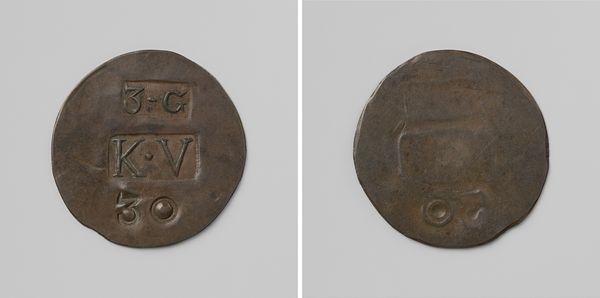
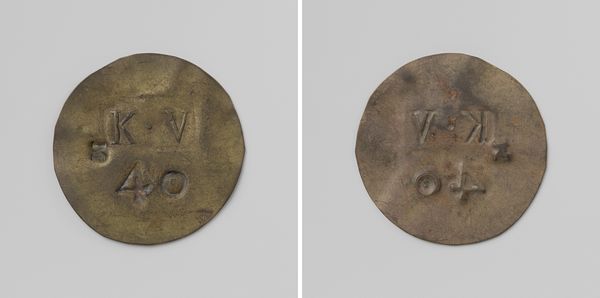
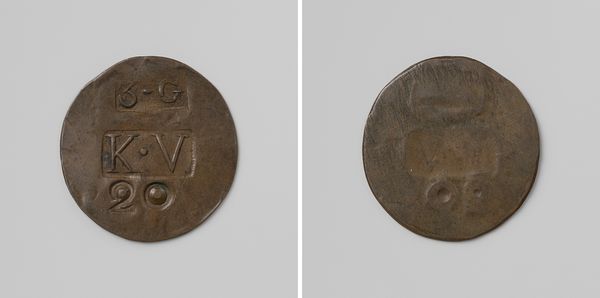
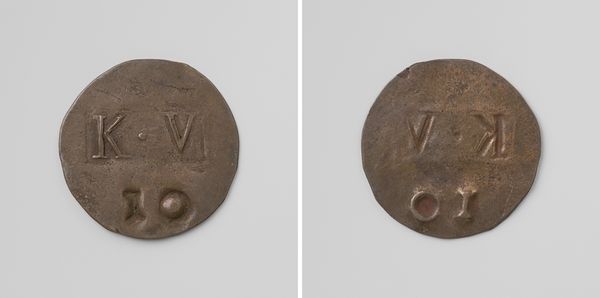
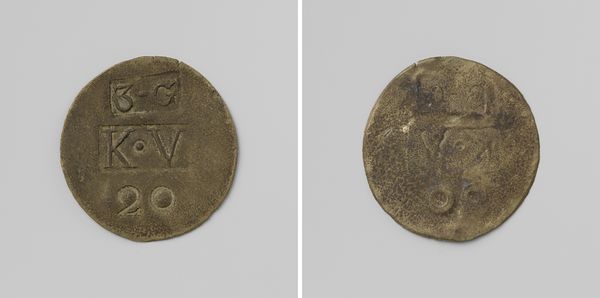
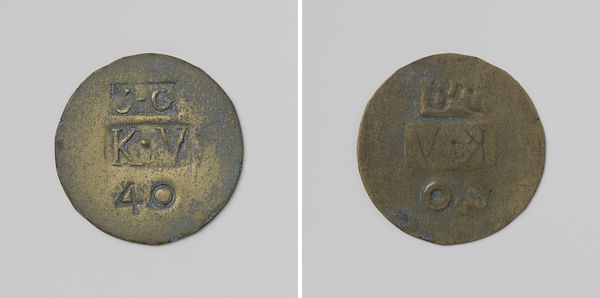
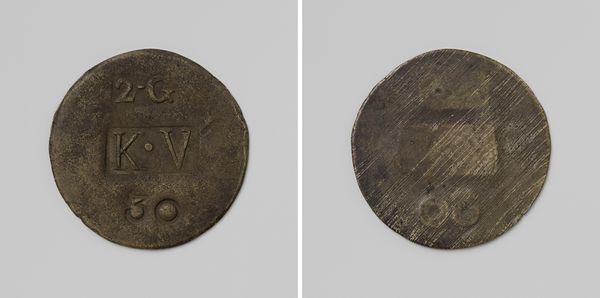
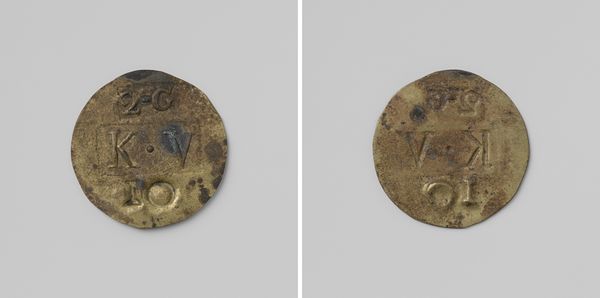
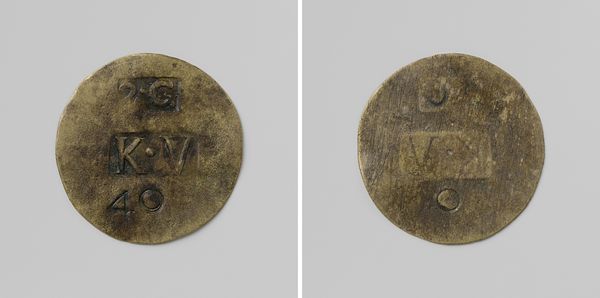
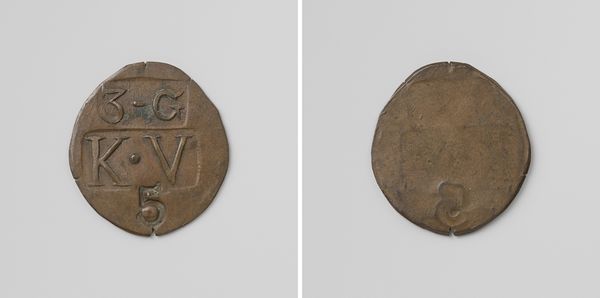
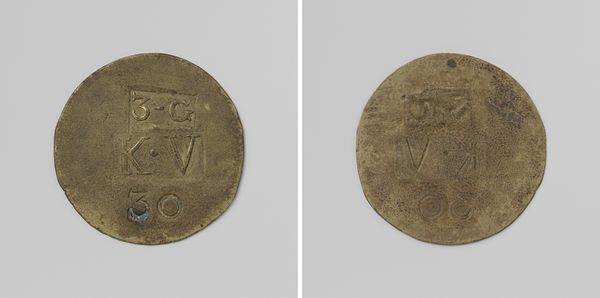
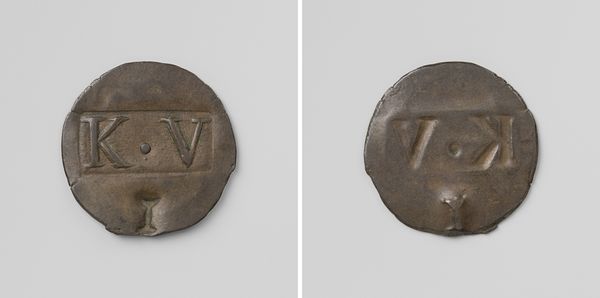
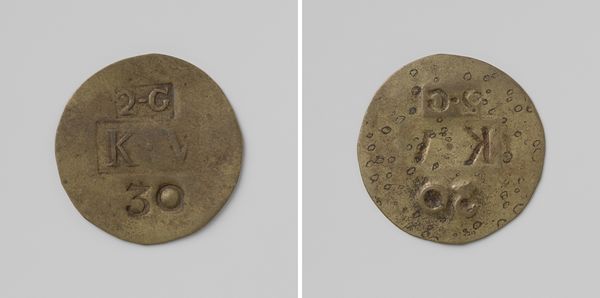
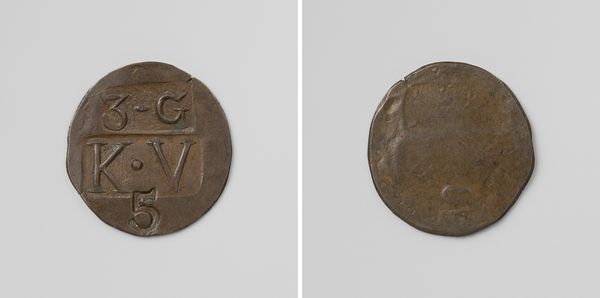
Derde gesticht van de kolonie Veenhuizen, huismunt geslagen op last van de Maatschappij van Weldadigheid ter waarde van dertig cent 1818 - 1859
0:00
0:00

anonymous
Rijksmuseum
print, metal
#
portrait
#
medieval
# print
#
metal
#
sculpture
#
ceramic
#
history-painting
#
miniature
Dimensions: diameter 3.8 cm, weight 5.20 gr
Copyright: Rijks Museum: Open Domain
Curator: Looking at this coin, I find myself wondering about the stories it could tell, echoing through time like a tangible whisper of forgotten interactions. Editor: Absolutely, the stark simplicity is quite striking. It’s unassuming at first glance, but those worn edges speak of a well-circulated history. There is something deeply intimate about objects meant to be held, passed around, changing hands... what can you tell us about it? Curator: Well, what we’re seeing here is a piece of coinage. According to our records, it was created somewhere between 1818 and 1859. The coin was produced for the Veenhuizen colony. Its full name is: "Derde gesticht van de kolonie Veenhuizen, huismunt geslagen op last van de Maatschappij van Weldadigheid ter waarde van dertig cent." That is a mouthful! Editor: So it wasn't part of a larger national currency, it was a specific coinage minted for internal circulation... interesting! This evokes a feeling of a closed-off, perhaps even a controlled economy. What kind of society used this? Curator: The coin embodies the social experiment carried out by the Society of Benevolence. It symbolizes a way for people to rebuild their lives, literally trading it for work and services within this isolated community. Editor: The initials stamped so clearly onto its surface are compelling. "KV", bold, geometric, centered; what does that say about its time? Curator: They speak to an era striving for control and order. There’s a definite attempt to standardize and categorize within a rapidly changing societal structure. The image seems straightforward, utilitarian but perhaps deceivingly so, pointing to the era's paternalistic approach to social welfare. It also alludes to a larger context: the political and economic landscape shaped by industrialization and the aftermath of Napoleonic wars. Editor: This resonates powerfully. Seeing these simple materials –metal made useful, imprinted with a clear, functional message. I feel like I better understand the world that forged this artifact. Thank you. Curator: And thank you, I find these little objects truly speak to the heart of history, and the continuity of value across centuries.
Comments
No comments
Be the first to comment and join the conversation on the ultimate creative platform.
 Collect
 React
React Comment
More like this