About this artwork
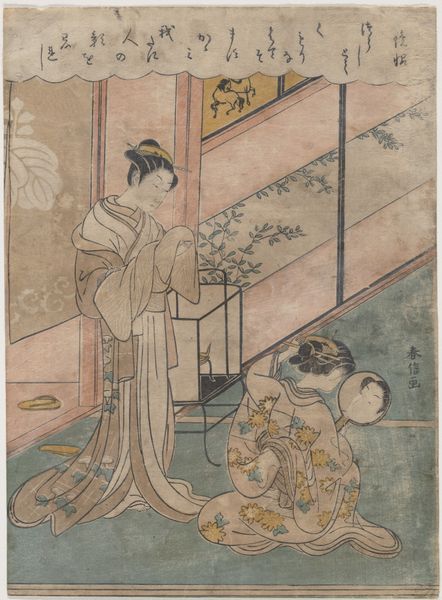
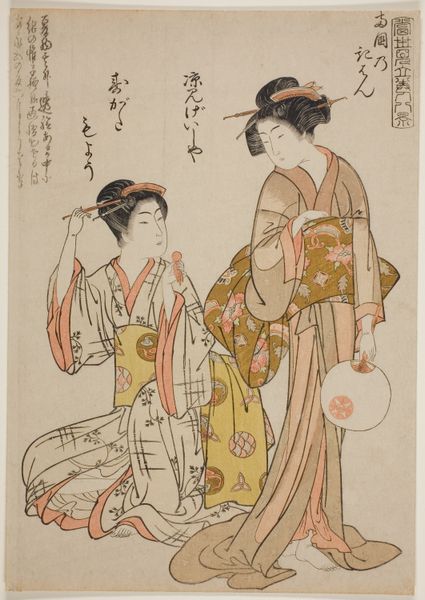
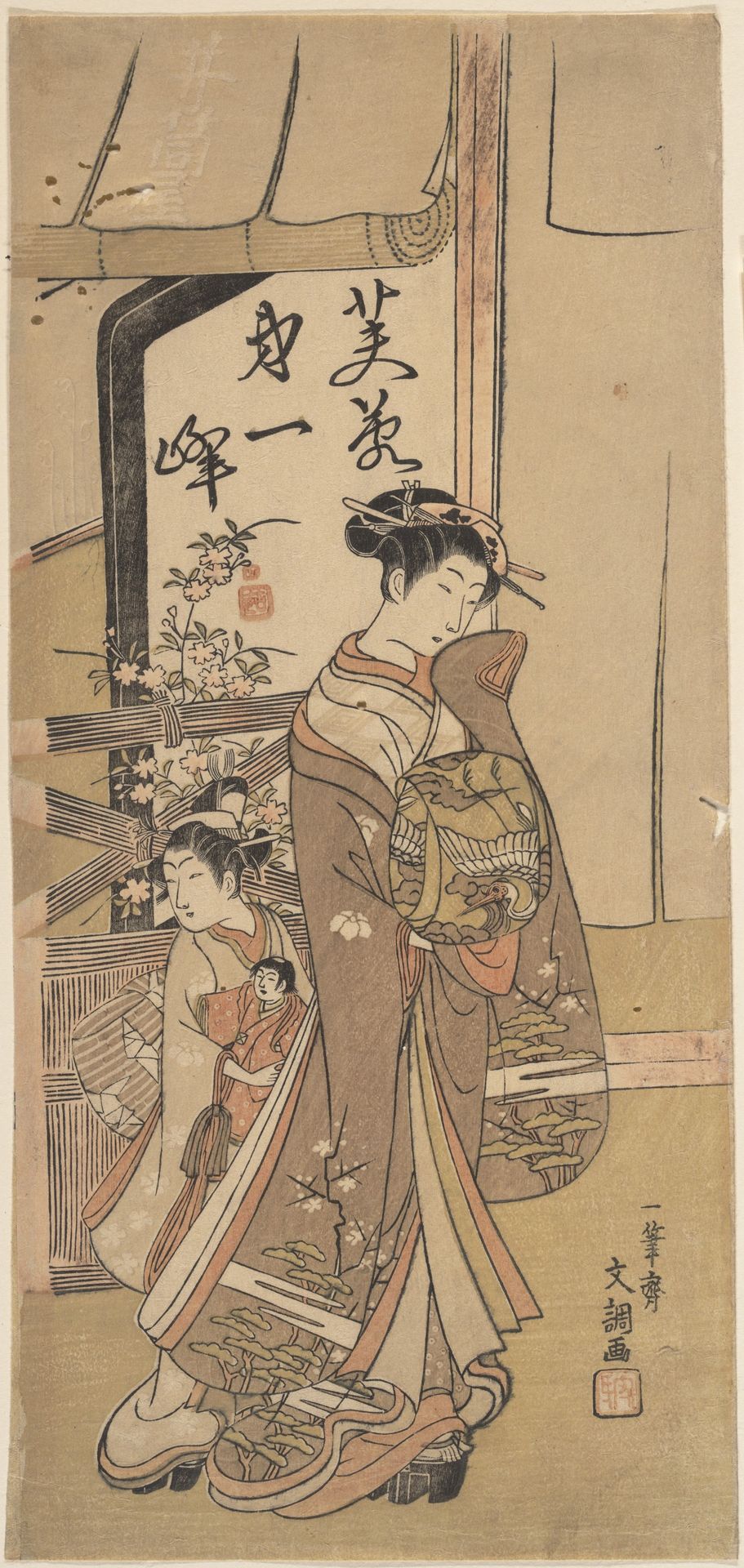
Editor: So, this woodblock print, "A Courtesan Followed by a Girl Attendant Carrying a Doll," by Ippitsusai Buncho, from around the 18th century… I’m immediately struck by the woman’s elegant pose and the detail in her kimono. The entire scene feels both intimate and performative, somehow. How do we understand this portrayal within its social context? Curator: Precisely! The floating world, or ukiyo-e, prints like this offer invaluable insights into Edo-period Japan. Notice how the print not only depicts a courtesan but also frames her through the lens of societal expectations and consumer culture. Editor: Consumer culture? How so? Curator: Think about who was buying these prints and why. They were popular amongst the merchant class, offering them a glimpse into the glamorous lives of the pleasure quarters, which were heavily regulated yet still fascinating. This particular piece, showcasing a high-ranking courtesan, reveals the aspiration and status associated with this world. Editor: I see, it's less about the individual woman and more about her symbolic role. It's a depiction that reflects the observer more than the subject, maybe? Curator: Absolutely! Furthermore, examine the girl carrying the doll. How does that detail impact your understanding of the courtesan's representation? It touches upon themes of lineage, expectations, and maybe even the performative nature of motherhood within this unique societal niche. Editor: It almost seems like a staged image, meant to portray a certain idealized version of femininity, even if the reality was probably much different. Curator: Exactly. These prints acted as a form of social commentary, reflecting both desire and the existing social order, revealing the complex politics of imagery within a seemingly simple genre scene. I always appreciate that juxtaposition. Editor: I hadn't considered that level of analysis before, but understanding who the art was *for* really shifts the perspective. Thank you!
A Courtesan Followed by a Girl Attendant Carrying a Doll 1723 - 1792

Ippitsusai Bunchō 一筆齊文調
1765 - 1792
The Metropolitan Museum of Art
Metropolitan Museum of Art, New York, NYArtwork details
- Medium
- print, woodblock-print
- Dimensions
- 12 1/2 x 5 7/8 in. (31.8 x 14.9 cm)
- Location
- Metropolitan Museum of Art, New York, NY
- Copyright
- Public Domain
Tags
portrait
girl
asian-art
flower
ukiyo-e
japan
figuration
woodblock-print
genre-painting
Comments
No comments
About this artwork
Editor: So, this woodblock print, "A Courtesan Followed by a Girl Attendant Carrying a Doll," by Ippitsusai Buncho, from around the 18th century… I’m immediately struck by the woman’s elegant pose and the detail in her kimono. The entire scene feels both intimate and performative, somehow. How do we understand this portrayal within its social context? Curator: Precisely! The floating world, or ukiyo-e, prints like this offer invaluable insights into Edo-period Japan. Notice how the print not only depicts a courtesan but also frames her through the lens of societal expectations and consumer culture. Editor: Consumer culture? How so? Curator: Think about who was buying these prints and why. They were popular amongst the merchant class, offering them a glimpse into the glamorous lives of the pleasure quarters, which were heavily regulated yet still fascinating. This particular piece, showcasing a high-ranking courtesan, reveals the aspiration and status associated with this world. Editor: I see, it's less about the individual woman and more about her symbolic role. It's a depiction that reflects the observer more than the subject, maybe? Curator: Absolutely! Furthermore, examine the girl carrying the doll. How does that detail impact your understanding of the courtesan's representation? It touches upon themes of lineage, expectations, and maybe even the performative nature of motherhood within this unique societal niche. Editor: It almost seems like a staged image, meant to portray a certain idealized version of femininity, even if the reality was probably much different. Curator: Exactly. These prints acted as a form of social commentary, reflecting both desire and the existing social order, revealing the complex politics of imagery within a seemingly simple genre scene. I always appreciate that juxtaposition. Editor: I hadn't considered that level of analysis before, but understanding who the art was *for* really shifts the perspective. Thank you!
Comments
No comments