About this artwork
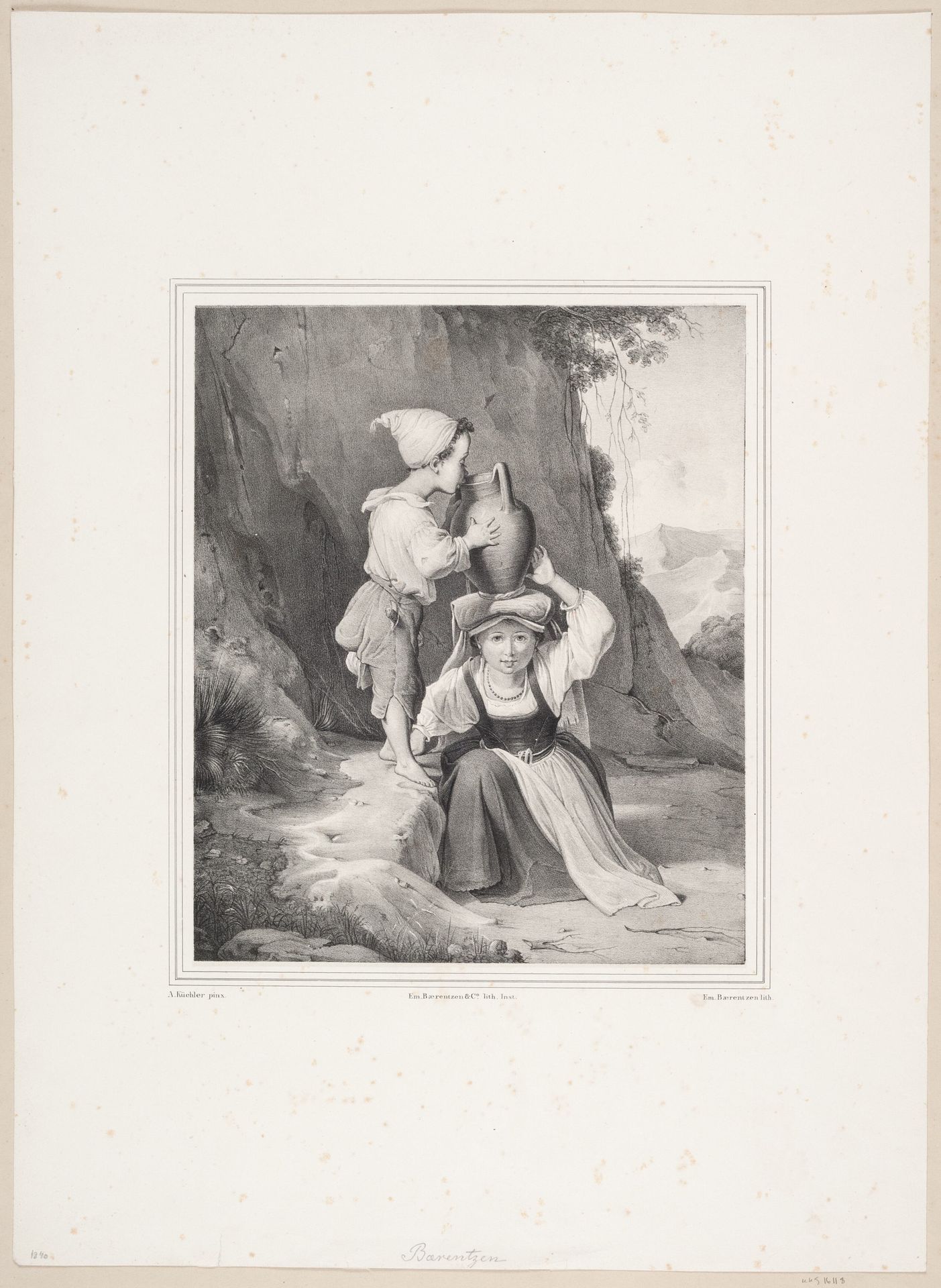
Emil Bærentzen made this print, "A Little Boy Drinking From a Jug Carried on a Little Girl's Head," using lithography. The picture offers a glimpse into the lives of children, likely in rural Denmark. The act of sharing water becomes a symbol of simple living. Looking closer, the image hints at the division of labor, with the girl carrying the heavy load while the boy drinks. It also depicts children wearing peasant clothes, a common theme in art that romanticizes rural life and idealizes the innocence of childhood. Prints like this played a role in shaping social perceptions and national identity. They were circulated widely and helped spread ideas about Danish culture. To fully appreciate this work, we might dig into archives, newspapers, and political pamphlets to understand the social dialogues that defined 19th century Danish culture. By connecting the artwork with its historical context, we can see the complex relationship between art and society.
En lille dreng drikker af en krukke, som en lille pige bærer på sit hoved
1840 - 1867


Artwork details
- Dimensions
- 311 mm (height) x 261 mm (width) (billedmaal)
- Location
- SMK - Statens Museum for Kunst
Comments
Be the first to share your thoughts about this work.
About this artwork
Emil Bærentzen made this print, "A Little Boy Drinking From a Jug Carried on a Little Girl's Head," using lithography. The picture offers a glimpse into the lives of children, likely in rural Denmark. The act of sharing water becomes a symbol of simple living. Looking closer, the image hints at the division of labor, with the girl carrying the heavy load while the boy drinks. It also depicts children wearing peasant clothes, a common theme in art that romanticizes rural life and idealizes the innocence of childhood. Prints like this played a role in shaping social perceptions and national identity. They were circulated widely and helped spread ideas about Danish culture. To fully appreciate this work, we might dig into archives, newspapers, and political pamphlets to understand the social dialogues that defined 19th century Danish culture. By connecting the artwork with its historical context, we can see the complex relationship between art and society.
Comments
Be the first to share your thoughts about this work.