drawing, ink, indian-ink, pencil, chalk
#
portrait
#
pencil drawn
#
drawing
#
ink
#
pencil drawing
#
indian-ink
#
pencil
#
chalk
#
15_18th-century
#
portrait drawing
#
genre-painting
#
history-painting
#
academic-art
Copyright: Public Domain
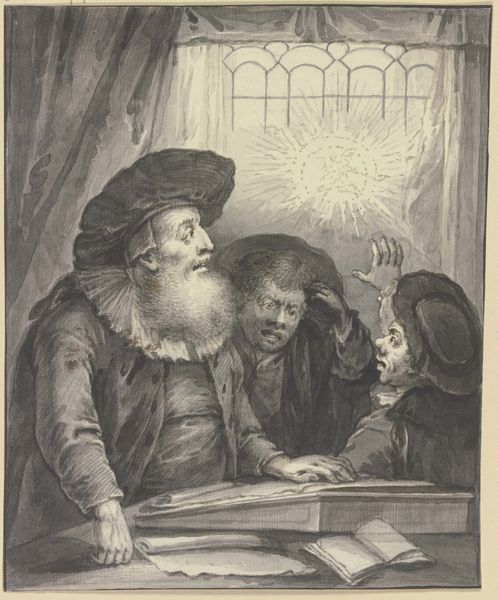
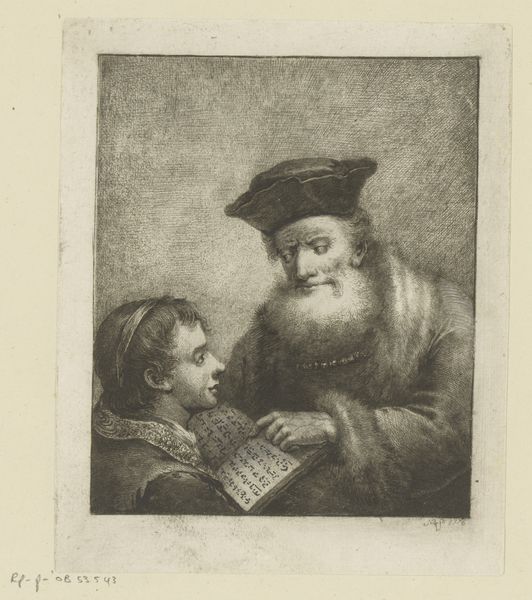
Editor: So, this is Johann Andreas Benjamin Nothnagel’s “Rabbiner mit zwei Schülern an einem Tisch,” from 1778. It’s a drawing rendered in pencil, ink, and chalk. The figures around the table have a palpable tension, don't you think? What sort of story is unfolding here? Curator: I am immediately struck by the semiotic density embedded in what seems like a simple genre scene. Note the rabbi’s attire—the wide-brimmed hat, the ruff—signifying authority and tradition. Then look at the pupils; one raises his hand, perhaps in eagerness, the other scratches his head, revealing his struggle. Nothnagel isn't just depicting a classroom; he’s capturing a dynamic tension between tradition, inquiry, and intellectual challenge. What resonates with you about the way the artist portrays the Rabbi? Editor: His presence is so weighty! The enormous beard, that massive hat... they loom over the two students. It's like he *is* tradition, in human form. But is it a benevolent or oppressive presence? Curator: Ah, precisely. That is the crux of the image. Is the weight of tradition nurturing or stifling? Consider the historical context. This drawing emerges from a period of both Enlightenment and ongoing antisemitism. Nothnagel could be exploring how Jewish identity navigated those turbulent currents, expressing tensions between religious heritage and pressures for integration. Does the style influence your sense of the Rabbi? Editor: Definitely! It’s academic art, right? So a realistic, studied approach. Not a caricature, but a deliberate attempt at… authenticity? Curator: Yes! The attention to detail lends credibility and invites viewers to consider the figures not as types but as individuals within a specific cultural and historical moment. Do you find echoes of these tensions today? Editor: Absolutely. This makes me think about current debates around cultural preservation versus adaptation and how we negotiate the past in the present. Curator: Indeed. Nothnagel's drawing becomes a powerful lens through which we can examine those enduring dynamics. Thank you for this insightful experience. Editor: Thanks. Now, I'm seeing even more depth in what seemed like a simple snapshot of a classroom.
Comments
No comments
Be the first to comment and join the conversation on the ultimate creative platform.
 Collect
 React
React Comment
More like this