photography, gelatin-silver-print
#
sculpture
#
landscape
#
street-photography
#
photography
#
historical photography
#
gelatin-silver-print
#
cityscape
#
realism
Dimensions: height 173 mm, width 228 mm
Copyright: Rijks Museum: Open Domain
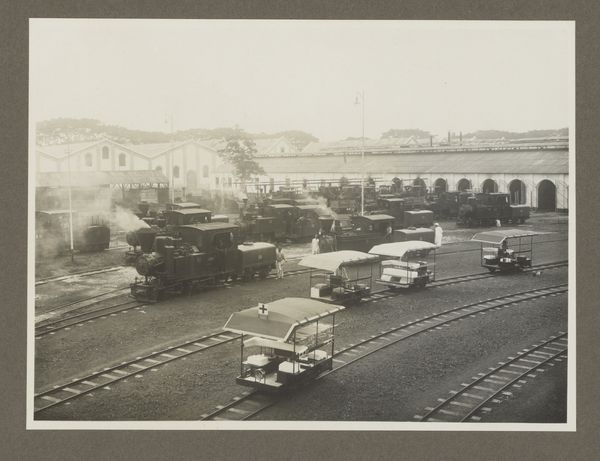
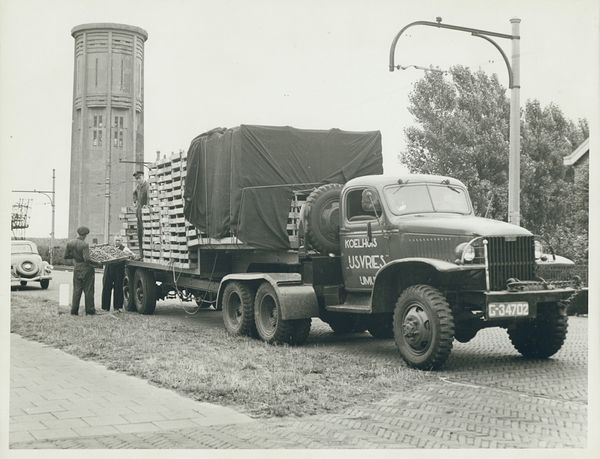
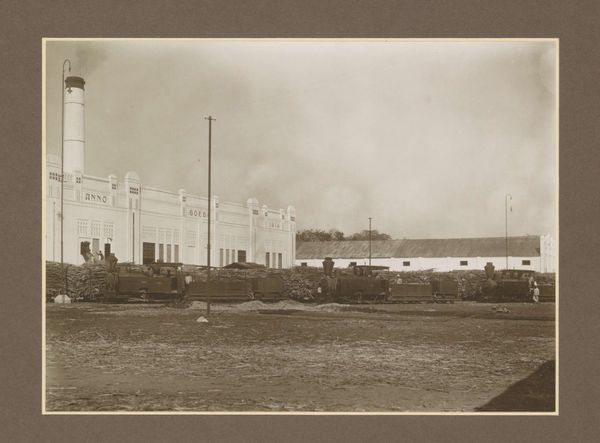
Editor: This photograph, titled "Transport van plaatijzeren drums," possibly from 1932, captures a scene at the Rijksmuseum and is a gelatin-silver print. The repeated drums give it a strong industrial feel. How do you interpret this work, focusing on its symbolism? Curator: The drums, repeated across the trucks, are compelling. We see a clear image, but also cultural echoes. The industrial landscape contrasts with figures riding on top - perhaps an illusion of precarious balance, speaking to labor, movement, and possibly colonial economies. Notice the "BRAAT Soerabaia" text - this connects us to specific history in Indonesia, and how this imagery travels. How does this historical context influence the image’s weight? Editor: It adds a layer of complexity, almost a tension. Knowing it depicts labor in Indonesia shifts the visual balance – the workers are no longer just part of the industrial scene, but individuals within a specific power dynamic. Curator: Precisely! The drums transform from mere containers to symbols of resources, trade, and perhaps even exploitation. Even the high angle gives a god's eye view, subtly implying power. It's a landscape imprinted with unseen narratives. Do you find this resonates in contemporary visual culture as well? Editor: Definitely! It makes me consider contemporary supply chains and the hidden human cost. Curator: Seeing the continuities – from colonial era labour practices to present global movement of resources – can transform the image, making it a powerful reflection on history. Editor: Absolutely, this deepens my understanding beyond the immediate aesthetic impression and creates an entry point for cultural critique.
Comments
No comments
Be the first to comment and join the conversation on the ultimate creative platform.
 Collect
 React
React Comment
More like this